

A fair studio rental cancellation policy spells out three things in plain language: how much notice you need to give, what happens to your deposit at each notice window, and what you owe if you cancel at the last minute or don’t show. Most policies tie refund percentage to how far out you cancel, ranging from a full refund with early notice to zero refund inside 24 to 48 hours, with damage or cleaning deposits handled on a separate track from the rental fee itself.
TL;DR:
- Cancellation notice windows typically range from 24-48 hours for hourly bookings to 30-90 days for large multi-day productions, with longer windows for complex events.
- Refunds follow a sliding scale: full refunds are usually available for cancellations well before the notice window, partial refunds are common inside the window, and no refunds apply for same-day or no-show cancellations.
- Damage deposits are separate from rental fees and are refunded after an inspection confirms the studio was returned in good condition, usually within a set number of business days.
- Studios enforce steep penalties for last-minute cancellations and no-shows, often charging 50% or 100% of the fee, with card holds being a common enforcement method.
- Clear, simple cancellation clauses specifying notice periods, refund tiers, and damage deposit handling prevent disputes and make enforcement straightforward.
Table of Contents
- Common notice windows and what they typically mean
- Refunds, deposits, and damage holds: what to expect
- Same-day cancellations, no-shows, and late fees
- Rescheduling, rollovers, and date changes
- Drafting a fair cancellation policy: clauses that hold up
- How emergencies and force majeure get handled
- Legal considerations and tenant rights in cancellation terms
- What strict cancellation policies protect for studio owners
- Lessons from running a studio in Lower Manhattan
- How we handle cancellations and rebookings at our studio
- FAQ
- Sources
Common notice windows and what they typically mean
Notice windows exist because every studio is managing a calendar, not just a room. A short window costs less to enforce but leaves a studio exposed if a client bails the night before a big production day. A long window protects revenue on complex bookings but can feel rigid to a client whose shoot got rescheduled by a brand on short notice.
Here’s how the windows typically break down in practice:
- 24 to 48 hours: common for hourly or single-day shoots, often paired with full forfeiture if missed, as seen in one studio’s policy requiring 24-hour notice to cancel or reschedule.
- 7 to 14 days: typical for weekly bookings or recurring clients who need some flexibility without opening the door to constant changes; one performing arts venue allows changes or cancellations up to 12 days before booking, after which the renter is responsible for the fee.
- 30, 60, or 90 days: used for large events, multi-day productions, or setups involving outside crew and rented equipment, where a civic venue’s policy retains 50% of fees for cancellations more than 90 days out and 100% at 90 days or less.
The pattern holds across venue types: the bigger the production footprint, the longer the notice window, because rebooking a complex setup takes real lead time.
Refunds, deposits, and damage holds: what to expect
Renters often lump “deposit” into one category, but a studio contract usually splits it two ways. A refundable booking deposit secures the date and gets returned or applied based on the notice window. A damage or cleaning hold is separate, released after an inspection confirms the space came back in good condition.
Refund percentages generally follow a sliding scale:
- Full refund when cancellation happens well outside the notice window, often tied to a 48-hour minimum like the one in an event space rental agreement requiring a refundable deposit and advance notice.
- Partial refund, commonly 50%, for cancellations that fall inside the standard window but outside the final cutoff.
- No refund for same-day or no-show cancellations, regardless of the reason given.
Damage deposits typically return within a set number of business days after inspection, not immediately at checkout.
Pro Tip: Put the refund percentage and the exact number of days in the same sentence of your contract. “Cancellations made 7 or more days in advance receive a 100% refund” leaves no room for argument.
Same-day cancellations, no-shows, and late fees
Studios charge steep penalties for same-day cancellations and no-shows because the lost hour almost never gets rebooked. Unlike a hotel room, a half-day studio booking has no walk-in demand to fill the gap.
Typical penalty structure:
- 50% charge for cancellations inside the minimum notice window but before the shoot date.
- 100% charge, often the full session fee, for same-day cancellations or no-shows.
- Card holds or pre-authorized charges are common enforcement tools, since chasing an invoice after the fact rarely works.
One dance studio’s cancellation page states that rentals canceled with more than 24 hours’ notice receive a full refund, with unpaid invoices voided, which shows how a clean 24-hour cutoff can work in either direction depending on which side of it you land on.
Rescheduling, rollovers, and date changes
Most studios would rather move your date than lose the booking outright, but the rules around how that works matter as much as the cancellation terms themselves.
- Ask for a one-time rollover before assuming a cancellation is your only option: many studios allow a single date change if requested with reasonable notice.
- Expect to pay the current rate on the new date, with your original payment applied as credit rather than refunded and rebooked from scratch.
- Confirm the credit’s expiration window in writing. Credits that sit unused for months often become a point of dispute later.
- Know when forfeiture applies versus transfer: a studio typically allows a transfer if you ask before the notice deadline, and forces forfeiture if you ask after.
A customer-facing FAQ from one dance studio captures the general approach well: it emphasizes contacting the studio as soon as possible to discuss options when circumstances change, since terms often flex depending on how early you reach out.
Drafting a fair cancellation policy: clauses that hold up
After three decades of booking, rebooking, and occasionally un-booking studio time in Manhattan, I’ve learned that a cancellation clause only works if both sides can read it once and understand it. Legal padding doesn’t protect anyone, it just creates confusion at the worst possible moment.
A workable clause structure looks like this:
- Notice window: “Cancellations made [X] or more days before the booking date receive a full refund of the rental fee.”
- Partial refund tier: “Cancellations made between [X] and [Y] days before the booking receive a 50% refund.”
- No-show/same-day: “Cancellations made less than 24 hours before the booking, or failure to appear, forfeit the full rental fee.”
- Damage hold: “The damage deposit will be refunded within [X] business days following inspection of the space.”
Pro Tip: Send the cancellation terms again in your booking confirmation email, not just the signed contract. Clients read emails on shoot day; they rarely reread a PDF from three weeks ago.
I once had a fashion client cancel a two-camera video shoot the morning of, after a stylist no-showed on their end. The contract’s same-day clause meant the booking fee held, which covered the crew and lighting rental I’d already committed to. Without that clause spelled out clearly in advance, that conversation would have been a lot uglier. Our own studio rental contracts and fees guide walks through more clause examples if you’re drafting your own.
Keep a short checklist for every confirmation email: notice window, refund percentage per tier, damage deposit timeline, and the exact process for requesting a date change.
How emergencies and force majeure get handled
No cancellation policy should pretend emergencies don’t happen, but “emergency” needs a definition or it becomes a loophole. A fair policy separates true force majeure, think fire, flood, a government shutdown order, or a documented medical emergency, from ordinary scheduling conflicts dressed up as crises.
Most studio contracts handle this with a short force majeure clause that waives the standard penalty when the cancellation stems from circumstances outside either party’s control. This typically means a full refund or a credit toward a future date, rather than the usual tiered refund schedule. The key is requiring documentation: a doctor’s note, an official closure notice, or similar proof, so the clause doesn’t become a catch-all excuse for a late cancellation with no real justification behind it.
Weather is the gray area most studios get wrong. A snowstorm that shuts down the subway is different from a light rain that makes a client nervous about outdoor backup shots. Spell out what counts: transit shutdowns, building closures, or official state of emergency declarations, and leave the rest under standard notice rules.
Legal considerations and tenant rights in cancellation terms
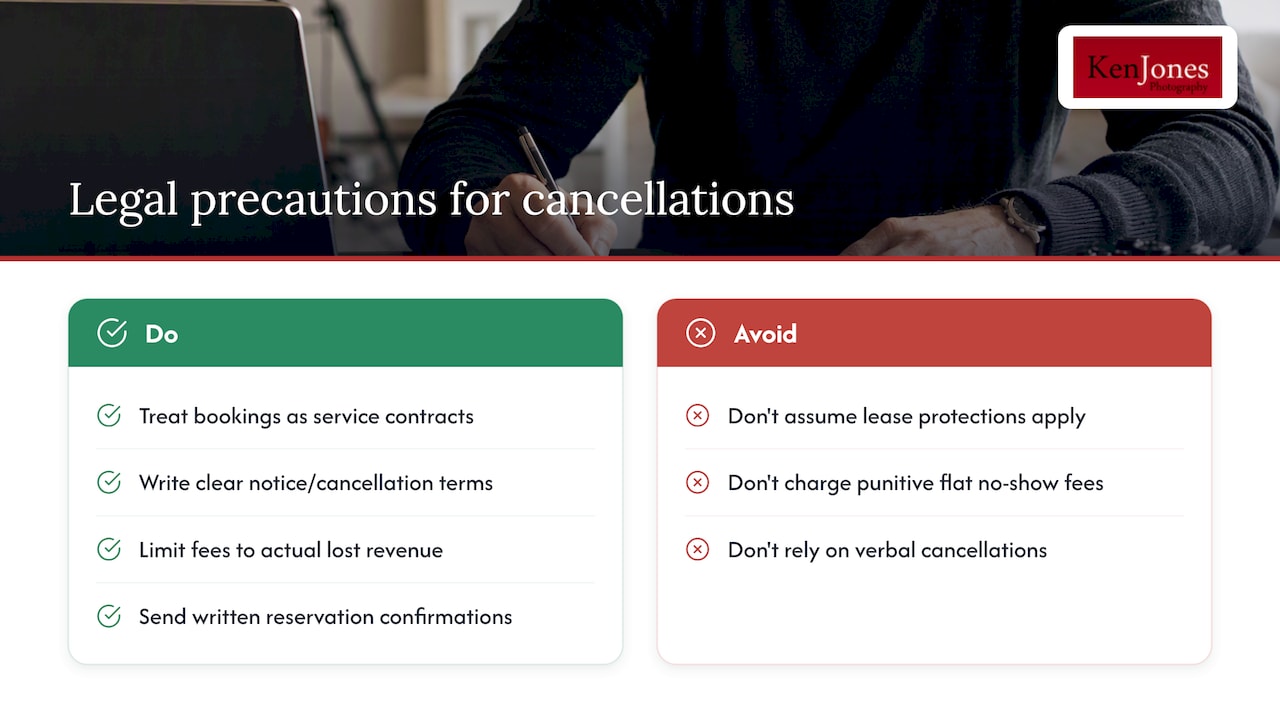
Studio rentals are short-term service contracts, not leases, which matters more than it sounds like it should. Tenant protections that apply to apartment leases generally don’t extend to a half-day studio booking, so the enforceability of a cancellation clause comes down to contract law, not landlord-tenant statute.
That said, a clause still has to be reasonable to hold up if a client disputes a charge. Courts and card processors tend to look unfavorably on penalty language that reads as punitive rather than compensatory, meaning a 100% no-show charge is easier to defend when it reflects real lost revenue (the booked hours a studio couldn’t resell) rather than an arbitrary flat fee. Clear, specific language protects both sides better than aggressive language does.
If you’re a renter disputing a charge, read the contract’s notice requirement first. Many disputes come down to a client believing they canceled “in time” based on a verbal conversation that never made it into writing. A studio’s written confirmation, like our own reservation and payment confirmation process, exists precisely to remove that ambiguity.
What strict cancellation policies protect for studio owners
A studio’s cancellation policy is really a revenue protection plan wearing a legal costume. An empty four-hour block on a Tuesday afternoon is lost income that can’t be recovered once the date passes, unlike a product that sits on a shelf waiting for the next buyer.
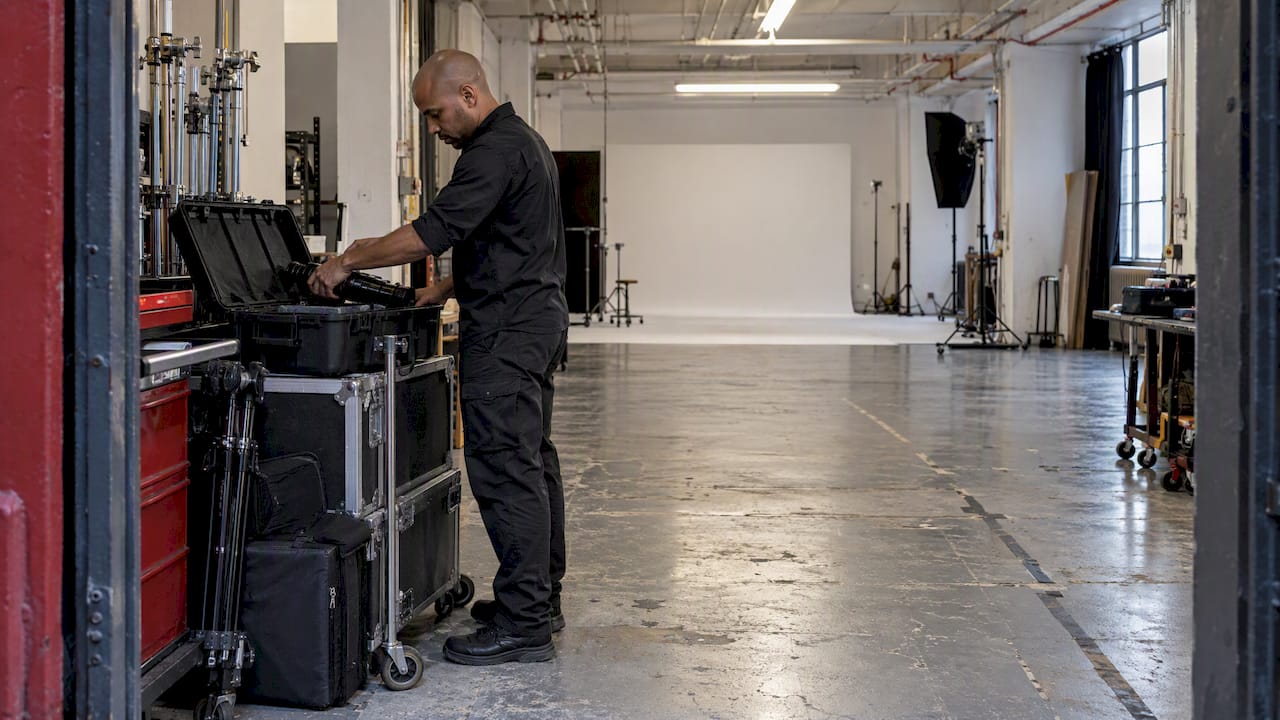
Operationally, a studio booking isn’t just a room. It often involves staffing, equipment staged in advance, and sometimes outside crew or rented gear tied to that specific date, as covered in our equipment checklist for pro shoots. A last-minute cancellation doesn’t just cost the rental fee, it can leave a studio paying for commitments made on the client’s behalf.
That’s why the tiered refund structure exists: it matches the studio’s real exposure to the timing of the cancellation. Early cancellations cost little because the slot can likely be rebooked. Late cancellations cost a lot because the window to fill that slot has closed. Booking management tools and clear deposit policies exist to reduce that risk, and operational tactics like reminders and deposits are standard practice across service businesses that deal with the same no-show problem.
Lessons from running a studio in Lower Manhattan
The clearest cancellation terms I’ve written came after a mess, not before one. A client once assumed a verbal “we might need to push this” counted as formal notice. It didn’t, and the conversation that followed wasn’t fun for either of us.
Simple language prevents that. If your contract states the notice window and refund tier in one sentence, there’s nothing to interpret.
When a client asks for leniency, most studios will work with a documented, good-faith request made early. What rarely works is asking the day of and hoping goodwill covers it.
— Ken
How we handle cancellations and rebookings at our studio
We include clear cancellation terms in every booking confirmation, avoiding fine print, so there’s no guessing about notice windows or refund tiers. When a date genuinely needs to move, we work toward a one-time rollover rather than a flat cancellation whenever the schedule allows it, and our production approach aims to minimize surprises that show up mid-shoot.

If you want to see how our terms are worded before you book, or you’d like a second set of eyes on a clause you’re drafting for your own space, visit our studio rental page to review availability and reach out with questions.
FAQ
How far in advance do I need to cancel a studio rental?
It depends on the venue, but common windows range from 24 hours for hourly bookings to 7 to 12 days for weekly or recurring sessions, and 30 to 90 days for large multi-day productions. Always check the specific contract, since one venue’s 12-day change policy looks very different from another’s 24-hour rule.
Can I cancel my booking and get a refund?
Usually yes, if you cancel within the studio’s stated notice window, though the refund amount often depends on how early you cancel. Some contracts offer a full refund with sufficient notice, like a 24-hour full-refund policy, while late cancellations typically forfeit part or all of the fee.
Are 30-day cancellation policies legal?
Yes, a 30-day (or any other length) notice requirement is enforceable as long as it’s clearly stated in the signed contract and the associated penalty is reasonable relative to the studio’s actual lost revenue. These terms fall under standard contract law rather than tenant protection statutes, since a studio rental is a service agreement, not a lease.
What happens if I’m a no-show for my studio booking?
Most studios charge the full rental fee for a no-show, since the booked hours can’t be resold once the date passes. Some studios enforce this through a card hold placed at booking, which is why reviewing the payment terms before you sign matters as much as reviewing the cancellation window.
Sources
- Civic Center Rental Cancellation Request Form
- Studio Rental Policies updated 4/26
- STUDIO RULES/POLICIES – Rent A Set