

TL;DR:
- A studio rental package includes the space, climate control, Wi-Fi, and basic amenities, but lighting and grip equipment are usually extra.
- Reviewing contractual policies like deposits, cancellation penalties, insurance, and restoration obligations helps prevent unexpected costs.
A studio rental package is defined as a bundled agreement that grants a photographer or production team access to a physical studio space along with a specified set of amenities, equipment, and services for a set period. Understanding what is included in a studio rental package before you sign anything is the single most effective way to protect your budget and your shoot day. The industry term for this agreement is a studio hire contract, and its contents vary more than most renters expect. Kenjonesnyc has seen first-time clients walk into Manhattan shoots assuming everything is covered, only to discover that the lighting kit, the seamless paper, and even the cleaning fee were all billable extras. This guide breaks down exactly what you should expect, what you need to ask for, and what the fine print usually hides.
What is typically included in a standard studio rental package?
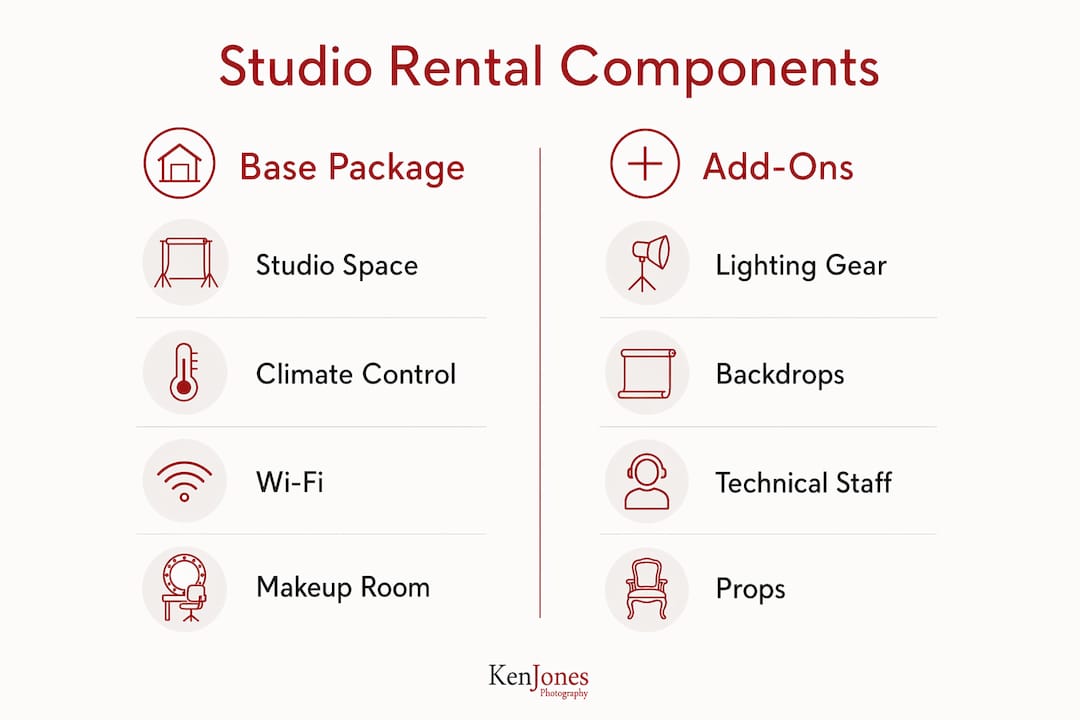
A standard studio rental package covers the physical space itself, climate control, and a core set of production-ready amenities. These are the inclusions that come with the base rate, regardless of the rental tier. Basic amenities like climate control and high-speed Wi-Fi are considered standard in most professional studios. That baseline matters because it directly affects how much additional budget you need to allocate before the shoot begins.
Most professional studios include the following in their standard package:
- Studio space access for the contracted hours, including setup and breakdown time
- Climate control to maintain consistent temperature for talent comfort and equipment performance
- High-speed Wi-Fi for tethered shooting, digital asset transfer, and on-set communication
- Makeup and changing rooms for talent preparation
- Restrooms accessible to the full crew
- Basic furniture such as chairs, tables, and a client lounge area
- Parking information or loading dock access, though dedicated parking spots are rarely included in base rates
Access hours deserve special attention. Many studios advertise a rate that covers shooting hours only. Setup and wrap time may count against your booked block, which means a six-hour shoot can easily require an eight-hour booking. Confirm this before you commit to a time slot.
Pro Tip: Ask the studio manager to define “access hours” in writing. Knowing whether your clock starts at load-in or at first shot can save you from an overtime bill you did not budget for.
What optional equipment and services are available as add-ons?
Optional equipment and services represent the area where studio rental package details diverge most sharply between facilities. The difference between a studio that includes a full grip package and one that charges separately for every light stand is the difference between a predictable budget and a chaotic one. Add-on rentals can increase your total budget by 20–50% compared to the base rate. That range is wide enough to derail a production that was not planned carefully.
Lighting and grip equipment
Professional lighting packages typically include strobe heads, power packs or monolights, light stands, and modifiers such as softboxes and beauty dishes. Grip equipment covers C-stands, sandbags, flags, and diffusion frames. Studios with all-in grip packages are preferred by working professionals because they eliminate the need to transport heavy gear across the city. Optional lighting and grip blocks are often priced as flat-rate packages, typically in the $600–$1,000 range for a full-day kit. That flat rate is almost always cheaper than renting individual pieces from a separate gear house.
Backdrops, props, and set pieces
Seamless paper backdrops in standard colors like white, black, and gray are included in many base packages. Specialty colors, muslin drapes, and hand-painted canvas backdrops are usually add-ons. Props and set dressing are almost never included in base rates. If your shoot requires furniture, plants, or architectural set pieces, budget for those separately or confirm availability with the studio in advance.
| Add-On Category | Typically Included in Base Rate | Typically an Extra Charge |
|---|---|---|
| Studio space and climate control | Yes | No |
| High-speed Wi-Fi | Yes | No |
| Makeup and changing rooms | Yes | No |
| Standard seamless paper (white/black) | Often | Sometimes |
| Professional lighting kit | Rarely | Yes |
| Full grip package | Rarely | Yes |
| Specialty backdrops and props | No | Yes |
| Digital tech or on-set assistant | No | Yes |
| Cleaning fee | No | Yes |
Technical support and on-set staff
Digital technicians and on-set assistants are almost always billed separately. A digital tech manages tethered capture, color management, and file backup during the shoot. Their day rate is a real cost that many clients overlook when reviewing studio rental features. Some studios offer in-house technical support as an add-on, which can be more cost-effective than sourcing crew independently, especially for teams new to a specific facility.
Pro Tip: If you are shooting tethered, ask the studio whether their Wi-Fi network supports the bandwidth your capture software requires. A slow connection on a busy shoot day costs more time than any gear rental.
What contractual policies come with studio rental agreements?
Studio rental agreements define far more than cost and time. They establish your legal obligations as a renter, and the policies are non-negotiable at most professional facilities. Standard contracts require a 50% deposit with cancellation penalties that increase significantly within 48 hours of the shoot date. That structure protects the studio’s revenue, but it also means your deposit is at serious risk if a client cancels late.
Key contractual policies to review before signing include:
- Deposit structure: Most studios require 50% upfront to confirm the booking, with the balance due on or before the shoot day.
- Cancellation policy: Cancellations within 48 hours of the shoot typically result in full forfeiture of the deposit. Some studios charge the full day rate for same-day cancellations.
- Overtime billing: Overtime is billed at 1.5 times the hourly rate, charged in 15–30 minute increments. A shoot that runs 45 minutes over can add several hundred dollars to your invoice.
- Insurance requirements: Studios require general liability insurance with at least $1,000,000 in coverage. If you do not carry a policy, short-term event insurance is available for approximately $50–$150 per day.
- Permitted use: The agreement specifies what types of production are allowed. Adult content, open flames, and water-intensive sets often require separate written approval or are prohibited entirely.
- Studio alterations: Mounting gear to ceilings or walls without written consent is a common restriction. Unauthorized modifications can result in financial liability for restoring the studio to its original condition.
“Rental agreements are as much about permitted use and reinstatement policies as about cost and time. Many renters are genuinely surprised by restoration liabilities they did not anticipate when they signed the contract.”
The restoration clause is the one that catches people off guard most often. If your crew tapes anything to a painted wall, drills a single hole, or leaves the space in worse condition than they found it, you may owe the studio for repairs. Read the exit condition requirements before your crew touches anything.
How do you evaluate studio rental packages and avoid hidden costs?
Evaluating studio rental packages requires more than comparing hourly rates on a website. The most successful shoots begin with detailed, upfront communication about technical needs, which allows the studio to pre-stage sets and avoid costly delays on shoot day. Sharing backdrop colors, power requirements, and special set needs in advance gives the studio time to prepare and gives you time to identify gaps in their offerings before you are standing on the floor with a crew on the clock.
A practical evaluation process follows these steps:
- Request a full inclusions list in writing. Ask the studio to itemize every amenity, piece of equipment, and service included in the base rate. Do not rely on a website description.
- Confirm electrical capacity. Studios vary widely in power availability, ranging from 200 to 1,200 amps. A large strobe setup or a video production with multiple monitors and playback stations can exceed what a smaller studio can safely deliver.
- Check load-in access. Freight elevator availability, loading dock hours, and street parking restrictions in NYC can add an hour to your setup time if you have not confirmed them in advance.
- Ask about cleaning fees. Mandatory cleaning fees range from $25 to $100 and are often not listed in the base rate. They appear on the final invoice and surprise renters who did not ask.
- Verify acoustic isolation. If you are recording audio on a video shoot, confirm that the studio has adequate sound isolation. A visually perfect space with thin walls next to a busy Manhattan street is operationally useless for audio work.
- Clarify overtime increments. Know exactly when the clock starts and in what increments overtime is billed. A 15-minute increment policy is far more forgiving than a full-hour policy if your shoot runs slightly long.
One client mistake that comes up repeatedly in NYC commercial work involves teams that book a studio based on photos alone. The space looks ideal online, but the electrical panel cannot support the lighting package they planned, the freight elevator only runs until 5:00 PM, and the studio is directly above a subway line. Checking operational capabilities like load-in access and electrical capacity before booking is not optional. It is the difference between a shoot that runs on time and one that costs twice the budget.
A useful resource for comparing what different facilities offer is this studio amenities comparison guide, which breaks down typical gear, lighting, and backdrop inclusions across professional rental spaces. For teams planning their first NYC studio booking, this 2026 studio rental guide covers preparation steps in detail. Understanding corporate photography session costs also helps teams budget realistically when studio rental is part of a larger production.
Key Takeaways
A studio rental package covers the physical space and core amenities at the base rate, with lighting, grip, technical staff, and cleaning fees almost always billed as extras that require upfront confirmation.
| Point | Details |
|---|---|
| Base rate inclusions | Space, climate control, Wi-Fi, and makeup rooms are standard; lighting and grip are usually add-ons. |
| Add-on cost risk | Optional equipment and services can increase total rental costs by 20–50% above the base rate. |
| Deposit and cancellation | Most studios require a 50% deposit, with full forfeiture for cancellations within 48 hours. |
| Insurance requirement | General liability coverage of at least $1,000,000 is standard; short-term policies cost $50–$150 per day. |
| Pre-booking communication | Sharing technical needs before booking prevents delays and reveals operational gaps before shoot day. |
What renters consistently get wrong about studio packages
After 30 years of shooting in New York City, the pattern I see most often is this: clients read the base rate, assume it covers everything they need, and then spend the first hour of the shoot day sorting out what is missing. The studio is not trying to deceive anyone. The inclusions are listed, usually clearly. But renters skim the details and fill in the gaps with assumptions.
The assumption that costs me the most on past shoots was around lighting. I once booked a space for a beauty campaign that listed “professional lighting available.” That phrase meant one monolight and a single softbox. My lighting plan required six heads and a full modifier kit. We lost 90 minutes sourcing additional gear from a rental house two blocks away, and the overtime bill at the end of the day reflected every one of those minutes.
What I tell every team I work with now is to treat the studio rental agreement like a production document, not a hotel reservation. Read the permitted use clause. Confirm the power load. Ask about the cleaning policy before you bring in a fog machine or a food stylist. The studios that serve professional productions well are the ones that answer these questions clearly and without hesitation. If a studio manager cannot tell you the amperage on the main panel or the overtime increment policy, that tells you something important about how the facility operates.
The other thing renters underestimate is the value of a studio with a genuinely all-in package. Transporting grip equipment through Manhattan is expensive and time-consuming. A studio that includes a full lighting and grip kit in the base rate saves you the rental cost, the transport cost, and the setup time. That combination of savings often justifies a higher hourly rate compared to a bare-bones space.
— Ken
Kenjonesnyc studio rental: production-ready in Manhattan’s Financial District
Kenjonesnyc operates a full-service studio in Manhattan’s Financial District, built for fashion, beauty, commercial, and corporate productions. The studio’s Manhattan studio rental packages include professional lighting, grip equipment, seamless backdrops, makeup and changing facilities, and high-speed connectivity, all configured for working crews who need to shoot efficiently from the moment they walk in.
With over 30 years of production experience behind every booking, Kenjonesnyc brings more than square footage to a rental. The team understands what a fashion editorial, a beauty campaign, or a luxury product shoot actually requires on the floor, and the studio is equipped accordingly. Teams that want to understand exactly what is included before booking can reach out directly through kenjonesnyc.com to discuss package details, technical specifications, and availability.
FAQ
What does a standard studio rental package include?
A standard studio rental package includes access to the physical studio space, climate control, high-speed Wi-Fi, and basic amenities such as makeup rooms, changing areas, and restrooms. Lighting, grip equipment, and technical staff are typically billed as separate add-ons.
What does a studio rental agreement cover beyond the hourly rate?
A studio rental agreement covers deposit terms, cancellation penalties, overtime billing rates, insurance requirements, permitted use restrictions, and studio restoration obligations. These contractual policies define your financial liability as a renter and apply regardless of the rental tier.
Is insurance required for studio rental?
Most professional studios require general liability insurance with at least $1,000,000 in coverage as a condition of rental. Renters without an existing policy can purchase short-term event insurance for approximately $50–$150 per day.
How do hidden fees affect the total cost of a studio rental?
Hidden fees such as mandatory cleaning charges ($25–$100), overtime billed at 1.5 times the hourly rate in 15–30 minute increments, and unplanned equipment rentals can substantially increase the final invoice above the quoted base rate. Requesting a full itemized inclusions list before booking is the most reliable way to avoid surprises.
What should you confirm before booking a studio for a photo or video shoot?
Confirm the electrical capacity (studios range from 200 to 1,200 amps), load-in access and freight elevator hours, Wi-Fi bandwidth, cleaning fee policy, overtime increment structure, and whether lighting and grip equipment are included or billed separately. Sharing your full technical requirements with the studio manager before booking prevents delays and budget overruns on shoot day.