
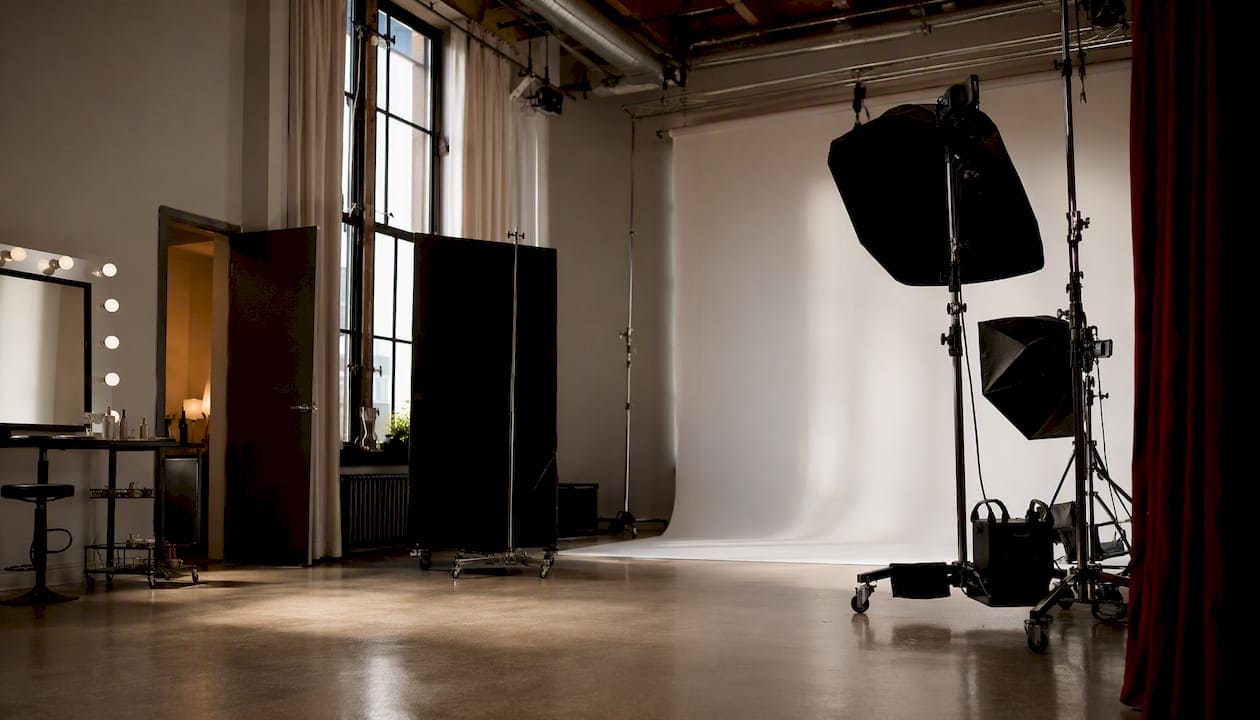
For most NYC productions that need speed, predictable outcomes, and a crew that can hit the ground running, a full-service studio is the safer default. The exception is when you have a fully self-sufficient crew, a tight base-space budget, and the flexibility to absorb logistical surprises. Ken Jones Photography operates FultonStudio in Manhattan’s Financial District as a full-service option, and NYC studio hourly rates currently run $120–$500 per hour depending on room type and included services.
Here is a quick map to the right choice:
- Editorial fashion day or beauty shoot: Full-service. Hair and makeup coordination, lighting, and a production manager on-site prevent the hour-by-hour scramble that kills creative momentum.
- Small e-commerce product shoot with your own gear: Either model works. A raw space saves on base rent; a full-service room saves setup time. Budget and crew size decide it.
- Multi-day film, TV, or commercial production: Full-service campus or a raw soundstage with a separately hired production team. Confirm whether your facility has Level-2 Qualified Production Facility status early if the NY State film production tax credit applies to your project.
Key Takeaways
Full-service studios are the right default for most NYC productions; raw spaces save money only when your crew and gear are fully self-sufficient and your schedule has room for logistical variables.
| Point | Details |
|---|---|
| Default recommendation | Full-service suits most time-sensitive or complex NYC productions; raw spaces work when you bring everything yourself. |
| NYC hourly rate range | Studio rates run $120–$500/hr; full-day bookings typically carry a 15–30% discount over hourly rates. |
| Top three checklist items | Confirm power capacity, freight access, and insurance certificate wording before signing any studio contract. |
| Hidden costs to watch | Overtime at 1.5x, extra power tie-ins, cleaning fees, and union day-player rates add up fast in raw spaces. |
| Ken Jones Photography / FultonStudio | Offers full-service production at FultonStudio in Manhattan’s Financial District, covering lighting, crew, and delivery under one booking. |
Table of Contents
- What do “full-service” and “raw/black-box” mean in NYC studio rentals?
- What does each model include, and what must you bring?
- What are the pros, cons, and best use cases for each model?
- What do NYC studio rentals actually cost? Three sample budgets
- What should you confirm before you sign the studio contract?
- How do you negotiate a better deal on NYC studio rentals?
- A real FultonStudio booking day: budget, scope, and lessons
- When I always recommend full-service in NYC
- Ken Jones Photography brings full-service production to FultonStudio
- Sources
- FAQ
What do “full-service” and “raw/black-box” mean in NYC studio rentals?
Full-service means the studio provides more than four walls. You are booking a space that comes with on-site crew support, production-grade lighting and grip equipment, a production manager or studio coordinator, hair and makeup facilities, greenroom access, permitting assistance, and often digital tech support. The studio handles the infrastructure so your team focuses on the work. Ken Jones Photography’s studio rental package is a clear example: creative direction, assistants, lighting, and retouching are all available under one booking.
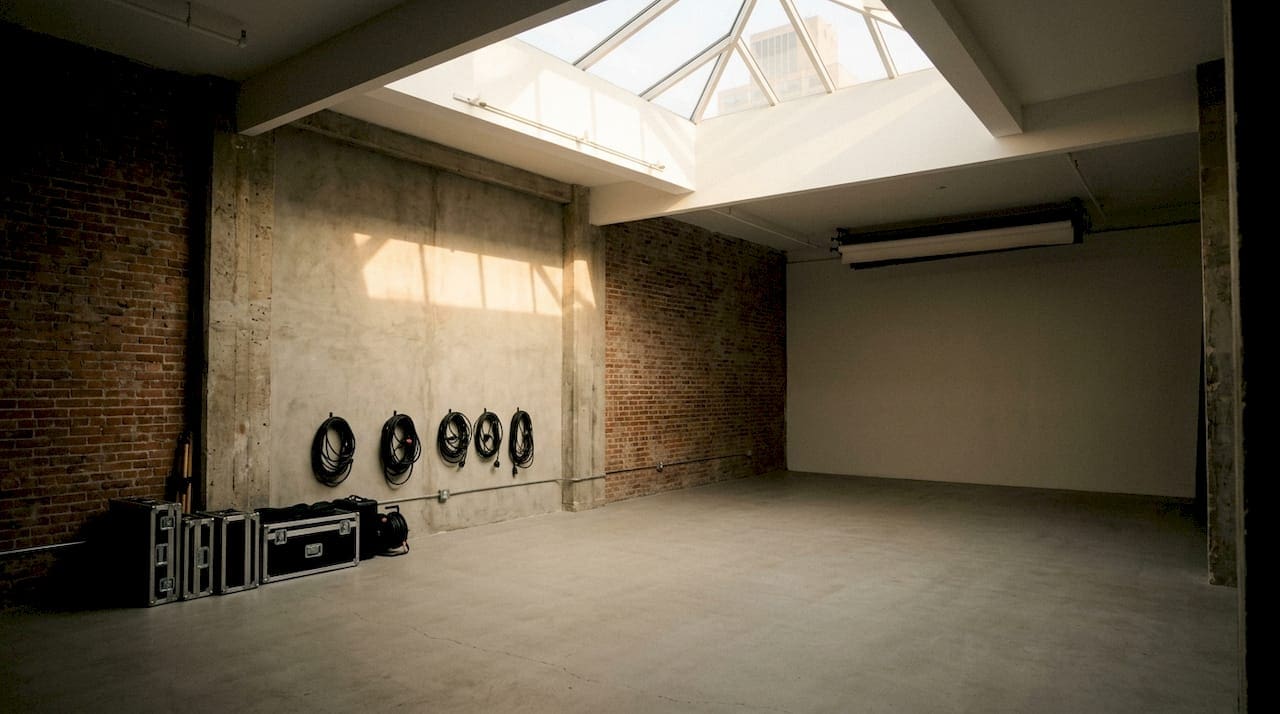
Raw or black-box means you are renting square footage. The space is typically empty or minimally finished, with basic utilities and little else. You bring every piece of gear, every crew member, and every amenity. The Chocolate Factory Theater in Long Island City is a well-known example: a 1,500-square-foot raw warehouse with a garage door, overhead lighting, three 20-amp circuits, and two bathrooms, known locally as a typical raw space option. Nothing more unless you negotiate add-ons.
Most NYC productions encounter hybrids. A full-service studio may offer a “space-only” rate if you bring your own grip package. A raw warehouse may sell add-on production packages for lighting or a generator. Read every quote carefully before assuming which model you are actually booking.
What does each model include, and what must you bring?
Full-service studio: what’s typically included
- Production-grade lighting (strobes, continuous, modifiers)
- Grip and C-stand package
- On-site studio coordinator or production manager
- Hair and makeup room or dedicated prep area
- Greenroom and client lounge
- High-capacity power (100 amps or more, sometimes 3-phase)
- Wi-Fi and upload infrastructure for tethered shooting or livestreams
- Permitting assistance for exterior or street-adjacent work
- Cleaning between bookings
- Insurance certificate coordination
Full-service studios in NYC often bundle production support rooms, grip and electric, and on-site production offices so productions can scale within one campus rather than juggle off-site logistics. What you still need to bring: your specific camera system, talent, wardrobe, props, and any specialty equipment the studio does not stock.
Raw/black-box space: what’s typically included
- Bare square footage (finished or unfinished)
- Basic overhead or ambient lighting
- Standard electrical circuits (often 20-amp residential-grade)
- Restrooms (sometimes shared with other tenants)
- Wi-Fi (variable quality)
- Loading access (garage door, freight elevator, or street-level only)
What you must bring to a raw space: every piece of production gear, your full crew, hair and makeup supplies, a generator if power is insufficient, catering, and your own insurance certificate. Permits for parking trucks or using the sidewalk are your responsibility.
Commonly misunderstood items: Insurance certificates are required at nearly every NYC studio regardless of model, but the wording requirements differ. Overtime rates at full-service studios typically run 1.5x the hourly rate after the booked window. Exclusivity is not automatic at raw spaces that host multiple tenants or rehearsals.
Neighborhood rules add another layer. Residential Manhattan blocks carry noise restrictions that affect generator use and load-in windows. Long Island City and Bushwick offer more freight-friendly access and larger floor plates, but transit time from Midtown or Downtown adds to your day.
What are the pros, cons, and best use cases for each model?
Full-service studios trade a higher base rate for reliability. You get a known quantity: the lighting works, the greenroom is clean, someone on-site can solve problems before they become delays. The trade-off is less flexibility to reconfigure the space radically or bring in competing vendors. For a fashion editorial, a corporate headshot day, or a beauty campaign, that reliability is worth the premium. The production mistake to avoid: assuming the full-service rate covers everything. Always confirm what is included in writing. A studio that charges $350 per hour but bills separately for the digital tech, the grip package, and overtime past six hours can cost more than a raw space with a hired crew.
Raw spaces give you maximum creative control and a lower base-space cost. You can paint the walls, rig custom lighting positions, and bring in any vendor you choose. The trade-off is that every gap in your planning becomes a real problem on shoot day. The production mistake to avoid here is underestimating power. A raw warehouse with three 20-amp circuits cannot run two 2,400-watt strobes, a hair dryer, and a monitor stack simultaneously. Productions that skip the power audit end up renting a generator at the last minute, which costs more than the power upgrade would have.
Three concrete matchups:
- Portrait or headshot session (1–4 people, half day): Full-service wins. The setup time savings alone justify the rate difference, and a production manager keeps the schedule on track.
- E-commerce product shoot (tabletop, 1 photographer, 1 assistant): Raw space or a small creator room is often the smarter call. You need a clean background, controlled light, and a table. You do not need a greenroom.
- Multi-day TV or commercial production: Full-service campus or a raw soundstage with a fully hired production team. Confirm whether the facility is a Level-2 Qualified Production Facility — QPF status can materially change your budget through the NY State film production tax credit.
What do NYC studio rentals actually cost? Three sample budgets
NYC video studio rates run roughly $120–$500 per hour in 2026, with half-day and full-day discounts of approximately 15–30% common across most facilities. Small creator rooms and single-camera interview spaces start around $120–$180 per hour. Mid-tier cyclorama or sound-treated rooms run $200–$325 per hour. Full soundstages with production support land at $400–$500 per hour.
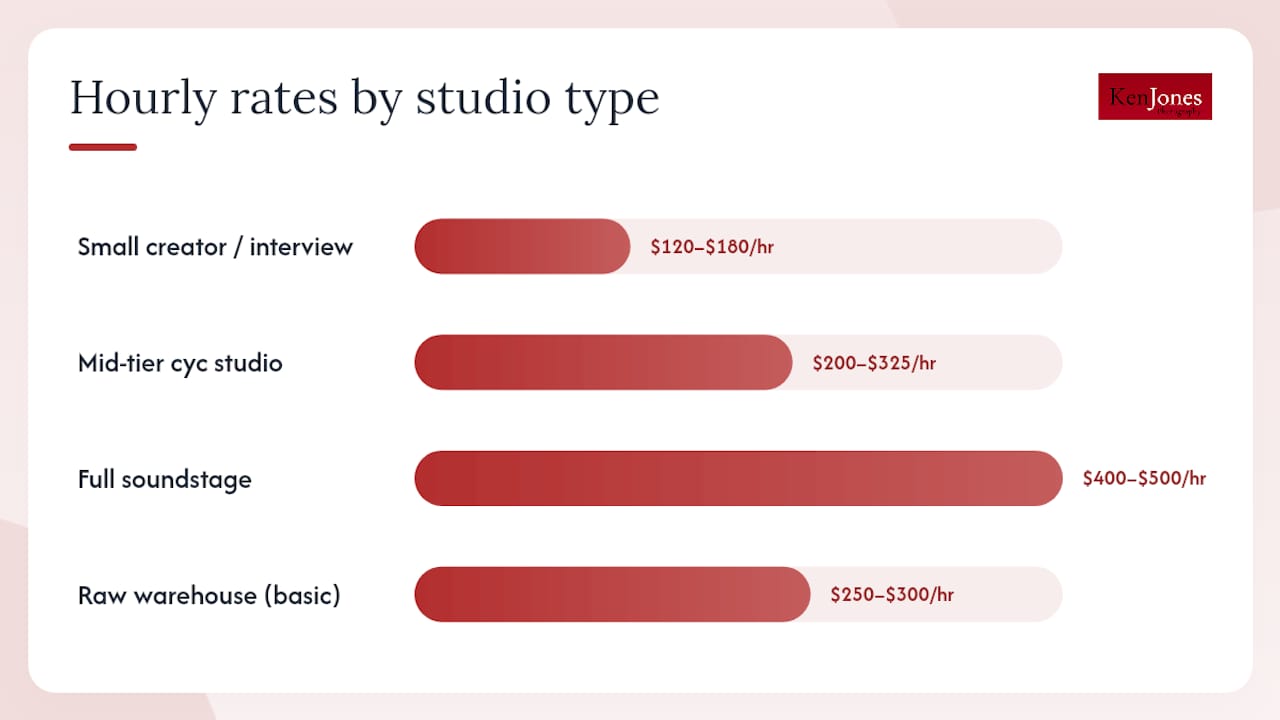
| Studio Type | Typical Hourly Rate | Best For |
|---|---|---|
| Small creator / interview room | $120–$180/hr | Social content, corporate interviews, headshots |
| Mid-tier cyc / sound-treated studio | $200–$325/hr | Fashion, beauty, e-commerce, editorial |
| Full soundstage / full-service campus | $400–$500/hr | Commercial, TV, film, multi-day productions |
| Raw warehouse (e.g., Chocolate Factory) | $250/hr for the first 12 hours (basic), $300/hr each additional hour; higher for exclusive use or clear-out packages | DIY productions, art installations, rehearsals |
Oak Studios offers a flat-rate day option at $2,000 for up to 10 hours, including a strobe lighting package, digital capture station, and grip equipment — a useful benchmark for what bundled full-service pricing looks like at the mid-tier level.
Sample budget 1: small portrait day (4 hours, full-service room)
- Studio rental: $250/hr x 4 hrs = $1,000
- Digital tech / tethering support: $400
- One lighting assistant: $350
- Hair and makeup (if needed): $400
- Contingency (10%): $215
Total: approximately $2,365
Sample budget 2: e-commerce product shoot (full day, raw space)
- Studio rental: $250/hr x 8 hrs = $2,000
- Photographer (your own or hired): $1,200
- One assistant: $350
- Lighting rental (brought in): $300
- Contingency (10%): $385
Total: approximately $4,235
Sample budget 3: multi-day small film production (2 days, full-service campus)
- Studio rental: $400/hr x 16 hrs = $6,400
- Production manager: $1,200
- Digital tech: $800
- Two lighting/grip assistants: $1,400
- Hair and makeup: $800
- Contingency (10%): $1,060
Total: approximately $11,660
Hidden fees to watch for: overtime billed at 1.5x after the booked window, extra power tie-in charges for large lighting packages, rigging permits, cleaning fees if you use paint or practical effects, and union day-player rates if the production triggers union jurisdiction.
What should you confirm before you sign the studio contract?
Work through this checklist before committing to any NYC studio, full-service or raw:
- Dates and load-in/out windows: Confirm exact start and end times, including setup and strike. Many NYC studios charge from the moment the freight door opens.
- Square footage and ceiling height: Minimum 14 feet for most commercial work; 18+ feet for overhead rigs or large cyc work.
- Freight access and load-in door: Verify door dimensions, freight elevator weight limits, and whether a loading dock or street-level access is available.
- Power capacity: Confirm total amperage, whether 3-phase power is available, and the cost of a tie-in for large lighting packages.
- HVAC and air conditioning: Critical for talent comfort and equipment stability. Confirm it runs during your booking window, not just business hours.
- Soundproofing and noise policy: Ask specifically about shared rehearsal activity during your booking and any neighborhood noise ordinances.
- Restrooms and greenroom count: One restroom for a 20-person crew is a real problem. Confirm capacity.
- Wi-Fi and upload speed: If you are tethering, livestreaming, or uploading same-day selects, test or confirm the upload speed in advance.
- Parking and curb permits for trucks: NYC requires permits for production vehicles. Confirm whether the studio handles this or whether it falls to you.
- Insurance certificate wording: Get the exact additional insured language before your broker issues the certificate. Wrong wording means the studio can refuse entry.
- Exclusivity and clear-out terms: Confirm whether other productions or rehearsals share the space during your booking.
- Cleaning and overtime policy: Get the overtime rate in writing and confirm who is responsible for cleaning after practical effects or food styling.
Technical specs to verify: cyc wall dimensions (width, height, and radius), floor finish (reflective floors create unwanted bounce in product work), grip inventory if full-service, and minimum ceiling height for your camera rig configuration.
Red flags: shared rehearsal activity during your booking window, ambiguous exclusivity language, no clear freight access, missing insurance requirements in the contract, and an overtime policy that is not stated in writing. The Manhattan studio rental guide covers many of these points in detail for Downtown and Midtown locations.
For a full question set to bring to any studio conversation, the studio rental questions checklist covers the items most productions overlook until it is too late.
How do you negotiate a better deal on NYC studio rentals?
The most reliable discount in NYC studio rentals is the full-day rate. Most studios price a full day at roughly 8x the hourly rate rather than 10x, which means you get two hours free simply by committing to the full day upfront. Ask for it explicitly; studios rarely volunteer it.
Off-peak pricing is real but underused. Weekday bookings, particularly Tuesday through Thursday, often carry lower rates than Friday or Saturday. If your production schedule is flexible, shifting a shoot day by 48 hours can save 10–20% on the base rate.
Bundled packages are worth negotiating at full-service studios. Ask whether the studio will bundle grip, digital tech, and studio time into a single line item. Studios prefer predictable bookings and will often discount the package rate to secure a confirmed day rather than risk an empty stage.
Pro Tip: Consolidate your prep and strike into the same booking window as the shoot. Productions that book a separate “prep day” at full rate, then a shoot day, then a separate “strike day” pay three minimums. Negotiate a single extended booking with a reduced rate for the prep and strike hours — most studios will accommodate this for a confirmed multi-day client.
For practical staging advice that helps you get more out of every rented hour, the guide on maximizing rented studio space is worth reading before your next booking.
Bring your own expendables: gels, tape, seamless paper, and cleaning supplies. Studios charge retail or above for anything pulled from their stock. Confirm what producers are permitted to bring versus what must be rented from the facility — some full-service studios have exclusivity agreements with their grip vendors.
A real FultonStudio booking day: budget, scope, and lessons
A recent Ken Jones Photography production at FultonStudio illustrates how full-service and separately booked elements interact in practice. The project was a fashion editorial for a New York-based designer: six looks, two models, a four-person crew, and a half-day window.
Line-item budget for that day:
- Studio rental (FultonStudio, 6 hours): $1,800
- Production manager / producer: $600
- Digital tech (tethering and selects): $450
- Two lighting assistants: $700
- Hair and makeup artist: $550
- Grip package (included in full-service rate): $0
- Contingency (10%): $410
Total: approximately $4,510
Ken Jones Photography provided creative direction, both assistants, and the lighting package as part of the full-service offering. The production manager and digital tech were booked separately through the studio’s vendor network.
Three lessons from that day:
- Schedule the hair and makeup call 45 minutes before the first shot. On this shoot, the first look ran 30 minutes late because the makeup call was set to coincide with the studio open time. That delay compressed every subsequent look. Build the buffer into the call sheet, not the contingency.
- Confirm power capacity before the lighting package is finalized. The original lighting plan included a 2,400-watt strobe pack that exceeded the available circuit load. Catching this during the pre-production call, not on shoot day, avoided a last-minute equipment swap.
- Client communication on selects timing prevents post-production surprises. The designer expected same-day selects delivered by 6 PM. That requires a digital tech on-site and a confirmed upload window. Clients who do not ask this question upfront often discover the gap when the invoice arrives.
The single client mistake to avoid: assuming that “full-service” means the studio handles client communication and delivery logistics. Those remain the photographer’s or producer’s responsibility regardless of the studio model.
When I always recommend full-service in NYC
The conventional wisdom says raw spaces save money. That is true for the base-space line item. It is rarely true for the total production cost once you account for everything a raw space does not provide.
The productions where full-service consistently delivers better outcomes are the ones where schedule compression is real. When a client has one day to capture six looks, three talent changes, and a video interview, every minute of setup time is a creative minute lost. A full-service studio where the lighting is pre-rigged, the greenroom is stocked, and a coordinator is managing the door is not a luxury. It is a production decision that protects the creative work.
Three practical rules of thumb:
- Crew size above six people: Full-service. The coordination overhead of managing a large crew in a raw space with no on-site support adds hours to the day.
- Schedule under eight hours for complex work: Full-service. Tight windows have no room for the logistical surprises that raw spaces generate.
- First-time NYC production for an out-of-town client: Full-service. Clients unfamiliar with NYC logistics, parking, and load-in realities need a studio that absorbs those variables.
A raw space is the smarter financial move when your crew is self-sufficient, your gear is already packed and tested, and you have a full day or more with no schedule pressure. The pitfall to watch: raw spaces that list “production-ready” in their marketing but have residential-grade power, no freight access, and a shared-use policy that puts another tenant’s rehearsal in the adjacent room during your shoot.
Ken Jones Photography brings full-service production to FultonStudio
Ken Jones Photography offers a direct alternative to piecing together a production from separate vendors. At FultonStudio in Manhattan’s Financial District, the full-service offering covers creative direction, studio rental, production management, lighting, hair and makeup coordination, assistants, retouching, and final image delivery — all under one booking.
Three things that distinguish this from a standard studio rental: 30+ years of NYC commercial production experience behind every booking decision, predictable line-item pricing with no surprise add-ons, and an in-house crew and grip network that eliminates the vendor-coordination work that typically falls to the producer. For fashion brands, corporate clients, and e-commerce teams that need polished results without the overhead of managing a full production team independently, this is a practical solution.
The studio rental page has current availability, package details, and a contact form to discuss your specific project. If you want to see the work before you book, the studio rental portfolio shows the range of productions that have come through FultonStudio.
Sources
- Film, Video & Photo Studio Rental Brooklyn, NYC | Photography Studio
- General 1 — Oak Studios
- Film, Video & Photo Studio Rental Brooklyn, NYC | Film Studios NYC — Brooklyn Studios
FAQ
What is the difference between a full-service and a raw studio rental in NYC?
A full-service studio includes crew support, production-grade lighting, grip equipment, greenroom facilities, and on-site coordination. A raw studio provides bare square footage and basic utilities; you bring every piece of gear and every crew member yourself.
How much does it cost to rent a studio in NYC?
NYC studio rates run $120–$500 per hour depending on room type, with small creator rooms at $120–$180/hr, mid-tier cyclorama studios at $200–$325/hr, and full soundstages at $400–$500/hr. Half-day and full-day discounts of roughly 15–30% are common.
What should I confirm before booking a studio in NYC?
Confirm power capacity (total amps and 3-phase availability), freight access and door dimensions, insurance certificate wording, exclusivity terms, and the overtime rate in writing. Missing any of these is the most common cause of shoot-day delays.
Is a raw studio cheaper than a full-service studio for NYC productions?
The base-space rate is usually lower, but total production cost often is not. A raw space requires you to rent or bring every piece of gear, hire all crew independently, and absorb any logistical surprises — costs that a full-service rate typically covers.
Does Ken Jones Photography offer studio rental in NYC?
Yes. Ken Jones Photography operates FultonStudio in Manhattan’s Financial District as a full-service production space, covering studio rental, lighting, crew, hair and makeup coordination, and image delivery under one booking. Details and availability are at Kenjonesnyc.