

For a successful photo shoot styling NYC project, plan a few complementary looks, run a fitting several days before the shoot, and test each outfit on the subject under lighting close to your location. Experienced NYC photography studios handle this kind of pre-production for fashion, beauty, and corporate clients, and the shoots that go smoothly almost always have this groundwork in common.
TL;DR:
- Use a detailed look sheet for each setup, ensuring garments pass comfort, behavior, and visual clarity tests before the shoot begins.
- Avoid fine, repeating patterns or shiny synthetics on camera by testing fabrics at the actual shooting distance to prevent moiré and reflection issues.
- Match wardrobe and palette to each New York backdrop, with heavier fabrics for waterfronts and bold solids for subway environments, to enhance authenticity.
- Plan for rapid weather changes by carrying a compact kit and reserving a studio fallback to avoid delays caused by rain, wind, or temperature drops.
- Coordinate hair and makeup with the photographer beforehand and photograph finished looks on location to maintain continuity and reduce retakes.
Table of Contents
- Matching outfits and palettes to NYC backdrops
- Building a wardrobe plan that survives production
- Why patterns and fabrics misbehave on camera
- Dressing for New York’s seasons without losing the look
- Coordinating hair and makeup for the camera
- NYC permit basics you need before shoot day
- Your pre-shoot checklist, printed and taped to the call sheet
- Bringing NYC’s own style into the shoot
- Coordinating outfits for couples and groups
- Handling New York weather when it turns on you
- A styling mistake I still think about
- How Ken Jones Photography handles styling and production for you
- Sources
- FAQ
Matching outfits and palettes to NYC backdrops
New York gives you four backdrop types over and over: architectural streets, waterfronts, subway or transit stations, and studio white. Each one asks something different from wardrobe.
Brick, steel, and glass in SoHo or the Financial District reward structured silhouettes and textured mid-tones. A blazer with visible weave or a coat with some heft holds its shape against hard lines and reads as intentional rather than flat. Waterfront locations like DUMBO or the Brooklyn Bridge esplanade bring wind and shifting light off the water, so lighter fabrics move too much and lose shape in stills. Go with something that has weight, and bring a windproof layer even if it never appears in frame, because a subject who’s cold looks cold on camera regardless of what you tell them.
Subway platforms and stations mix fluorescent overhead light with occasional flashes of daylight from stairwells, and small patterns tend to vibrate or disappear entirely under that combination. Bold, simple shapes and solid colors hold up far better.
- Architectural streets: structured tailoring, textured mid-tones, avoid busy patterns against busy brick.
- Waterfront: weightier fabrics, windproof layers, colors that separate from gray sky and dark water.
- Subway and transit: bold solids over fine patterns, given mixed and often dim lighting.
- Studio: best for delicate whites, controlled sheen, and anything that needs even, predictable light.
Studio work is where you save your most delicate pieces, the ones with sheen or pale colors that would get eaten alive by uneven outdoor light. Streets and open locations are where you spend the looks built for movement and layering.
Building a wardrobe plan that survives production
A look sheet is the single most useful document on a shoot day, and I’ve never seen a production run smoothly without one. It lists every garment by setup, who’s bringing it, whether there’s a backup, and when rented pieces need to go back. One sheet per setup, not one sheet for the whole day, because trying to track twelve outfits on a single page is how things get left at the studio.
Every garment earns its place on set by passing three tests: does the subject move comfortably in it, does it behave on camera, and does it read the way you intend to a viewer scrolling past it in three seconds. A jacket that looks sharp on a hanger can bind across the shoulders the moment someone raises an arm, and you won’t know until you put a person in it.
Timing matters as much as the checklist itself.
- Lock wardrobe direction at booking, before anyone shops or pulls samples.
- Schedule the fitting several days before the shoot, never the morning of, according to Storyflow’s wardrobe planning guide.
- Photograph every assembled look on the actual subject under light approximating what you’ll use on shoot day.
- Confirm backups exist for anything that might stain, wrinkle badly, or have uncertain sizing.
On commercial and campaign work, the client or brand typically covers wardrobe cost and rental fees, while single-subject portrait or headshot sessions often have the individual bring their own clothes with photographer guidance. On complex days with multiple looks or locations, a stylist earns their fee just by keeping the look sheet honest and the fittings on schedule.
Pro Tip: Photograph every finished look before you call action. It costs five minutes and saves a reshoot.
Why patterns and fabrics misbehave on camera
Moiré occurs when fine, repeating fabric patterns conflict with the pixel grid on a camera sensor, producing colored banding or a rippling effect that has nothing to do with how the fabric looks in person. It happens because the pattern’s frequency exceeds what the sensor can resolve cleanly, a phenomenon detailed in The ASC’s technical breakdown of moiré, and it is genuinely difficult to remove in post without softening detail you wanted to keep.
The fix happens on set, not in editing.
- Shoot a test frame at your actual focal length and camera-to-subject distance before committing to a pattern.
- Watch for banding or a swimming look in fine stripes, herringbone, or small houndstooth.
- Swap the garment, change your distance, or stop down the aperture if moiré appears.
- Avoid shiny synthetics under hard directional light, or add diffusion to soften the reflection.
Fine repeating patterns can push past a camera sensor’s resolving limit and generate moiré that is difficult to correct afterward, which is why testing patterns at shooting distance before the real take matters more than any fix you can attempt later. Textured mid-tones like charcoal, bone, or olive also tend to hold detail more reliably across a range of exposures than pure black or pure white, which clip easily and lose the fabric’s texture.
Dressing for New York’s seasons without losing the look
Winter shoots need thin, photographable layering rather than one bulky coat, unless that coat is the whole point of the shot, and you’ll want a plan for visible breath in cold air if you’re shooting close on faces. Summer calls for breathable fabrics and a sweat-proof makeup plan, plus time built in for quick changes if a subject overheats between setups. Spring and fall are the forgiving seasons: mid-tones and light outerwear photograph beautifully in New York’s low, warm late-afternoon light.
- Keep a weather kit on every outdoor shoot: clear garment bags, fabric tape for hems, a travel steamer.
- Pack blotting papers and a small touch-up kit regardless of season.
- Build buffer time into summer schedules for wardrobe and makeup resets.
- Treat heavy winter outerwear as a deliberate styling choice, not a default.
Coordinating hair and makeup for the camera
Makeup intensity should match the shoot’s purpose. Corporate headshots want a natural, retouch-light finish that still looks polished in a LinkedIn thumbnail, while fashion editorial can push further because the retouching budget and intent are different. Shine control matters everywhere: mattifying primer and blotting papers between setups keep skin from reflecting hot studio lights or midday sun.
- Photograph the finished hair and makeup look before shooting begins, for continuity if you reshoot later.
- Keep a written product list alongside the reference photo, not just a memory of what was used.
- Budget roughly 45 to 90 minutes for a full beauty look and 20 to 30 minutes for a natural, camera-ready finish.
- Carry a basic touch-up kit: powder, lip color, a small mirror, bobby pins.
Coordination between the stylist, the hair and makeup artist, and the photographer before the first frame saves far more time than fixing things mid-shoot. Our beauty photography work runs on exactly this kind of pre-shoot alignment.
NYC permit basics you need before shoot day
New York City requires a permit from the Mayor’s Office of Media and Entertainment when a shoot uses equipment beyond handhelds, brings in vehicles, or claims exclusive use of public space, and liability insurance, typically $1 million, is required whenever a permit applies, according to MOME’s permit rules.
- Determine whether your shoot uses only handheld cameras or tripods, with no vehicles, lighting rigs, or exclusive space claims.
- If it qualifies, request a Letter-in-Lieu of Permit rather than a full permit, keeping sufficient sidewalk space clear for pedestrians and using no props.
- If your location is a city park, check NYC Parks’ film shoot request process separately, since parks often require their own approval on top of MOME rules, with lead times of five to seven days depending on the park.
- Confirm who owns the property you’re shooting on and contact them directly before relying on public-space assumptions.
I go into more detail on how we handle these calls on real bookings in our permit exemption guide.
Your pre-shoot checklist, printed and taped to the call sheet
- Confirm look sheets, backups, and garment return dates for every setup.
- Pack the weather kit and complete camera and pattern tests in advance.
- Verify permit status or Letter-in-Lieu paperwork and insurance if required.
- Confirm hair, makeup, and transportation logistics with every person involved.
- Print contact numbers and the day’s schedule; don’t rely on a phone battery.
Bringing NYC’s own style into the shoot
New York doesn’t have one look, it has a dozen neighborhoods each with their own visual language, and the strongest shoots borrow from that instead of importing a generic fashion-magazine aesthetic. SoHo reads as clean, minimal, and tailored. The Lower East Side leans toward layered, textured, slightly worn-in pieces. The Financial District, where our studio sits on Fulton Street, has a sharper, more buttoned-up energy that suits corporate and commercial work particularly well.
Referencing what’s actually happening in the city, current gallery openings, a designer’s new collection, the color palette showing up in storefronts that season, gives a shoot a sense of time and place instead of feeling shot on a soundstage anywhere in the country. That doesn’t mean chasing every trend. It means paying attention to texture, proportion, and color stories that are genuinely circulating in New York right now, and letting them inform choices rather than dictate them outright.
Cultural specificity also shows up in small production details: shooting near a subway grate that’s distinctly New York, using a fire escape as a graphic element, working the diagonal light that only happens between certain buildings at certain hours. These are things a photographer who works the city regularly knows on sight, and they’re part of what makes a shoot feel native to New York instead of merely staged in it. Our NYC location portfolio has examples of this across different neighborhoods and looks.

Coordinating outfits for couples and groups
Group and couple shoots fail in a specific way: everyone looks fine individually, but together the frame feels chaotic because nobody planned for how the colors and tones would sit side by side. The fix isn’t matching outfits, which reads stiff and dated, it’s a shared palette with room for individual variation.
Pick two or three colors that work together, then let each person’s outfit pull from that palette in a different proportion. One person might wear a full piece in the accent color while another carries it only in an accessory. Keep formality levels consistent across the group, since one overdressed person and one underdressed person creates a visual mismatch that’s hard to correct in editing.
Texture matters just as much as color once you have more than one person in frame. If everyone wears the same weight and finish of fabric, the group reads as flat; a little variation, one textured piece, one smooth, one with pattern, gives the eye somewhere to land without creating visual noise. For couple shoots specifically, avoid literal matching (same shirt, different color) in favor of a shared tone with different silhouettes, which photographs as considered rather than costume-like.
Handling New York weather when it turns on you
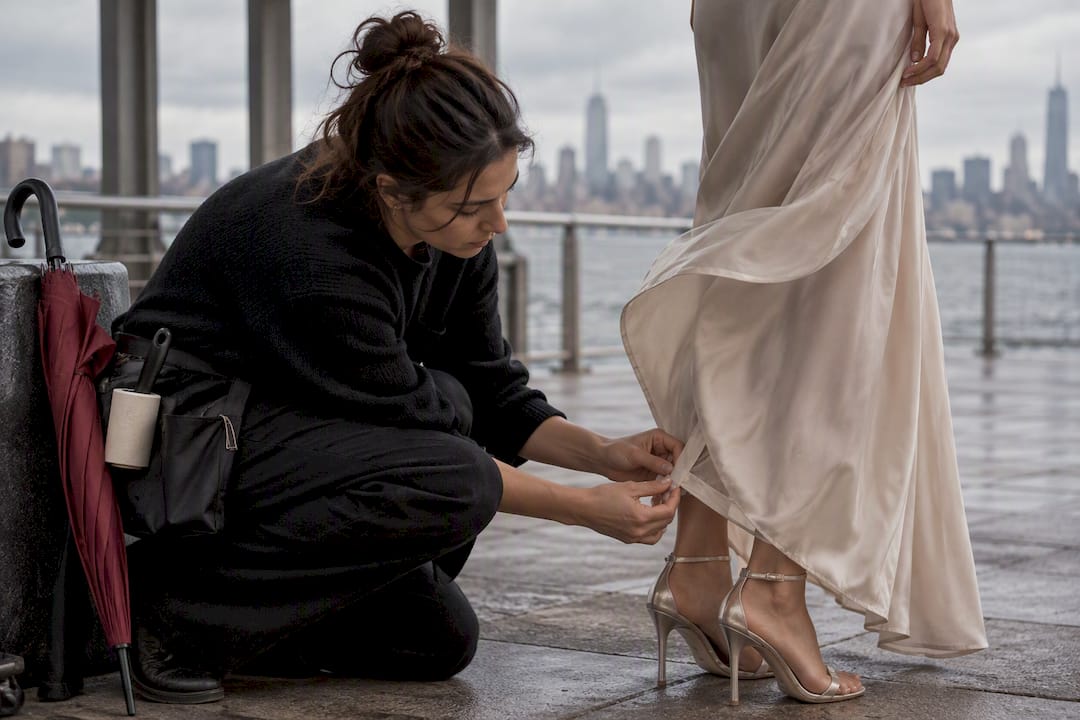
New York weather changes fast, and a shoot booked for a clear afternoon can turn into wind, rain, or a sudden temperature drop with no warning. The best defense is a location plan that already has a backup built in, whether that’s a covered doorway, an interior lobby, or, when things get bad enough, packing the crew into a studio you’ve already reserved.
Keep a compact weather kit on every outdoor call: a large umbrella that isn’t the subject’s, a lint roller, hand warmers for winter waiting, and a change of socks if anyone’s standing near water. Rain doesn’t have to end a shoot. Light rain against city lights or wet pavement reflecting neon can produce some of the more striking frames of the day, provided the wardrobe and gear are protected between takes.
Wind is the trickier problem because it’s constant rather than occasional, and it fights against hair, loose fabric, and anything with a hemline that wasn’t weighted. Fabric tape, hair spray with real hold, and a plan for which looks simply don’t work in a stiff wind off the Hudson will save you from fighting the elements shot after shot. When conditions genuinely turn, having a studio fallback already booked means the day isn’t lost, just relocated.
A styling mistake I still think about
Years back, a subject showed up in a fine houndstooth blazer for a shoot near a construction site full of scaffolding and rebar. On the monitor, the jacket and the background pattern fought each other so badly the whole frame felt like static. We hadn’t tested it beforehand. A quick wardrobe swap and a fresh test shot fixed it in ten minutes, but it cost us those ten minutes we didn’t have. Test the look against the actual background before you commit to the frame.
— Ken
How Ken Jones Photography handles styling and production for you
Planning wardrobe, fittings, and location logistics takes real time, and most clients would rather spend that time on their business than on Client Case Studies & Results | CROWD Company’s case studies. We coordinate styling, run fittings, and manage hair and makeup as part of full production support, whether the shoot happens on location or in our studio near Fulton Street.

Our studio rental gives you a controlled environment for tricky fabrics or beauty work that outdoor light won’t cooperate with, and our beauty photography services fold hair and makeup coordination into the same production day. If you’re planning a shoot in New York and want someone who’s handled the wardrobe fights, the permit questions, and the weather curveballs before, get in touch through our main site and we’ll walk through what your project needs.
FAQ
What are some good ideas for a photoshoot in New York City?
Strong NYC shoot concepts lean on the city’s own texture: subway platforms for bold graphic looks, waterfront piers in DUMBO for editorial fashion, and studio setups near the Financial District for clean corporate or beauty work. The best concepts match wardrobe and palette to the specific backdrop rather than forcing one look across every location.
What is the 20 60 20 rule in photography?
Definitions of this rule vary across sources and it isn’t a standardized industry term with one fixed meaning, so treat any specific numeric breakdown with caution. In general use, it refers to spending roughly the middle portion of a shoot on your core, most reliable setups, with smaller portions at the start and end for warmup and experimental shots.
How much does a photoshoot cost in New York?
Pricing depends heavily on the type of shoot, from corporate headshots to full fashion campaigns, and reputable studios typically quote based on your specific scope rather than a flat rate. Ken Jones Photography prices projects individually across corporate portraits, fashion editorials, and commercial campaigns, with quotes available on request.
Where are some good locations for a fashion photoshoot in NYC?
DUMBO and the Brooklyn waterfront offer strong architectural and water backdrops, SoHo delivers clean street style with brick and cast-iron facades, and a studio setting in Lower Manhattan gives full control over light for delicate fabrics. Each location demands different wardrobe choices, so match silhouette and color to the setting before you shoot.