
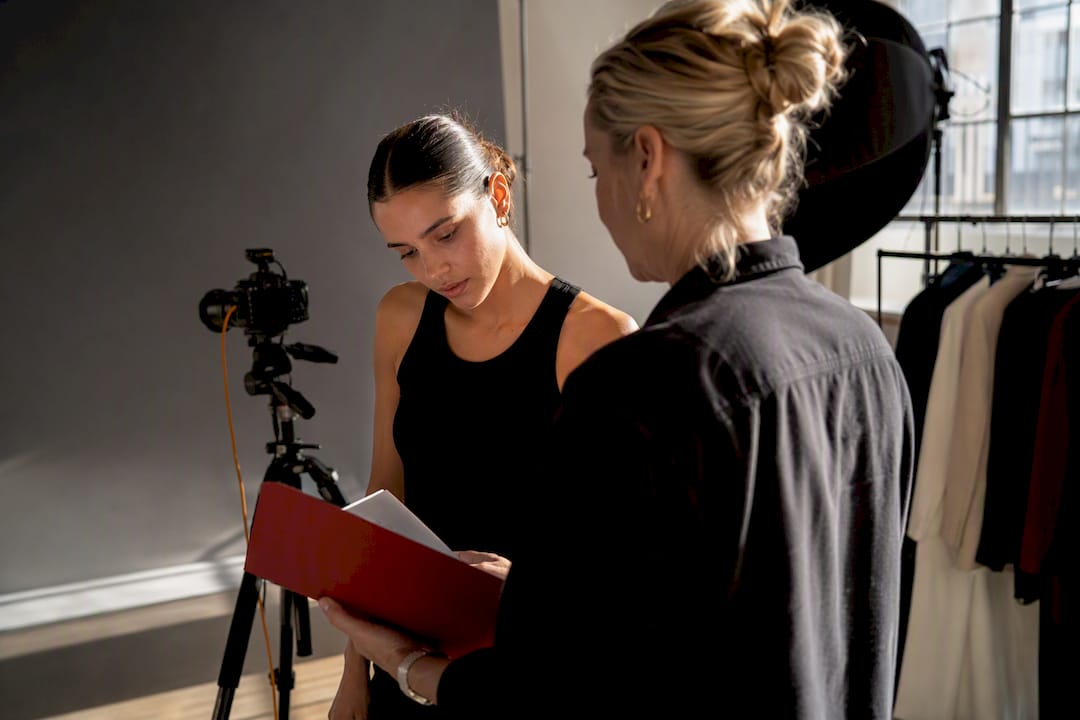
Yes, if you’re using photos to market or sell anything, get a signed model release at the shoot. The legal exposure comes from right-of-publicity and privacy law, and once a campaign is live, a missing signature is far more expensive to fix than it would have been to collect on set. If your use case sits in a gray zone, the commercial test below settles it fast.
TL;DR:
- Brands must obtain signed model releases for any photos used in commercial marketing, especially when images support a promotional or financial purpose.
- It is essential to specify media types, territories, and duration explicitly in the release to prevent disputes and ensure enforceability across jurisdictions.
- Signatures should be collected before the shoot, using electronic platforms like DocuSign when possible, and kept on file alongside the image files for legal protection.
- Releases involving minors require guardian signatures, and clear documentation of authority is vital to avoid enforceability issues later.
- Using generic templates without tailored language risks future legal complications; consulting a lawyer is recommended for high-value or cross-border campaigns.
Table of Contents
- When You Need a Model Release for Brands: The Commercial Test
- Core Elements Every Brand Model Release Should Include
- Signing Logistics: Minors, E-Signatures, and Jurisdiction
- Where to Find Model Release Templates for Brand Campaigns
- On-Set Checklist: How I Keep Releases From Slowing Down Production
- Why I Push Every Client to Treat Releases as Routine, Not Paperwork
- How Ken Jones Photography Handles Production and Releases for You
- Where to Verify Release Requirements and Find Templates
- Sources
- FAQ
When You Need a Model Release for Brands: The Commercial Test
Here’s the test I use on every shoot: does this photo support a financial or promotional objective for the brand? If yes, you need a release. It doesn’t matter whether the image looks like a candid moment on a subway platform or a polished studio beauty shot. Commercial use is defined by the purpose behind the image, not its style. That’s the commercial test at its simplest, and it applies the moment a business puts the photo to work.
In the United States, commercial use of a person’s likeness requires a signed model release to protect the brand against right-of-publicity and privacy claims. Editorial use, meanwhile, generally doesn’t carry the same requirement, but that protection evaporates the second an editorial photo gets repurposed into an ad.
I see this trip up brand teams constantly. A marketing manager pulls a great shot from an event recap for a paid social ad, assuming the original photographer’s blanket permission covers it. It usually doesn’t. Here’s where releases become non-negotiable for brands:
- Website staff photos and “meet the team” pages used to build brand trust
- Product listings and e-commerce photography featuring models or employees
- Paid social ads, display banners, and any boosted content
- Packaging, in-store displays, and point-of-sale materials
- Influencer and brand-ambassador content that gets reused in owned channels
Public events are the trickiest gray zone. Photographing a crowd at a launch party feels editorial, but if any of those faces end up in next quarter’s ad campaign, you needed a release the day you shot it, not the day you decided to use it. And because right-of-publicity law varies by state, with some states offering statutory damages and others relying on common law alone, brands operating across multiple markets can’t assume one loose approach covers every jurisdiction. When in doubt, get the release. It costs nothing extra at the shoot and saves you a legal review six months later.
Core Elements Every Brand Model Release Should Include
A model release isn’t a formality you sign and forget. It’s a contract, and like any contract, vague language is where the trouble starts. Here’s the clause-by-clause structure I insist on for every commercial shoot:
- Full legal names and identity fields. Use the model’s legal name, not a stage name or social handle, and include the brand’s full corporate name as the contracting party, not just a marketing division.
- A clear grant of rights. Spell out that the model grants permission to publish, reproduce, distribute, and create derivative works from the images. Vague permissive language creates disputes later.
- Scope: media types, territory, and duration. Does the grant cover print, digital, social, out-of-home, and broadcast? Is it limited to North America or worldwide? Is it perpetual or capped at two years? Blanket releases and limited releases serve different purposes, and a limited release that omits future channels a campaign is likely to use isn’t good enough for most brand work.
- Consideration. Payment, product, or even a modeling credit can count as consideration, but it needs to be documented. A release signed without any stated consideration is weaker if challenged.
- Waiver of claims. The model waives the right to sue over the use, provided the brand doesn’t use the image in a defamatory or misleading context. This clause protects both sides.
- Assigns and licensees language. If your agency, ad partner, or a retail buyer needs to use the same images, the release should extend to assigns and licensees, not just the brand named on the form.
- Property release trigger. If the shoot happens on private property, a rooftop, a storefront, a residential loft, you may need a separate property release from the owner in addition to the model release.
Pro Tip: Never rely on a release that only says “for advertising purposes” without naming specific channels. I’ve seen brands get pushback from a model’s agent a year later because the campaign moved into a channel the original release never mentioned. Specificity up front avoids that conversation entirely.
The strongest releases I’ve worked with mirror the fields laid out in the ASMP-backed release checklist, which has become something close to an industry standard for what a commercial release needs to hold up. A partner resource on media coverage makes a similar point about specifying permitted uses, territory, and duration, since ambiguity in any of those fields is exactly where disputes take root.
Signing Logistics: Minors, E-Signatures, and Jurisdiction
Get the release signed at the shoot, full stop. I’ve never had a signature go smoothly once a model has left the building. Delayed signatures create enforceability problems that can force a brand into last-minute campaign changes, sometimes days before launch.
A few practical notes for making this painless on set:
- Electronic signatures are legally valid under the ESIGN Act, and platforms like DocuSign or Adobe Sign are widely accepted for commercial shoots, including by many stock agencies.
- For minors, a parent or legal guardian must sign, and the guardian’s relationship to the child should be documented on the form itself, not assumed.
- Keep guardian contact details on file separately from the release, in case you need to verify authority months later.
- If the campaign involves a high budget, celebrity talent, or cross-border use, add a governing law and venue clause, since right-of-publicity protections aren’t uniform nationwide.
Brand teams sometimes assume that operating as an LLC or corporation somehow insulates them from publicity claims. It doesn’t. A signed release documents actual consent, and no amount of corporate structure substitutes for that paper trail.
Where to Find Model Release Templates for Brand Campaigns
You don’t need to draft a release from scratch. Two sources cover most brand needs. The American Society of Media Photographers has published release language for decades that photographers and agencies trust, and it hits every core clause: grant of rights, scope, consideration, and waiver. For faster turnaround, LawDepot offers downloadable U.S. model and entertainment release forms that work fine for simpler shoots, though they still need review before a major campaign relies on them.
Before you use any template, check it against this short list:
- Does it name specific media types, or just say “advertising” generically?
- Does it include assigns and licensees language for agency or retailer use?
- Does it address minors with a guardian signature field?
- Does it mention AI training or digital-replica use? Standard releases often lack this language, and if your images might feed a generative model, that’s a real gap.
- Does it specify governing law for multi-state campaigns?
Add your brand name, the actual channels you plan to use, territory, duration, and compensation terms before anyone signs. For celebrity endorsements, large budgets, cross-border shoots, or any AI-related use, skip the template shortcuts and get a lawyer to draft or review the release.
On-Set Checklist: How I Keep Releases From Slowing Down Production
After three decades of shoots in New York City, I’ve learned that release paperwork fails for boring reasons: nobody assigned it to a specific person, or nobody built it into the call sheet. Fix the process, not just the form.
- Confirm model ID and, for minors, guardian presence before hair and makeup starts.
- Get the release signed, paper or e-signature, before the model steps in front of the camera.
- Collect backup contact info in case a signature needs verification later.
- Name image files so they map directly to the signed release on file.
Pro Tip: Frame the release as standard industry paperwork, not an unusual request. Models sign these constantly, and treating it as routine speeds up signing and avoids awkward negotiations mid-shoot.
I’ve had one campaign pulled at the eleventh hour because a guardian signature was missing on a minor model’s release, caught during a client’s legal review two days before launch. A five-minute checklist at check-in would have caught it on day one. Retain releases for the life of the campaign plus several years afterward, and keep them filed alongside the corresponding image files so a future licensing request doesn’t turn into an archive hunt. Good recordkeeping also unlocks future stock and licensing opportunities without reopening negotiations with the model.
Why I Push Every Client to Treat Releases as Routine, Not Paperwork
The real cost of skipping a release isn’t legal, it’s operational. I’ve watched a launch date slip because someone assumed a release wasn’t needed for what looked like a simple lifestyle shot. Build the signature into your call sheet the same way you build in hair and makeup, and it stops being a scramble.
— Ken
How Ken Jones Photography Handles Production and Releases for You
Chasing down signatures after a shoot wraps is a headache most brand teams don’t have time for, and it’s exactly the kind of detail that falls through the cracks when a campaign is moving fast. Our studio builds release collection into the production process itself, so it happens at call time, not as a follow-up email three weeks later.

Whether you’re booking commercial campaigns, corporate headshots, or a full-day shoot that pairs photo and video production, the studio handles casting, styling, and paperwork alongside the creative work, all from its Financial District studio. If you want a production checklist tailored to your next brand shoot or want to talk through how releases fit into your campaign timeline, reach out through Kenjonesnyc and book a call before your next shoot date fills up.
Where to Verify Release Requirements and Find Templates
For the legal basics behind model releases, Stanford’s Copyright & Fair Use overview and Cornell Law’s Wex entry on publicity rights are solid starting points. For downloadable forms, see LawDepot’s release templates and the ASMP-based checklist. None of this replaces advice from a licensed attorney for high-value or complex campaigns.
This article is general information, not a substitute for advice from a qualified lawyer. Consult a qualified legal professional about your own circumstances before acting on anything here.
Sources
- Personal release agreements – Stanford Copyright & Fair Use
- Publicity — Cornell Law School Wex
- Model release forms: when you need one and what to include — LegalClarity
- Model and Entertainment Release — LawDepot
FAQ
What Does “Model Release” Mean?
A model release is a signed agreement in which a person grants a brand or photographer permission to use their image for specified purposes, usually commercial. It typically covers the scope, duration, and territory of use, along with consideration and a waiver of claims.
Where Can I Find a Model Release Form for a Photoshoot?
The American Society of Media Photographers publishes a widely used release template, and LawDepot offers downloadable U.S. model and entertainment release forms for quicker turnaround. Review either template against your specific campaign channels before use.
Is a Model Release Legally Required for Every Brand Photo?
It’s required whenever a photo supports a commercial or promotional purpose, which covers most brand marketing use. Editorial use typically doesn’t require one, but that changes the moment the image gets repurposed into an ad.
Can a Model Release Be Signed Electronically?
Yes. Electronic signatures carry the same legal weight as ink under the ESIGN Act, and platforms like DocuSign or Adobe Sign are standard practice on commercial shoots.
What Happens if a Brand Uses a Photo Without a Signed Release?
The brand risks a right-of-publicity or privacy claim from the person photographed, and remedies vary by state, with some states allowing statutory damages. Getting the release signed at the shoot avoids the issue entirely.