

Lock your script and chain of title before anything else moves. Every expensive mistake I’ve seen on a Manhattan shoot traces back to one of two failures: cameras rolled before the script was final, or someone assumed a release was signed when it wasn’t. A solid pre-production checklist keeps both from happening.
Here’s what every production must have confirmed before day one:
- Script locked and distributed (final draft, version-dated)
- Script breakdown complete (cast, props, VFX, stunts, special permissions tagged)
- Shooting schedule published and approved
- Key crew hired and deal memos signed (line producer, UPM, 1st AD)
- Locations confirmed with signed location agreements
- Permits submitted and COIs on file
- Equipment list finalized and rentals reserved
- Casting complete with signed talent releases
- Call sheet template ready for first shoot day
- Chain of title documented and legal counsel engaged
- Insurance bound (General Liability, Workers’ Comp, E&O application started)
- Master checklist published with named owners for every row
Your 24-hour priority: Assign one person to own the master checklist and deliver the first locked script draft within 48 hours. Nothing downstream can be finalized without it.
Key Takeaways
A locked script and verified chain of title are the two items that determine whether every other pre-production decision can proceed safely and on schedule.
| Point | Details |
|---|---|
| Lock script before scheduling | No budget, schedule, or crew deal should be finalized until the script is locked and version-dated. |
| Chain of title and releases first | Missing releases or incomplete chain-of-title can render a project unexploitable; budget a significant portion of pre-production time for legal documentation. |
| Tech scout is a systems test | Verify power, load-in routes, and camera blocking on-site; distribute annotated photos to all department heads within 24 hours. |
| Assign named owners, not checkboxes | Every checklist row needs a person, a date, and a one-sentence confirmation note, not just a check mark. |
| Ken Jones Photography for NYC production | The FultonStudio in Manhattan’s Financial District offers studio rental, production support, and crew services for commercial, fashion, and video shoots. |
Table of Contents
- 1. Your department-by-department pre-production checklist
- 2. Script breakdown: the document that drives everything else
- 3. U.S. legal, insurance, and chain-of-title requirements
- 4. Tech scout: what to verify before you commit to a location
- 5. Production paperwork and deliverables: who owns what and when
- 6. How to use, customize, and share your checklists
- 7. Budgeting and business entity setup
- 8. Hiring key production heads
- 9. Storyboard, shot list, and shot planning
- 10. Scheduling, shooting schedules, and call sheets
- 11. Casting, talent releases, and crew deal memos
- 12. Equipment, rentals, and tech logistics
- 13. Timeline and cost considerations for pre-production
- 14. Health, safety, and risk assessments on set
- 15. Contingency planning for common pre-production disruptions
- 16. Communication plans and call trees for the production team
- 17. Integrating post-production planning into pre-production
- What I’ve learned from years of NYC production work
- Sources
- FAQ
1. Your department-by-department pre-production checklist
Industry-standard checklists typically organize pre-production into 12–15 departments, each with its own owner and lock date. The table below mirrors that structure. Print it, drop it into a shared spreadsheet, or import it into production software like StudioBinder or Studiosity.
| Department | Key Items | Owner | Must Be Locked By |
|---|---|---|---|
| Script / Story | Final draft, title clearance, copyright registration | Writer / Director | Before scheduling begins |
| Schedule & Budget | Shooting schedule, top sheet, contingency line | Line Producer / UPM | 3 weeks before shoot |
| Casting | Auditions complete, offers out, contracts signed | Casting Director / Producer | 2 weeks before shoot |
| Locations | Agreements signed, permits submitted, COIs on file | Location Manager / Producer | 14–21 days before shoot |
| Art / Wardrobe | Costume fittings, set dressing approved, prop list locked | Production Designer / Stylist | 1 week before shoot |
| Camera / Lighting / Sound | Package confirmed, power test scheduled, expendables ordered | DP / Gaffer / Sound Mixer | 5–7 days before shoot |
| Stunts / SFX | Safety coordinator hired, rehearsals scheduled, permits filed | Stunt Coordinator | 2 weeks before shoot |
| Transportation & Accommodation | Vehicles confirmed, hotel blocks reserved, parking plan | Transportation Coordinator | 1 week before shoot |
| Catering & Welfare | Caterer booked, dietary needs collected, welfare facilities confirmed | Production Coordinator | 1 week before shoot |
| Insurance & Legal | GL, Workers’ Comp, HNOA bound; E&O application started | Producer / Entertainment Attorney | 3 weeks before shoot |
| Post / VFX / Music | Editor engaged, VFX supervisor briefed, music licensing started | Post Supervisor / Producer | Before production begins |

Pre-production milestone timeline:
| Milestone | Days Before First Shoot Day |
|---|---|
| Script locked | Before all other scheduling |
| Key crew hired | 21 days |
| Permits & COIs submitted | 14–21 days |
| Tech scout | 7–10 days |
| Equipment confirmed | 5–7 days |
| Call sheet issued | 24–48 hours |
Pro Tip: Assign a named owner to every checklist row, not just a department. A one-sentence “locked” note, with the date and the person who confirmed it, is more reliable than a checkbox. Checkboxes get clicked prematurely; a name and date do not.
Downloadable templates in PDF and CSV formats are available from StudioBinder and Storyflow. Both can be adapted to a single-page printable format or imported into Google Sheets for shared team access.
2. Script breakdown: the document that drives everything else
The script breakdown is the single most important pre-production document you will create. Every budget line, every scheduling decision, every crew hire flows from it. Trying to schedule or budget before the breakdown is complete is like building a floor plan without knowing how many rooms you need.
What to tag in every scene:
- Cast (principal, day players, background)
- Props (hand props, set dressing, hero items)
- Wardrobe (period, specialty, multiples for stunts)
- Vehicles (picture cars, camera vehicles, insert cars)
- Special effects (practical fire, rain, wind, breakaways)
- Stunts (any action requiring a coordinator)
- VFX (on-set elements, greenscreen, reference markers)
- Animals (any live animal, including insects)
- Special permissions (minors on set, weapons, controlled locations)
- Music / third-party content (any source music, logos, artwork visible on camera)
Mini stripboard example (3 scenes, 2 locations):
| Strip | Scene | Location | Cast | Day/Night | Special |
|---|---|---|---|---|---|
| 1 | 4 | Rooftop, Tribeca | 1, 3 | Day | Stunt coordinator |
| 2 | 7 | Rooftop, Tribeca | 1 | Day | Drone permit |
| 3 | 12 | Office interior | 2, 4 | Night | Practical fire |
Grouping scenes 4 and 7 together saves a full company move. That one scheduling decision can cut a day off your shoot, which on a union production in New York can mean tens of thousands of dollars.
Breakdown pass sequence:
- Writer or director does the first creative pass, flagging story elements.
- Producer reviews for budget implications and flags anything with cost risk.
- UPM and 1st AD do the scheduling pass, grouping by location and day/night.
- Each department head reviews their own elements for accuracy.
Pro Tip: Run a second “safety pass” specifically for rights and clearances: source music, visible artwork, brand logos, and third-party trademarks. Missing any of these can block your Errors & Omissions insurance application and delay distribution.
3. U.S. legal, insurance, and chain-of-title requirements
Missing chain-of-title documentation, unsigned releases, or incomplete insurance can block distribution outright. According to entertainment attorneys, pre-production legal readiness must include chain-of-title documentation, employment agreements with IP assignment clauses, location and talent releases, permits, and insurance certificates before a project is distribution-ready.
Required insurance types:
| Insurance Type | What It Covers | When to Obtain |
|---|---|---|
| General Liability | Third-party bodily injury and property damage | Before any location access |
| Workers’ Compensation | Crew injuries on set | Before first hire |
| Hired / Non-Owned Auto (HNOA) | Vehicles used in production not owned by the company | Before any driving begins |
| Errors & Omissions (E&O) | IP claims, defamation, privacy violations | Application starts in pre-production; bound at delivery |
U.S. productions should form a dedicated production entity (typically an LLC) before signing any agreements. This separates production liability from personal assets and is often required by location managers and distributors before they will execute agreements.
Chain-of-title checklist:
- Option or assignment agreement for underlying source material
- Writer’s agreement with work-for-hire or IP assignment clause
- Copyright registration with the U.S. Copyright Office
- Signed talent releases (on-camera talent, voice talent)
- Signed location releases and location agreements
- Music licenses (sync and master) or original score agreement
- NDAs for key crew with access to unreleased material
Incomplete chain-of-title and missing releases are the most common reasons a finished project becomes unexploitable.
Practical timeline for legal milestones:
- Engage entertainment counsel: as soon as the project is greenlit
- Submit permit applications in major cities (New York, Los Angeles, Chicago): 14–21 days before the shoot
- Deliver COIs to location owners: at least 5 business days before access
- Begin E&O application: at picture lock, with all clearances assembled
Pro Tip: Keep a physical “chain of title” binder with a visible change log on the cover: document name, version, date last updated, and who signed. When your E&O broker asks for the chain at delivery, you will have it in one place.
When paying freelance crew and talent, consult IRS 1099-NEC reporting rules to confirm your withholding and reporting obligations for each contractor.
4. Tech scout: what to verify before you commit to a location
The tech scout is your last technical safeguard before deposits are paid and schedules are locked. Treat it as a live systems test, not a casual walkthrough.
What to verify on every tech scout:
- Power availability: Identify the main panel, breaker map, and available amperage. Test actual load capacity, not just the posted spec.
- Load-in and load-out routes: Walk the full path with a grip or gaffer. Measure doorways, elevator dimensions, and stairwell clearances.
- Parking and staging: Confirm where grip trucks, camera vehicles, and talent vehicles can park without permits or with permits already in hand.
- Noise sources: Listen for HVAC, street traffic, subway rumble, and neighboring businesses. Test at the time of day you plan to shoot.
- Cell coverage and Wi-Fi: Check signal in every room you plan to use. Dead zones affect communication and wireless video assist.
- Camera blocking: Walk each critical setup with the DP. Confirm sightlines, ceiling height for cranes or jibs, and window light direction.
- Restrooms and welfare facilities: Confirm availability and proximity for cast and crew.
- Emergency exits and safety routes: Note them for the safety briefing on shoot day.
Create a simple site plan by photographing the space and annotating it with camera positions, lighting placement, and load-in routes. Distribute annotated photos and time-stamped voice notes to all department heads within 24 hours of the scout.
For studio productions, a studio rental equipment checklist helps confirm power capacity, grip space, and available amenities before you commit to a booking. Practical setup diagrams and staging references can also help teams visualize load-in logistics before arriving on site.
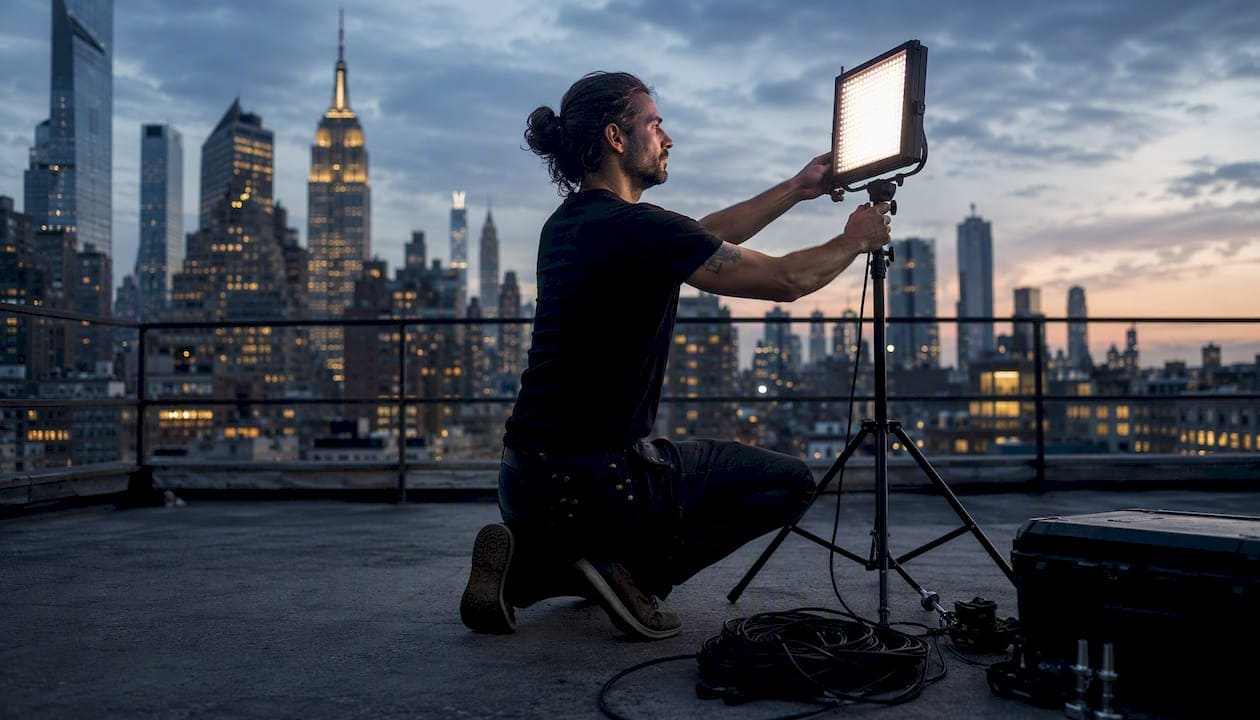
Pro Tip: Test camera and lens lines for each critical setup during the scout, not just the room in general. A lens that works beautifully at 35mm may clip a ceiling beam at 24mm. Discovering that on shoot day costs an hour; discovering it on the scout costs nothing.
5. Production paperwork and deliverables: who owns what and when
Paperwork is risk management. Create the document flow before production starts and assign a named owner to each item. A production coordinator functions as the central information hub for documentation, rights clearances, logistics, and scheduling, per Screen Skills’ production coordinator skills framework.
Core production documents and their owners:
- Call sheet: 1st AD issues 24–48 hours before each shoot day
- Daily production report (DPR): Production coordinator compiles at wrap
- Timecards: Department heads collect; production coordinator submits to payroll
- Incident log: On-set medic or safety officer maintains; producer reviews daily
- Media log: DIT or camera assistant tracks daily; delivered to post at wrap
- Talent and location releases: Producer collects before talent or location is used
Delivery checklist for final picture lock:
- Locked picture file (ProRes or DCP, per distributor spec)
- Dialogue list and closed captions
- Music cue sheet with all sync and master license documentation
- E&O insurance certificate
- Full chain-of-title package
- All signed releases (talent, location, music)
- Delivery memo signed by distributor
For freelance payments, confirm your 1099-NEC reporting obligations with a tax professional before the end of the calendar year. Misclassifying a crew member as an independent contractor when they qualify as an employee carries significant IRS penalties.
Pro Tip: Use a version-controlled shared folder (Google Drive or Dropbox) for all signed documents, with a local backup binder for originals. Name files with the date and version number: “LocationRelease_MainStreet_v1_2026-03-15.” Searching for an unsigned release at 11 PM before a 6 AM call is a problem you can prevent in pre-production.
6. How to use, customize, and share your checklists
Pick one master checklist and treat it as the single source of truth. Multiple versions circulating among department heads is one of the most reliable ways to create conflicting information and production delays.
Step-by-step versioning:
- v0.1 (first pass): Producer creates the master checklist from the script breakdown. All rows are open; owners are assigned but nothing is locked.
- v1.0 (lock review): After the pre-production meeting, all confirmed items are marked locked with date and name. This version goes to all department heads.
- v1.1 (post-tech-scout): Location, power, and camera-blocking items are updated with scout findings. Any new items discovered on scout are added.
- v1.2+ (rolling updates): Each change is logged in a change-log tab with date, item changed, and who authorized the change.
Format options:
- Printable PDF: Best for on-set reference and physical binders. Not editable, so it must be reprinted after each version update.
- Editable spreadsheet (Google Sheets or Excel): Best for shared team access, version control, and sorting by department or lock date.
- Production software import (StudioBinder, Studiosity, Movie Magic): Best for large productions where the checklist connects to scheduling, budgeting, and call sheets.
Collaboration rules: One person edits the master. Everyone else comments. Send a daily snapshot email to all department heads showing what changed since the previous day. This keeps everyone current without creating competing versions.
Pro Tip: Schedule a short “lock review” meeting, 30 minutes maximum, before any deposit is released or any contract is executed. Walk the open checklist items, assign a due date to each, and close the meeting with a clear list of what is still outstanding. This single habit prevents the most common pre-production failure: assuming something is done because no one mentioned it.
7. Budgeting and business entity setup
Form your production LLC before signing any agreements. This is not a formality; it is the legal structure that separates your personal assets from production liability and satisfies most location managers and distributors who require a named entity on their agreements.
Your budget top sheet should include above-the-line costs (writer, director, principal cast), below-the-line costs (crew, equipment, locations, catering), post-production, insurance, legal fees, and a contingency line of 10–15% of the total budget. The contingency is not optional. On location shoots in New York, weather delays, permit complications, and last-minute location changes are common enough that a budget without contingency is a budget that will be exceeded.
Open a dedicated production bank account under the LLC before any money moves. Mixing personal and production funds creates accounting problems and can complicate your E&O application. Keep all vendor payments, crew deals, and location fees running through the production account.
8. Hiring key production heads
The line producer, unit production manager (UPM), and 1st assistant director (1st AD) are the three hires that determine whether pre-production runs on schedule. Hire them before you lock the shooting schedule, not after.
The line producer owns the budget and the overall production plan. The UPM executes that plan day to day: negotiating vendor deals, managing crew paperwork, and tracking actual costs against the budget. The 1st AD owns the shooting schedule and the set. These three roles must be in constant communication, and their deal memos must include clear IP assignment clauses so there is no ambiguity about who owns the work product they create.
For smaller productions, a single experienced production coordinator can absorb some UPM functions, but the 1st AD role should never be combined with another position. The AD’s job is to keep the set moving; splitting their attention is a reliable way to fall behind schedule on day one.
9. Storyboard, shot list, and shot planning
The storyboard and shot list translate the script into a camera plan. They are the tools the director and DP use to confirm coverage before the shoot day, and they are what the 1st AD uses to build a realistic daily schedule.
A shot list for a commercial or editorial shoot should include scene number, shot number, shot size (wide, medium, close), camera movement, lens, and any special requirements (crane, gimbal, drone). For fashion and editorial work, building a shot list for a commercial shoot means thinking about the final usage first: a campaign image needs different coverage than a behind-the-scenes video. For fashion campaigns specifically, a fashion campaign shot list guide can help creative teams structure coverage across looks, setups, and talent.
Storyboards do not need to be polished illustrations. Rough thumbnails that communicate camera angle, subject position, and movement are enough. The goal is to identify problems before the shoot day, not to create presentation-quality artwork.
10. Scheduling, shooting schedules, and call sheets
The shooting schedule is built from the stripboard, which groups scenes by location, day/night, and cast availability. A 1:3 prep-to-shoot ratio is a useful rough guide: each day of shooting typically warrants multiple days of preparation to be executed cleanly.
Build the schedule with the 1st AD using production scheduling software. Lock it before you issue any crew deals, because day rates and overtime calculations depend on the confirmed number of shoot days. Once locked, any change to the schedule should go through a formal change-log process, not a text message.
The call sheet is the daily execution document. It lists crew call times, talent calls, location address, parking instructions, emergency contacts, and the day’s scene breakdown. Issue it 24–48 hours before each shoot day. A call sheet that goes out the morning of the shoot is a call sheet that will cause problems.
11. Casting, talent releases, and crew deal memos
Casting decisions should be finalized at least two weeks before the shoot. Once offers are out, collect signed deal memos before talent appears on set. A deal memo covers rate, usage rights, exclusivity, and the scope of the engagement. For union talent, confirm your signatory status with SAG-AFTRA before making any offers.
Talent releases must be signed before any footage is captured. For minors, a parent or legal guardian must sign, and you must comply with applicable state child labor laws. In New York, this means a valid work permit and compliance with the New York State Department of Labor’s regulations for minors in the entertainment industry.
Crew deal memos should include an IP assignment clause that transfers any work product created during the production to the production entity. Without this clause, a crew member could theoretically claim ownership of footage they shot or music they composed for the project.
12. Equipment, rentals, and tech logistics
Confirm your equipment package with the DP and gaffer at least one week before the shoot. For rental gear, reserve early, especially in New York where camera and lighting packages book out quickly during peak production seasons. Get written confirmation from the rental house, not just a verbal hold.
For studio shoots, review the studio rental questions to ask before booking to confirm power capacity, available grip equipment, and load-in logistics. A studio that lists “3-phase power available” may have a single 100-amp service, which is not enough for a large lighting package. Verify the actual amperage and the location of the main panel before you build your lighting plan.
A practical video pre-production checklist for technical gear should also include backup plans: a backup camera body, spare media cards, a generator if location power is uncertain, and a wireless video assist system with a spare battery kit. Equipment failures happen; productions that plan for them recover in minutes rather than hours.
13. Timeline and cost considerations for pre-production
Pre-production for a short commercial or branded video typically runs two to four weeks. A feature film or episodic series may require three to six months.
The most expensive pre-production mistake is starting too late. Permit applications in major U.S. cities require 14–21 days minimum. Insurance brokers need time to bind coverage. Location managers need time to negotiate agreements. Compressing pre-production to save money almost always costs more on the shoot day, when every hour of delay is billed at full crew rates.
14. Health, safety, and risk assessments on set
Every production, regardless of size, should complete a written risk assessment before the shoot. This document identifies hazards (electrical, physical, environmental), rates their likelihood and severity, and assigns mitigation measures and responsible parties.
For productions that involve stunts, heights, water, fire, or heavy equipment, a qualified safety coordinator should be on set. For all productions, designate a point person for medical emergencies and confirm that a first aid kit and an AED are accessible on set.
COVID-19 protocols have evolved since 2020, but many productions still maintain baseline measures: health screening questionnaires, ventilation requirements for interior locations, and a clear protocol for what happens if a cast or crew member tests positive during production. Check current SAG-AFTRA and IATSE guidelines for the most current recommendations, as these are updated periodically.
15. Contingency planning for common pre-production disruptions
The three most common pre-production disruptions are location cancellations, key crew unavailability, and permit delays. Plan for all three before they happen.
For location cancellations, identify a backup location during the scout phase, not after the primary location falls through. For key crew unavailability, maintain a short list of qualified alternates for the line producer, 1st AD, and DP roles. For permit delays in cities like New York, submit applications earlier than required and maintain a direct contact at the film office.
Weather is the most common shoot-day disruption for exterior locations. Build a weather day into the schedule and budget for any exterior shoot that cannot be moved indoors. A weather day costs money; losing a full shoot day because you did not budget one costs more.
16. Communication plans and call trees for the production team
Every production needs a written communication plan before the shoot begins. This document lists every department head’s name, role, cell number, and email, and defines who calls whom in an emergency.
The call tree structure is simple: the producer calls the 1st AD and the line producer. The 1st AD calls department heads. Department heads call their own crew. This structure keeps the producer from fielding 30 individual calls when something changes on set. Distribute the call tree with the first call sheet and update it whenever a crew member changes.
For day-to-day communication, designate a single channel for production-wide updates (a group text, a Slack channel, or a walkie-talkie frequency) and a separate channel for department-specific communication. Mixing the two creates noise that causes people to stop paying attention to either.
17. Integrating post-production planning into pre-production
Post-production planning belongs in pre-production, not at picture lock. Engage your editor before the shoot so they can advise on coverage, pacing, and any editorial requirements that affect how scenes are shot. For VFX-heavy productions, the VFX supervisor should be on set or at minimum involved in the tech scout to confirm reference markers, lighting conditions, and on-set element requirements.
Music licensing is another item that must start in pre-production. If your script calls for a specific song, begin the sync licensing process immediately. Publishers and record labels can take weeks to respond, and a “no” at delivery means either a costly re-edit or a last-minute replacement that rarely sounds as good.
Establish your post-production folder structure before the shoot begins. A practical video production checklist recommends setting up your post folder hierarchy during pre-production so that media, audio, graphics, and deliverables each have a designated location from day one. This prevents the chaotic media management that slows down editorial on short-turnaround projects.
What I’ve learned from years of NYC production work
The most common mistake I see from clients planning their first serious shoot in New York is treating pre-production as a checklist to complete rather than a readiness index to build. There is a real difference. A completed checklist can have wrong answers. A genuine readiness index means every item has been verified by the person responsible for it, not just checked off.
I had a client once who arrived at a Financial District location with a full crew and a catering order, only to discover the building’s freight elevator was out of service. The location manager had confirmed the address but had never asked about load-in logistics. The tech scout would have caught it in five minutes. Instead, it cost three hours of crew time and a rescheduled first setup.
Three mistakes I see repeatedly: permits submitted too late (New York’s Mayor’s Office of Media and Entertainment recommends submitting at least two weeks in advance for most locations), script changes made after the breakdown is complete without updating the breakdown, and owner assignments that exist on paper but were never communicated to the person named.
The rule I apply to every job: if you cannot name the person responsible for a checklist item and tell me when they last confirmed its status, that item is not done.
Production support and studio space for your next shoot
Ken Jones Photography operates the FultonStudio in Manhattan’s Financial District, offering full-service production support for commercial, fashion, corporate, and video shoots in New York City. The studio is equipped for photography and video production, with production support services that pair directly with the checklist work you’ve done in pre-production.

Production services available through Ken Jones Photography include:
- Studio rental with full lighting and grip support
- Location management and production coordination
- Casting, styling, hair, and makeup coordination
- Equipment packages and crew sourcing
- Post-production delivery including retouching and image delivery
Whether you need a video production partner for a branded content shoot, a studio for corporate interviews or product photography, or a full-service team for a fashion editorial, Ken Jones Photography can scope the production to your timeline and budget. Visit Kenjonesnyc or contact the studio directly to discuss availability for your next project.
Sources
Cross-checking your legal and insurance items with qualified entertainment counsel and your local film office is the most reliable way to confirm that your production meets current requirements. The sources below cover the most commonly needed areas.
For legal checklists and chain-of-title documentation, The Bowen Firm’s Production Legal Checklist and the Art and Media Law Pre-Production Legal Checklist are both practical starting points. For a deeper explanation of why each document matters, WADR Law’s guide to essential legal documents is worth reading before you engage counsel.
For downloadable templates and department-by-department checklist structures, StudioBinder’s pre-production checklist and Storyflow’s template library offer printable and importable formats. For video-specific pre-production workflows, Miura Visual’s video pre-production checklist covers technical and logistical items that film-focused guides sometimes omit.
- Production Legal Checklist v 3
- Pre‑Production Legal Checklist – Art and Media Law
- IRS Form 1099-MISC instructions
- The Ultimate Pre Production Checklist for Film FREE Checklist – StudioBinder
FAQ
What is a pre-production checklist?
A pre-production checklist is a department-by-department document that tracks every task, approval, and deliverable that must be completed before cameras roll. It typically covers script, schedule, budget, casting, locations, permits, insurance, equipment, and legal documentation.
What should be locked first in pre-production?
Lock the script before anything else. The script breakdown, shooting schedule, budget, crew deals, and legal documents all depend on a final, version-dated script. Starting any of these before the script is locked means redoing them when it changes.
How early should you submit permits for a shoot in New York City?
Submit permit applications at least 14–21 days before your shoot date for most New York City locations. The Mayor’s Office of Media and Entertainment processes most standard permits within that window, but complex locations or large productions may require more lead time.
What insurance does a U.S. production need?
At minimum: General Liability, Workers’ Compensation, and Hired/Non-Owned Auto coverage, bound before the shoot begins. Errors & Omissions insurance is required for distribution and should be applied for at picture lock with all clearances assembled.
How do you prevent a checklist from becoming outdated during production?
Maintain a single master checklist with one named editor and a version log. Send a daily snapshot to all department heads showing what changed. Any update requires a logged entry with the date, the item changed, and who authorized it.