
Most photo retouching lands somewhere between two business days and three weeks, depending on shoot type and image count. Headshots and simple e-commerce work move fastest, often two to five business days. Beauty, editorial, and wedding galleries take longer, often spanning multiple weeks, because hero images can require several hours each. As a rule of thumb, basic edits typically take only a few minutes per image, standard retouch can take from a quarter to nearly an hour, and high-end beauty work often requires significantly more time. Complex skin work, compositing, or a slow revision cycle from the client will push any of those numbers out further.
TL;DR:
- Retouching for beauty and editorial images typically requires one to two weeks, especially for high-end work involving skin preservation and color grading.
- Volume and client delays can significantly extend turnaround times, with wedding galleries often taking three to six weeks due to culling and batch processing.
- High-end retouching can demand one to four hours per image, while AI tools handle bulk tasks in seconds, making hybrid workflows essential for efficiency.
- Clear contract language, including specified start points, revision limits, and built-in time buffers, reduces client disputes over delivery dates.
- Building time expectations into quotes and workflows ensures reliable delivery, with most projects invoicing production time upfront and including one revision round.
Table of Contents
- How Long Does Retouching Take by Shoot Type?
- What Does Per-Image Retouching Time Actually Mean?
- What Slows Down Retouching Turnaround Time?
- How Should Photographers Write Turnaround Into Contracts?
- A Manhattan Editorial Shoot: What Actually Happened
- Why Predictable Delivery Is Part of the Service
- How Ken Jones Photography Handles Retouching and Delivery
- Sources
- FAQ
How Long Does Retouching Take by Shoot Type?
Retouching turnaround time depends more on the category of shoot than almost any other variable. A headshot session and a beauty campaign can use the same software and the same retoucher, yet land three weeks apart on the calendar, because the images themselves demand different levels of attention.
Portraits and corporate headshots move fastest. Most studios, including ours, deliver in two to five business days. The reason is simple: lighting is controlled, backgrounds are usually clean or replaced with a flat color, and clients typically need one strong frame per person rather than a full story told across twenty images. There’s less room for scope creep when the brief is “make this executive look sharp and approachable.”
Beauty and editorial work takes longer, often one to two weeks for a full set. Hero images in a beauty campaign might need frequency separation, dodge and burn, color grading, and careful skin work that preserves texture instead of smoothing it into plastic. That kind of retouching often runs 2 to 3 hours per image, and a shoot with six or eight hero shots adds up fast.
Weddings and events carry a different bottleneck: volume. A single wedding can generate 3,000 to 6,000 raw frames. Culling and selection alone can take a full day or two before retouching even starts. Delivery windows of three to six weeks are common industry-wide for full galleries, though many studios offer a faster sneak-peek set within 48 to 72 hours.
Product and e-commerce photography benefits from repeatable pipelines. Once a lighting setup and background treatment are locked, batch processing can move hundreds of SKUs through in days rather than weeks.
- Portraits/headshots: 2 to 5 business days
- Beauty/editorial: 1 to 2 weeks, longer for cover-level retouching
- Weddings: 3 to 6 weeks for full galleries, faster for previews
- E-commerce/catalog: days for high volume with standardized backgrounds
What Does Per-Image Retouching Time Actually Mean?
When a studio quotes “per-image” pricing or timing, that number hides a wide range of actual labor. Basic edits, cropping, exposure correction, minor color balance, take 1 to 5 minutes each. Standard portrait retouch, skin smoothing, blemish removal, light dodge and burn, sits at 15 to 45 minutes.
High-end beauty retouching is where the real time goes. A professional retoucher often spends one to two hours per image for quality work, with some beauty shots stretching to four hours. That is not padding. Frequency separation alone, done properly, is a slow, layered process that cannot be rushed without the skin looking waxy.
Statistic: AI tools can complete batch tasks like background removal or culling very quickly, while human retouchers typically spend many minutes per image. on comparable work. That gap is why hybrid workflows have become standard rather than optional.
- Basic edits: 1 to 5 minutes per image
- Standard retouch: 15 to 45 minutes per image
- High-end beauty: 1 to 4+ hours per image
- AI-assisted batch tasks: seconds per image for culling, background swaps, and simple corrections
AI handles the repetitive, low-judgment tasks well. It struggles with nuanced skin texture, hair strand detail, and compositing decisions that require an eye trained on the final use case, a magazine cover reads differently than an Instagram grid. Hybrid workflows can cut total production time meaningfully, but only when instructions are clear upfront. Skip that step and you’ll spend the saved time on rework instead.
What Slows Down Retouching Turnaround Time?
Several factors push delivery dates later than a client expects, and most of them are predictable if you know what to look for.
- Skin, hair, and background complexity. Problem skin, stray hairs against busy backgrounds, or reflections in jewelry can double or triple per-image time. A studio observation on this is blunt: per-photo averages can run around 5 minutes for light edits, but time balloons fast for problem skin or heavy compositing.
- Culling and selection. Sorting 2,000 images down to 150 final selects is real labor, often a full day for a large shoot, and it happens before retouching even begins.
- Compositing and multi-image work. Combining several frames into one final image (common in product and beauty work) adds hours that a simple per-image quote doesn’t capture.
- Client-driven delays. Late selects and multiple rounds of revision requests are the single biggest reason a “one week” quote turns into three. Every added revision round resets part of the clock.
Photographers should track actual time spent per image type over several projects and consider investing in Photography SEO Services | Be Discovered & Book More Shoots to balance workload while growing their business. A checklist approach that accounts for complexity, image count, and skill level produces far more accurate quotes than guessing from memory.
How Should Photographers Write Turnaround Into Contracts?
Vague timeline language causes more client disputes than almost any other line item in a photography contract. Say “turnaround starts when final selects are received” instead of “after the shoot,” and you eliminate an entire category of arguments before they start.
Contract language that works in practice looks something like this: “Retouched images will be delivered within 7 business days of receiving final selects. This includes one round of revisions. Additional revision rounds are billed at $75 per image.” Spelling out business days, not calendar days, and stating the revision count up front, are the two habits that prevent the most friction.
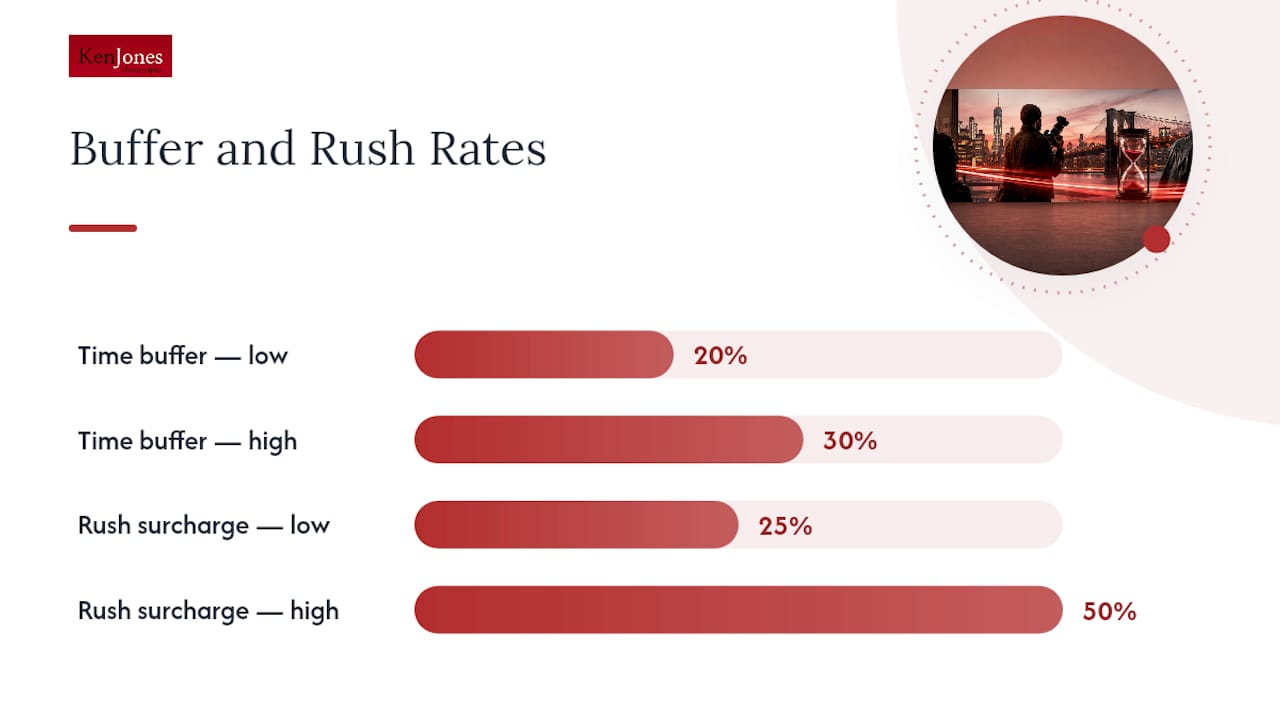
For buffer math, a rough formula holds up well across project types: per-image time × image count, plus a 20 to 30% buffer for unexpected complexity or scheduling gaps. Workflow guides consistently recommend that 20 to 30% cushion along with clear business-day language to avoid client misunderstandings, and I’ve never seen a studio regret building in that margin.
Rush fees should be structured, not improvised. A 25 to 50% surcharge for expedited delivery, capped at a limited number of rush slots per month, keeps pricing fair without turning every deadline into an emergency.
- Define the start point explicitly (shoot date vs. final selects received)
- State revision counts and overage fees in writing
- Quote business days, never calendar days
- Build in a 20 to 30% time buffer before promising a date
Our own breakdown of studio retouching workflow and revision policy covers how these terms translate into an actual production schedule.
Pro Tip: Quote your rush fee as a percentage of the total invoice, not a flat number. It scales fairly whether the job is five images or five hundred.
A Manhattan Editorial Shoot: What Actually Happened
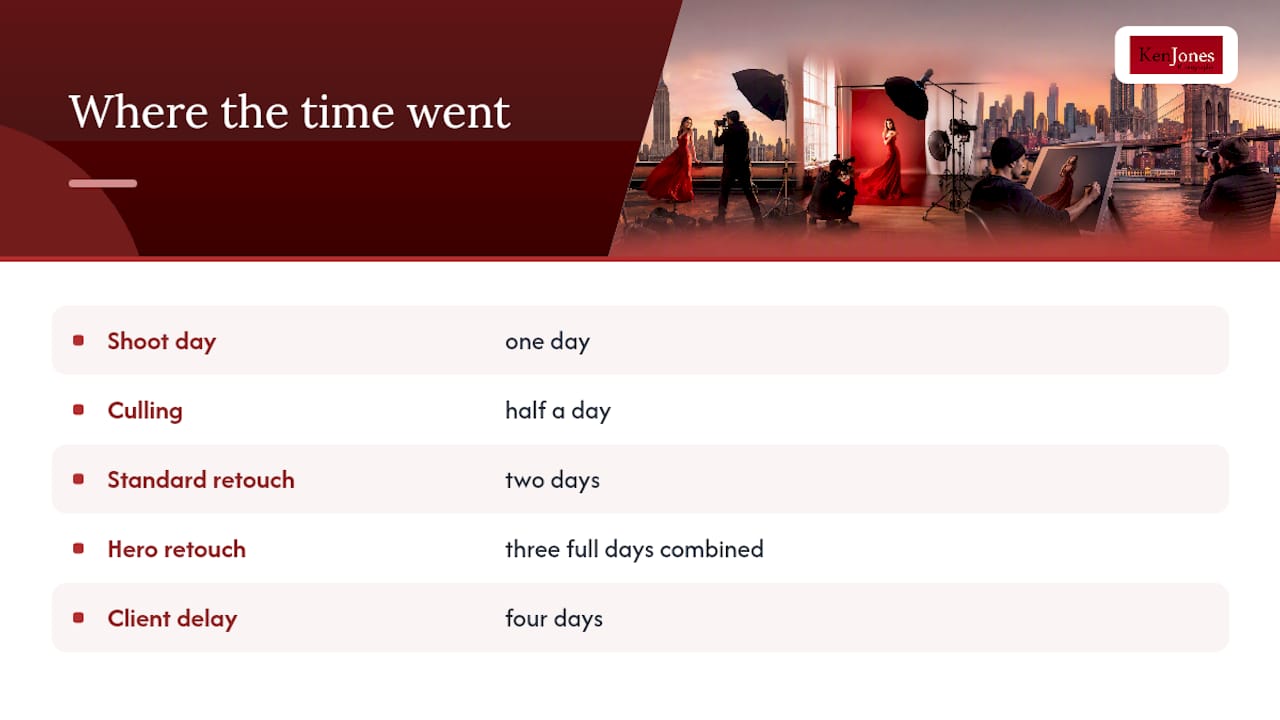
A recent beauty editorial we shot in the Financial District studio is a decent case study in where time really goes. Shoot day: one day, six looks, roughly 400 frames. Culling to 40 selects: half a day. Standard retouch on 30 supporting images: two days. The four hero images, the ones going to print, took three full days combined because the client wanted texture-preserving skin work and a specific color grade matched to a mood board.
The mistake wasn’t ours, but it cost us anyway: the client sat on final selects for four days before sending them over, which pushed delivery from “the following Monday” into the next week. We now build a selection deadline into every brief with a soft penalty for late selects.
Never fix in post what you can fix on set. A stray hair or a wrinkled collar takes ten seconds to correct with a clip or a comb before the shutter fires. Left for retouching, that same fix can eat twenty minutes per frame across a whole gallery.
Tight on-set habits, checking screens between setups, keeping a steamer nearby, doing a beauty pass before each look, save more retouching hours than any software upgrade.
Why Predictable Delivery Is Part of the Service
Clients remember missed deadlines longer than they remember good lighting. A campaign that ships a week late can blow a launch date, and that reputational cost lands on the photographer, not the retoucher three time zones away. Fast and good are both possible, but rushed high-end beauty work almost always shows in the skin. Ask any photographer you’re hiring how they define “business days” and what happens if you’re slow sending selects. The answer tells you more than their portfolio does.
— Ken
How Ken Jones Photography Handles Retouching and Delivery
Ken Jones Photography, KenJonesNYC, Ken Jones NYC, builds turnaround into the quote from day one, not as an afterthought once the invoice is signed. Corporate headshots typically ship in 2 to 5 business days. Beauty and editorial work gets the time it needs, usually one to two weeks, because texture-preserving skin retouching isn’t something we compress to hit an arbitrary date. Product and e-commerce shoots run on standardized pipelines built for volume.

Every project includes one round of revisions and a clear delivery date stated in business days, so there’s no guessing between shoot and inbox. If you’re planning a beauty campaign, browse the beauty photography portfolio to see the retouching quality behind those timelines, or check the studio headshot portfolio if you need corporate images turned around fast. Reach out through Kenjonesnyc to get a quote with a real delivery date attached, not a vague promise.
Sources
Claims in this article draw on retoucher time studies from Fstoppers, turnaround planning guidance from Retouching Labs, and AI-versus-human speed comparisons from Expert Graphic International.
- Why I Always Work With a Retoucher as a Professional Photographer | Fstoppers
- AI vs. Human Photo Retouchers: Quality, Speed and Cost Comparison – Expert Graphic International: Photo Editing Company
FAQ
How long does retouching take?
Most retouching runs from two business days for simple headshots to two to three weeks for beauty, editorial, or full wedding galleries, depending on image count and complexity.
What is the 20-60-20 rule in photography?
Definitions vary across sources, and no single authoritative version applies universally to retouching timelines; treat any specific version you encounter with caution rather than as a fixed industry standard.
How many photographers earn over $300,000 a year?
Reliable income breakdowns at that specific threshold aren’t publicly available in a form this article can verify, so no figure is stated here.
Is $4,000 a lot for a wedding photographer?
It depends heavily on market and package scope, but in major markets like New York City, pricing often reflects a reasonable mid-range for full-day coverage with an edited gallery, not at the high end.