
A successful executive interview video does three things: serves a clear business objective, captures studio-grade audio and image, and delivers modular assets your team can repurpose across channels. Get the messaging outline right before the camera turns on, build in audio redundancy, and shoot with a plan for at least three deliverables. A professional studio can carry the production load, but the priorities above are yours to lock first.
TL;DR:
- Scheduling 45 to 90 minutes for the shoot allows time for technical setup, warm-up, the main interview, pickups, and portraits, especially in office locations.
- Using specific, story-driven questions produces more quotable answers than broad opinion queries, improving the final content quality.
- A three-layer audio system with a boom mic, a lavalier, and a separate recorder ensures recoverable sound even if wireless packs fail.
- Pre-shoot preparation with a messaging outline and a one-page prep note greatly reduces confusion and improves on-camera performance.
- Regular filming schedules, such as quarterly or biannual sessions, lead to better outcomes than one-off shoots due to familiarization and process improvement.
Table of Contents
- What Are Executive Interview Videos For?
- Pre-Production: The Prep Note and Messaging Outline That Prevent Chaos
- How Do You Write Executive Interview Questions That Get Usable Answers?
- On-Set Technical Checklist for Executive Interviews
- How Do You Direct an Executive to Sound Natural on Camera?
- Turning One Shoot Into a Full Content Package
- How Long Should You Schedule for an Executive Interview Shoot?
- A Shoot-Day Lesson Worth Remembering
- How Ken Jones Photography Supports Executive Interview Production
- Sources
- FAQ
What Are Executive Interview Videos For?
Before you book a crew, decide what business outcome the video is supposed to move. A recruiting video needs a different tone and length than an investor reassurance piece or a product credibility clip for your website. That single decision drives lighting choices, question design, and even how long you book the room.
A strong executive interview must align message, audience, and distribution before production, or the final edit tends to sit unused because nobody agreed on what it was supposed to accomplish. I’ve seen teams shoot 40 minutes of great footage with no idea whether it was for a landing page or an all-hands meeting. Send stakeholders a short alignment checklist before you shoot:
- Who is the primary audience: customers, investors, candidates, or employees?
- What single action should they take after watching?
- Is this a long-form interview, a 30-second quote reel, or walking b-roll with voiceover?
- Who signs off on the final cut, and by when?
Pre-Production: The Prep Note and Messaging Outline That Prevent Chaos
The single biggest predictor of a smooth shoot day is what happens two weeks before it. Skip this and you’ll spend your interview time discovering problems that should have been solved on a phone call.
Build a messaging outline, not a script. List one central theme, two or three supporting points, and any facts, figures, or names that need to come out exactly right. Executives sound more credible when they’re working from topics and real examples rather than memorized lines. Preparing leaders around topic maps and stories, rather than word-for-word scripts, produces more natural on-camera delivery, which is the whole point of hiring a crew instead of just propping up a phone.
Next, circulate a one-page prep note. A single sheet covering purpose, audience, wardrobe guidance, expected timing, and a contact name reduces the on-set confusion that eats into your interview window. Here’s what belongs on it:
- Purpose of the video and where it will run
- Who will be in the room (crew size, any observers, comms lead)
- Wardrobe direction, including what to avoid on camera
- Any accessibility needs for the executive or crew
- Arrival time, address, and a mobile number for day-of questions
Pro Tip: Reserve 45 to 60 minutes even if you only need 10 minutes of usable footage. Executives rarely nail their best answer on the first take, and you’ll want time for pickups and a few quick portraits while the lighting is already set.
How Do You Write Executive Interview Questions That Get Usable Answers?
Weak questions produce weak footage. Ask “What makes our company different?” and you’ll get a vague, unquotable answer that sounds like every other executive interview ever filmed. Ask “Tell me about a specific client problem your team solved last quarter, and walk me through what changed” and you get a story with a beginning, middle, and end.
Questions framed with context and a request for a concrete example produce answers that hold up on their own after editing, which matters because you won’t be there to explain the setup when the clip runs on your homepage. Structure your question order like this:
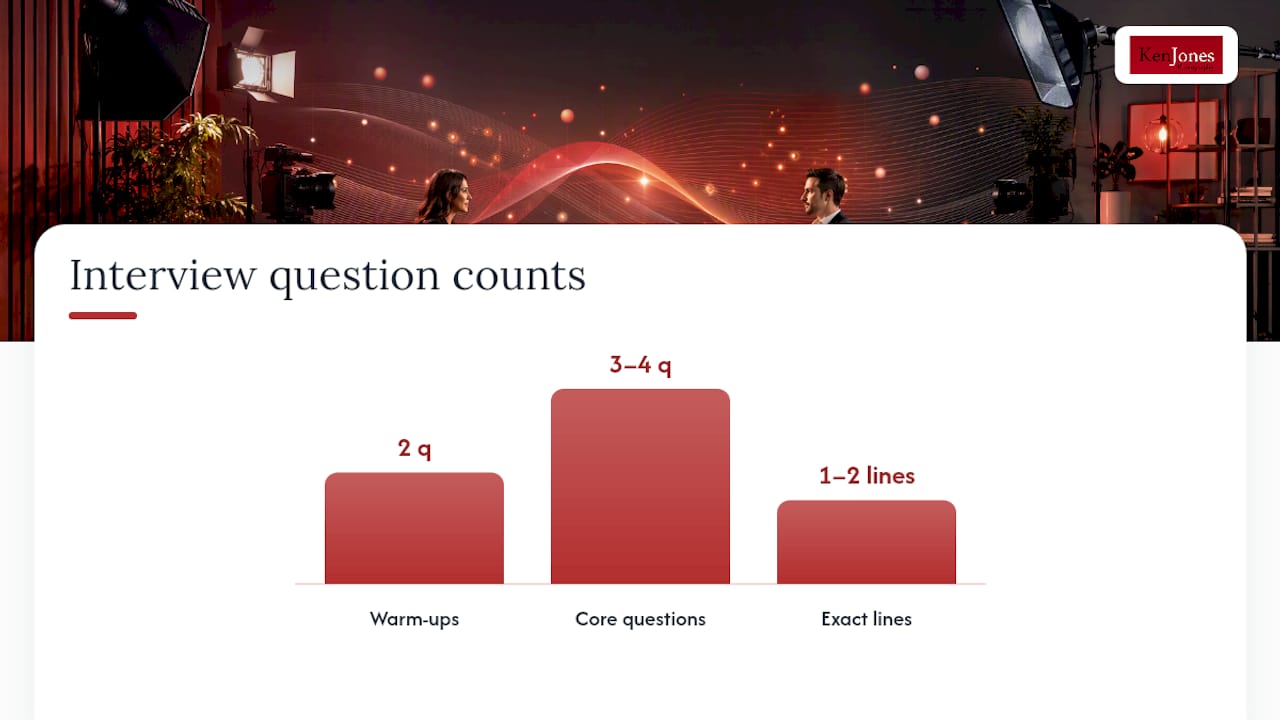
- Open with two low-stakes warm-up questions to settle nerves and check audio levels.
- Move into three or four core questions that ask for stories, numbers, or timelines.
- Save any line that must be phrased precisely, a legal statement or a tagline, for the end, and consider a teleprompter for that one moment rather than the whole interview.
A hybrid approach works best: free-flowing interview for substance, teleprompter only for the one or two lines that need to be exact.
On-Set Technical Checklist for Executive Interviews
This is where I’ve seen more shoots go sideways than any other stage, and it’s almost always audio. A brilliant answer with muffled or clipped sound is unusable, period.
Run a three-layer audio chain: a primary boom mic overhead, a hidden lavalier as backup, and a separate local recorder capturing both feeds independently. Audio redundancy with a boom, lav, and backup recorder is what separates a recoverable session from a wasted one when a wireless pack drops out mid-answer, which happens more often in Manhattan office buildings than most comms teams expect, thanks to elevator shafts and dense Wi-Fi.
On lighting and lenses: three-point lighting with consistent color temperature, paired with 85 to 100mm prime lenses, gives executives flattering, authoritative framing without the harsh look of a wide lens up close. Our interview lighting setup guide breaks down exactly how we build that look in a studio versus an office.
- Shoot multi-camera when the schedule is tight; it cuts down retakes and gives editors far more flexibility later.
- Frame slightly wide of center to leave room for lower-third graphics.
- Cover glass desks and glossy conference tables. Reflections and glare are the number one distraction reviewers flag.
- Pick wardrobe that reads as solid color, avoids fine patterns that strobe on camera, and matches the brand’s tone without looking like a costume.
Our wardrobe guidance for video interview shoots and tips on what makes a corporate interview look professional go deeper on both of these if you want the full breakdown.
How Do You Direct an Executive to Sound Natural on Camera?
The director’s real job is building rapport fast, because a nervous executive gives generic answers. A good director watches body language, adjusts pacing, and quietly signals the interviewer when to dig deeper or move on.
Decide early whether the interviewer sits on camera or stays off camera asking questions the executive answers directly to lens. On-camera interviewers create a conversational feel; off-camera keeps focus entirely on the executive, which most corporate videos want.
- Start with two throwaway questions purely to loosen shoulders and check comfort with the lens.
- Let silence sit. Executives often add their best line a few seconds after they think they’ve finished answering.
- Ask the same question two different ways if the first answer runs too long or drifts off message.
Turning One Shoot Into a Full Content Package
A single 45-minute session should never produce just one video. Planning a shoot as a package of modular deliverables, a hero cut, short social edits, and pull quotes, gets far more value out of the same production day than treating it as a one-off asset.
- Decide before the shoot which deliverables you need: a 2 to 3-minute hero video, 30 to 60 second social cuts, and three to five text pull quotes for slides or press.
- Capture b-roll and stills during natural pauses that visually back up whatever claims the executive makes in the interview.
- Match export specs to each channel (vertical for social, horizontal for the website) and note which platform gets which cut before post-production starts.
Amplifying that content once it’s cut is its own discipline. Teams that also invest in SEO support to extend the reach of executive video content tend to get more mileage out of the same footage over the following months.
How Long Should You Schedule for an Executive Interview Shoot?
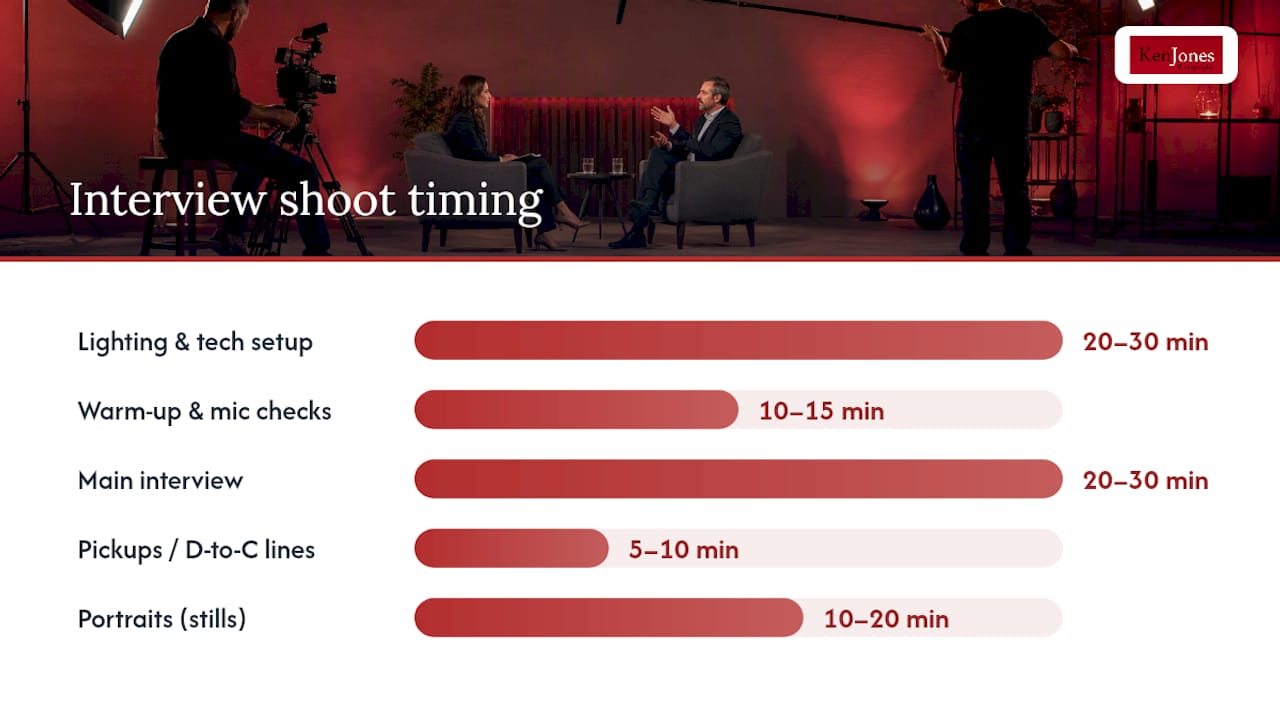
Twenty minutes on the calendar is a fantasy. Realistic shoot days run 45 to 90 minutes depending on wardrobe changes and how many deliverables you’re after.
A workable split looks like 20 to 30 minutes for lighting and technical setup, 10 to 15 minutes for warm-up and mic checks, 20 to 30 minutes for the main interview, 5 to 10 minutes for pickups or direct-to-camera lines, and 10 to 20 minutes for portraits if you’re grabbing stills while the lighting is already dialed in.
Budget drivers are mostly about crew size and location. A studio shoot with a controlled setup often runs faster and cheaper than an office location shoot, where you’re fighting ambient noise, window glare, and furniture you can’t move. Companies that film executives on a regular cadence, quarterly or twice a year, tend to get better results over time than teams doing a rushed one-off, because the crew, the questions, and the executive all improve with repetition.
A Shoot-Day Lesson Worth Remembering
Years ago, a comms team walked in assuming their CEO would just “talk naturally” with zero prep, no messaging outline, nothing. Forty minutes in, we had five minutes of usable footage because every answer wandered. We stopped, wrote three bullet points on an index card, and reshot the core questions. The footage transformed.
The lesson: preparation isn’t about scripting an executive into a robot. It’s about giving them just enough structure that their real expertise comes out clean. That index card probably saved the entire project.
— Ken
How Ken Jones Photography Supports Executive Interview Production
If your team needs a full production partner rather than a single freelancer juggling audio, lighting, and directing solo, a well-equipped studio team can fill that role. Where a lot of one-person crews force you to choose between good audio and good lighting because they’re running both alone, a dedicated team ensures nothing gets sacrificed on shoot day.

Our corporate interview video production service covers pre-production messaging outlines, wardrobe consultation, three-point lighting, redundant audio, and multi-camera setups, all managed so your executive’s time on camera is used well. If a studio environment suits your shoot better than an office location, our Fulton Street studio rental in Lower Manhattan gives you a controlled space without the glare and noise problems that come with borrowed conference rooms. Ready to plan a shoot? Visit Kenjonesnyc to check availability and get a quote for your next executive interview production.
Sources
- Executive Interview Video Production: What Actually Works
- Data-Driven Executive Interview Production: A Strategic 5-Point Checklist – iStudiosMedia
- How do you prepare executives for an on-camera interview? | Griffith Media
FAQ
How Long Does an Executive Interview Video Shoot Take?
Most shoots run 45 to 90 minutes once you account for lighting setup, warm-up, the main interview, pickups, and optional portraits. Booking only 20 to 30 minutes usually forces you to cut the pickups or the portraits, the parts that make the final package flexible.
What Questions Should You Ask an Executive on Camera?
Ask for specific stories, numbers, or timelines instead of broad opinion questions like “what makes us different.” Save any line requiring exact wording for a teleprompter moment near the end rather than scripting the whole interview.
Do You Need Backup Audio Equipment for an Executive Interview?
Yes. A three-layer chain of boom mic, hidden lavalier, and a separate local recorder protects the session if a wireless pack drops out, which is common in dense office buildings.
Can Ken Jones Photography Handle the Full Production, Including Studio Space?
Yes. Ken Jones Photography, KenJonesNYC, Ken Jones NYC, offers interview video production along with studio rental in Lower Manhattan, covering lighting, audio, wardrobe guidance, and post-production from one team. Current pricing is available on the studio’s website.
Should You Film Executive Interviews Once or on a Recurring Schedule?
A recurring schedule, quarterly or twice a year, tends to produce stronger results than a single rushed shoot because the crew and executive both get more comfortable with repetition. A one-off shoot still works well if the prep note and messaging outline are solid going in.