

The strongest album covers share one quality: they stop you cold before you read a single word. Whether you’re a music artist planning your first release or a creative director briefing a photographer, having a clear concept before the shoot is what separates a cover that defines a career from one that gets lost in a streaming grid. Here are ten distinct album cover photography concept examples, each with a named exemplar, a quick production note, and the genre it tends to serve best.
- Dramatic portrait — artist as subject, low-key lighting, tight crop. Study Lauryn Hill’s The Miseducation of Lauryn Hill: a single face, direct gaze, emotional weight. Studio shoot, one key light, minimal props.
- Staged narrative — a constructed scene that tells a story without words. Think Phoebe Bridgers’ Punisher: a figure in a skeleton suit against a suburban night. Requires set or location scouting, costume, and art direction.
- Location-driven environmental — artist placed in a meaningful real-world setting. Bob Dylan’s The Freewheelin’ Bob Dylan is the textbook: two people on a snowy Greenwich Village street. Permits may apply; weather is a variable.
- Architectural/street documentary — the building or street is the cover. Led Zeppelin’s Physical Graffiti used the Chelsea Hotel facade with figures in windows. No talent required; composition and light do the work.
- Abstract collage or mixed media — layered imagery, texture, found objects. Requires post-production compositing and a clear color palette brief.
- Minimalist negative space — one subject, one color field, maximum breathing room. Works across genres; demands precise lighting and a very clean set.
- Double exposure or surreal composite — two images merged in camera or post. Needs careful pre-visualization and a controlled studio environment.
- Still life / product as prop — objects stand in for the artist. Strong for electronic and ambient genres where anonymity is part of the brand.
- Documentary / live performance — candid energy, motion blur, available light. The Doors’ Morrison Hotel used a real hotel lobby with the band photographed through the window. Authentic, but requires fast editorial instincts.
- Typographic / graphic treatment — photography becomes a substrate for bold type. The image must leave a clear, uncluttered zone for the album title and artist name.
Album covers are broadly portrait-based or conceptual, and that single decision shapes everything downstream: lighting approach, location, wardrobe, and whether the image will anchor the artist’s visual identity for years. Decide which category you’re in before you book a single crew member.
Pro Tip: The single most common production mistake is failing to plan for the square-safe crop and the full asset pack before the shoot. If you compose only for a horizontal frame, you will lose critical image area when the label exports the square streaming thumbnail. Shoot square-aware from frame one.
Ken Jones Photography works with music artists and creative teams on exactly this kind of production planning, from concept through final file delivery.
Key Takeaways
The strongest album covers begin with a clear concept, a locked usage list, and a photographer who plans for every format before the shoot starts.
| Point | Details |
|---|---|
| Choose your concept category first | Decide between portrait-based and conceptual before booking crew — it determines lighting, location, and wardrobe. |
| Lock the usage list before the shoot | Square, vertical, horizontal, and social crops must be planned on-set, not retrofitted in post. |
| Brief tightly with a moodboard and shot list | A written creative brief and a numbered shot list eliminate on-set ambiguity and protect the budget. |
| Budget for the full production scope | Combined production costs for a mid-scope shoot typically run several thousand dollars; full production usually requires a significantly larger budget. |
| Ken Jones Photography delivers the complete asset pack | One production day at FultonStudio covers the cover hero, supporting portraits, and all platform formats. |
Table of Contents
- Album cover photography concept examples, grouped by photographic style
- How to turn a concept into a creative brief and shot list
- Technical execution: composition, lighting, and file specs
- Production checklist: crew, locations, permits, and budget
- Postproduction and layout: retouching, color grading, and typography safe zones
- A real production lesson from the studio
- Legal considerations and copyright in album cover photography
- What 30 years in NYC studios taught me about choosing a cover approach
- Ken Jones Photography brings full production to your cover shoot
- Sources
- FAQ
Album cover photography concept examples, grouped by photographic style
Every concept listed above belongs to a broader photographic style family. Understanding those families helps you brief a photographer precisely and choose the right gear, crew, and location for your budget.
Portrait-based concepts
The portrait approach puts the artist at the center. The emotional read has to land in a fraction of a second, which means lighting, expression, and framing carry everything.
Dramatic portrait. The hero frame is a tight or medium-tight shot, often with a single key light creating strong shadow on one side of the face. Lauryn Hill’s The Miseducation of Lauryn Hill is the reference point: the cover communicates intimacy and authority without a single prop. For a low-budget variant, a black seamless backdrop, one Profoto B10, and a 85mm lens on a full-frame body gets you there. A fully produced version adds a second light for a subtle rim, a makeup artist, and a wardrobe stylist. This concept suits R&B, soul, and singer-songwriter genres where the artist’s face is the brand.
Capture at least four image ideas on the day: a tight square crop (hero), a medium shot with headroom for vertical reels, a wider environmental frame for press, and a clean horizontal for Spotify Canvas or YouTube banners.
Minimalist negative space. One subject, one color field, deliberate emptiness. The challenge is that “simple” is technically demanding: the set must be immaculate, the light perfectly even or perfectly dramatic, and the subject’s posture has to read clearly at thumbnail size. This concept crosses genres well, from indie pop to electronic.
Pro Tip: When choosing between a portrait and a conceptual approach, ask one question: will the artist’s face still be recognizable to a new audience in five years? If yes, lead with the portrait. If the music is more about a world or a feeling than a persona, go conceptual. That single decision should drive every other production choice.
Staged narrative concepts
Staged narrative covers construct a scene. Phoebe Bridgers’ Punisher is the clearest modern example: a figure in a skeleton suit photographed in a suburban setting at night. The image is strange, specific, and immediately memorable. Award-winning covers rely on visceral, attention-stopping imagery — ask whether your concept will hold a viewer’s curiosity even without any text on the frame.
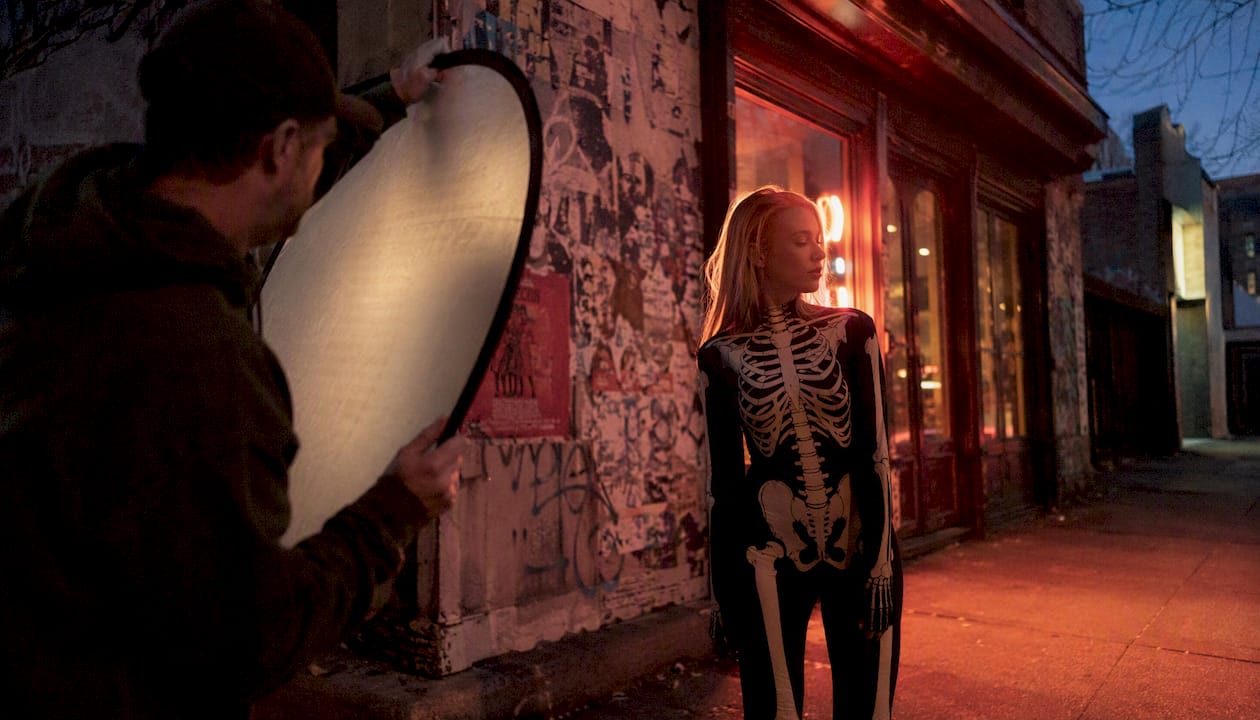
Low-budget variant: one location, one costume, available or single-light setup. Fully produced: a location scout, art director, prop stylist, gaffer, and a controlled lighting rig. Staged narrative suits indie, alternative, folk, and art-pop genres where storytelling is part of the artist’s identity.
For the shot list, capture the hero square, two supporting portraits of the subject in the scene, three detail stills of props or environmental elements, one wide establishing shot of the location, and one vertical for reels.
Location-driven and documentary concepts
Location-driven covers use the environment as a co-subject. Bob Dylan’s The Freewheelin’ Bob Dylan works because the setting — a specific New York City street in winter — is inseparable from the mood. The Doors’ Morrison Hotel went further: the band was photographed through a real hotel lobby window, giving the image a candid, almost stolen quality.
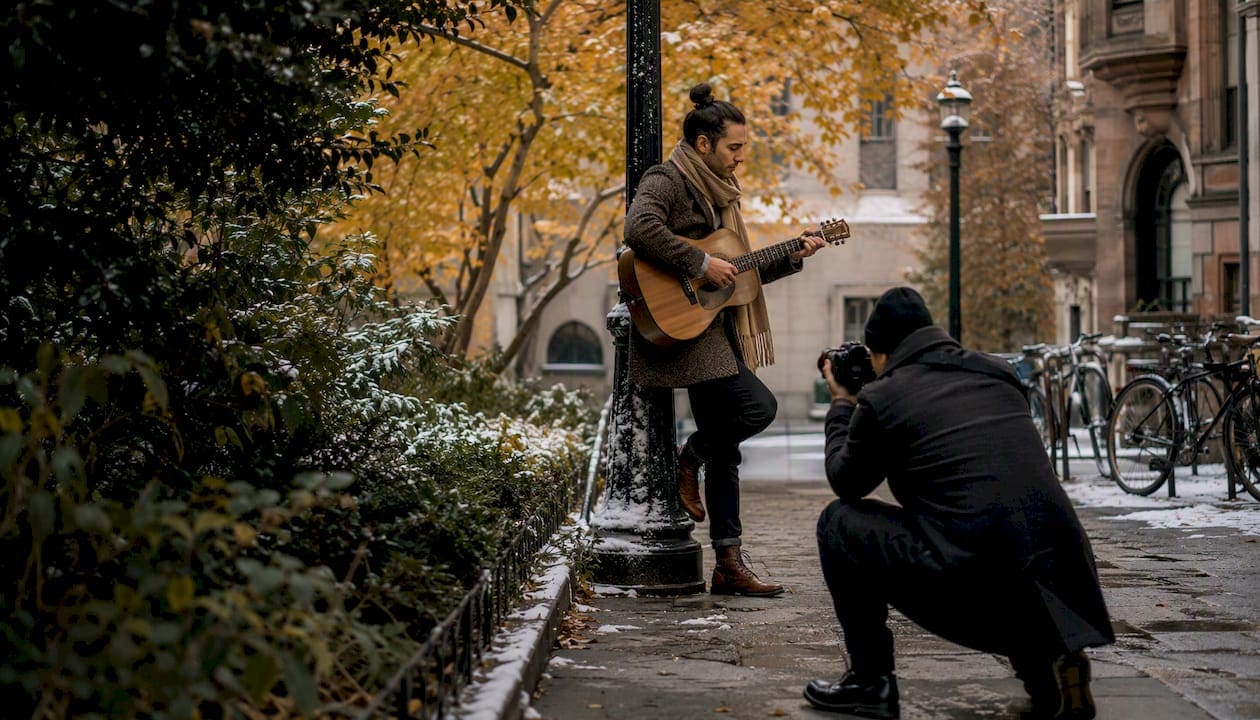
A location-driven concept benefits from embedding meaningful found objects and framing for close viewing; tuning placement and composition on-set can produce multiple viable cover candidates in minutes. Scout the location in the same light conditions you plan to shoot. For NYC shoots, check permit requirements through the Mayor’s Office of Media and Entertainment before you commit to a public space.
When photographing a band, pitch and pre-select locations and compositions in advance, and capture square crops and multiple orientations on-set to give the label usable options. This is not optional — retrofitting a horizontal composition into a square after the fact almost always costs you the best part of the image.
Genre suitability: folk, Americana, indie rock, hip-hop (urban environments), country.
Abstract, double exposure, and mixed-media concepts
These concepts live in post-production as much as on-set. A double exposure requires a controlled studio environment and careful pre-visualization: you need to know which two images will merge before you shoot either one. Abstract collage and mixed-media treatments demand a clear color palette brief and a designer who will work with the photographer’s files, not against them.
Shooting with film vs. digital changes not just the final look but the way the session is run — film demands discipline and reduces choices, which can help with conceptual clarity for a hero cover. Medium-format film, in particular, produces a tonal quality that digital compositing often tries to replicate.
Genre suitability: electronic, ambient, experimental, metal, art-pop.
How to turn a concept into a creative brief and shot list
A concept is just an idea until it’s written down in a form a photographer, stylist, and art director can all work from. The creative brief does not need to be long. It needs to be specific.
Creative brief template:
- Goal: What is this image for? (Album cover, streaming profile, press kit, merchandise, social)
- Hero image: One sentence describing the single frame the cover must deliver
- Mood references: Three to five images (not necessarily music-related) that capture the emotional tone
- Color palette: Two to four colors, with notes on whether they’re dominant or accent
- Typography considerations: Where will the album title and artist name sit on the square? Is there a clear zone for type, or will the designer need to work around the image?
- Usage list: Square cover (3000 x 3000px minimum), vertical for reels (1080 x 1920px), horizontal press image (3:2 or 16:9), streaming profile circle crop, merchandise applications
Plan your shoot as an asset pack — square hero, verticals, horizontals, and short clips — and decide formats and usage before the shoot to guarantee visual cohesion across every platform. Artists who skip this step routinely discover, after the shoot, that they have a beautiful cover image and nothing that works for their Instagram Stories or Spotify profile.
Sample shot list for a staged narrative concept:
- Hero square — subject in full costume, mid-shot, centered in scene, square-safe composition
- Supporting portrait A — tighter crop, face and shoulders, same lighting
- Supporting portrait B — three-quarter turn, different expression
- Detail still A — key prop close-up
- Detail still B — environmental texture or background element
- Detail still C — costume or accessory detail
- Location wide — full scene, subject small in frame, for press and editorial use
- Vertical reels frame — subject centered, headroom and footroom for 9:16 crop
Communicate reference images to the photographer through a shared folder or a simple PDF moodboard, not a text description alone. A visual reference eliminates ambiguity faster than any written note.
One legal reminder: secure signed talent releases for every person who appears on camera, clear prop rights for any branded or recognizable objects, and confirm location permissions before the shoot day. This is not a post-production problem — it’s a pre-production one.
For pre-shoot preparation guidance that applies equally to music artist sessions, the wardrobe, posing, and lighting prep framework developed for corporate shoots translates directly to album-cover planning.
Technical execution: composition, lighting, and file specs
The square crop is non-negotiable. Every compositional decision on-set must account for the 1:1 frame that will appear on streaming platforms, even when you’re shooting on a 3:2 or 4:3 sensor.
Composing for square while shooting multiple orientations
Mentally draw a square inside your viewfinder and keep the hero subject within it. Leave additional space above and below for the horizontal press crop, and additional space on the sides for the vertical reels frame. Photographers should treat themselves as the output for the artist’s creative process, shooting square-aware compositions and collaborating closely with the band and art director — not defaulting to whatever orientation feels natural in the moment.
A practical method: mark the square safe zone on a monitor or use in-camera crop overlays if your body supports them. Shoot the hero frames in that zone, then deliberately open the frame for supporting assets.
Four lighting setups matched to specific concepts
Low-key dramatic portrait (for R&B, soul, hip-hop): One large key light (softbox or beauty dish) at 45 degrees, no fill or a very weak fill at 4:1 ratio, dark background. The shadow side of the face should hold detail but read as shadow. A subtle hair light separates the subject from the background.
Natural-location daylight (for folk, Americana, singer-songwriter): Shoot in open shade or during the golden hour. A collapsible reflector on the shadow side opens the face without killing the ambient mood. Avoid direct midday sun — it creates unflattering shadows and blows out highlights in ways that are difficult to recover in post.
High-key minimal (for pop, indie pop, electronic): Large softboxes on both sides of the subject, a white or light-gray background lit separately to pure white. The goal is even, shadow-free light with a slight gradient on the background to avoid a flat, clinical look.
Controlled studio mixed-light for surreal or double exposure (for experimental, ambient, art-pop): Combine a hard key light with a colored gel on a background light. The contrast between a neutral subject and a saturated background creates the separation needed for compositing. Shoot the background plate and the subject plate in the same session under the same ambient conditions.
For creative portrait studios for music artists, the lighting setup and studio configuration are as much a part of the concept as the costume or location.
File specs and deliverables
| Deliverable | Spec | Notes |
|---|---|---|
| Native RAW files | Camera native (CR3, ARW, NEF) | Archive; not for delivery to label |
| Retouched master TIFF | 16-bit, Adobe RGB, 300 DPI | Print and merchandise use |
| Square streaming export | JPEG, sRGB, 3000 x 3000px | Spotify, Apple Music, streaming platforms |
| Vertical reels export | JPEG, sRGB, 1080 x 1920px | Instagram Reels, TikTok, YouTube Shorts |
| Horizontal press export | JPEG, sRGB, 3:2 or 16:9 crop | Press kits, EPKs, editorial |
Pro Tip: Medium-format digital (Fujifilm GFX, Hasselblad X2D) produces a tonal gradation in skin and fabric that full-frame sensors approach but rarely match at equivalent print sizes. For a cover that will appear on vinyl or large-format merchandise, the medium-format advantage is real. For streaming-only releases, a well-lit full-frame body is entirely sufficient.
Production checklist: crew, locations, permits, and budget
The scope of your shoot determines the crew. A solo artist portrait in a controlled studio requires far fewer people than a full set build with multiple looks.
Crew by shoot scope
Minimal (solo portrait, studio): Photographer, one lighting assistant, makeup artist. Budget band: lower end of a half-day studio rate plus talent and crew fees.
Mid-scope (staged narrative or location): Photographer, art director or creative director, stylist, hair and makeup artist, gaffer or lighting tech, production assistant. A location scout fee if the location is new to the team.
Full production (set build, multiple looks, band): All of the above plus a grip, a set designer or prop stylist, a second photographer’s assistant, and a retoucher on call. Multi-day shoots add a producer.
Location planning and permits
For NYC shoots, the Mayor’s Office of Media and Entertainment issues film permits for public locations. Some locations require permits for any commercial photography; others are permit-free for small crews. Always confirm before the shoot day — a permit problem on the morning of a shoot is expensive and stressful. Have a backup interior location identified for weather contingencies, particularly for fall and winter shoots.
For the decision between studio and location, the environmental vs. studio approach framework covers the trade-offs in control, lighting continuity, and cost clearly.
Budget ranges and timeline
Commissioning artwork and planning photoshoots together establishes a sustained visual world for an album and often requires a combined budget of several thousand dollars when production, wardrobe, and makeup are included. The figures below reflect U.S. market rates.
| Scope | Crew | Timeline | Budget Band |
|---|---|---|---|
| Minimal (studio portrait) | 2–3 people | Half day | $1,500 |
| Mid-scope (location or set) | 4–6 people | Full day | $4,000 |
| Full production (set build, multi-look) | 7 people | Full day to multi-day | $10,000 |
Props and set notes: build a set when the concept requires a controlled environment that doesn’t exist in the real world. Source found objects when the concept calls for authenticity or texture. Maintain a prop continuity log — photograph the set from multiple angles before talent arrives so you can reset between looks without guessing.
A structured shoot timeline with defined setup, creative core, and wrap phases reduces delays and eliminates last-minute creative indecision. Build the timeline into the call sheet and share it with every crew member the day before.
If you’re planning a combined photo and video day, one production day can deliver both photo and short-form video assets with the right crew configuration, which significantly reduces the per-asset cost.
Postproduction and layout: retouching, color grading, and typography safe zones
The shoot delivers raw material. Postproduction is where the cover becomes a cover.
Deliverable list for a complete asset pack:
- Master RAW files (archived, not delivered)
- Retouched master TIFF (16-bit, Adobe RGB)
- Square streaming JPEG (3000 x 3000px, sRGB)
- Vertical crop for reels and Stories (1080 x 1920px)
- Horizontal press JPEG (3:2 or 16:9)
- Social profile circle crop (minimum 640 x 640px, but deliver at 3000 x 3000px and let the platform crop)
Retouching priorities
Skin and light cleanup come first, but texture preservation matters as much as smoothing. A cover that looks over-retouched loses the authenticity that makes a portrait compelling. Maintain highlight detail in the hero shot — blown-out skin or fabric is difficult to recover and reads as amateur at large print sizes. Match the color grade across the entire asset pack so the square cover, the vertical reels frame, and the press image all feel like they came from the same world.
Color grading should reinforce the genre cue. Warm, slightly desaturated grades suit folk and Americana. High-contrast, cooler grades work for hip-hop and R&B. Saturated, graphic color suits pop and electronic. Muted, filmic grades with lifted blacks suit indie and alternative. These are tendencies, not rules — breaking the genre grammar deliberately is a legitimate creative strategy.
Typography safe zones
The album title and artist name typically sit in the lower third or upper third of the square frame. Keep a clear, relatively low-contrast zone in one of those areas during the shoot — a slightly out-of-focus background, a dark shadow area, or a plain color field. Brief the photographer on where the type will land before the shoot, not after. Retrofitting a typography zone in post almost always means cropping into the image or adding a gradient overlay that weakens the photograph.
Pro Tip: Export a low-resolution JPEG of the hero frame and drop it into a simple Photoshop or Canva template with placeholder type before you finalize the retouch. If the type placement looks forced, adjust the crop or the grade while you still have the full file open. This five-minute check saves hours of back-and-forth with the designer.
For social media asset planning that pairs with a cover shoot, guidance on capturing vertical and short-form assets is worth reviewing before you finalize the shot list.
A real production lesson from the studio
A music artist came into the FultonStudio with a clear concept: a dramatic portrait, dark background, single strong light, minimal wardrobe. The brief was tight and the reference images were good. The shoot went well. The hero square was strong.
The problem surfaced two weeks later, when the label asked for a vertical asset for Instagram Reels and a horizontal image for the press kit. The hero frame was composed so tightly for the square that there was no usable headroom for a 9:16 crop and no background space for a 16:9 press image. Every crop either cut the top of the artist’s head or revealed the edge of the seamless backdrop.
The lesson isn’t “shoot looser.” It’s “shoot the square hero tight, then deliberately open the frame for the asset pack before you move to the next setup.” Those are two distinct compositions, and both need to happen under the same light, in the same session, before the talent changes wardrobe.
The fix in production is straightforward: after locking the hero square, step back two feet, reframe for vertical headroom, shoot five frames, then rotate the camera and shoot the horizontal. The whole sequence takes four minutes. Skipping it costs a reshoot.
Photographers should treat themselves as the output for the artist’s creative process — which means thinking about every format the image will live in, not just the one that looks best in the viewfinder.
Pro Tip: Build the asset-pack sequence into the shot list as a mandatory block, not an afterthought. Label it “asset pack frames” and give it a time allocation on the call sheet. When it’s on the schedule, it happens. When it’s not, it gets skipped in the rush to wrap.
Legal considerations and copyright in album cover photography
Copyright in album cover photography involves several overlapping rights, and getting them wrong is expensive. Here’s what creative teams need to understand before the shoot.
Photographer’s copyright. Under U.S. copyright law, the photographer owns the copyright to images they create unless a written work-for-hire agreement transfers ownership to the client. Most commercial photographers license specific usage rights rather than transferring full copyright. Confirm in writing exactly what rights you are licensing: format (digital, print, merchandise), territory (U.S. only, worldwide), duration (one year, perpetual), and exclusivity.
Talent releases. Every person who appears recognizably in the cover image needs a signed model release authorizing commercial use of their likeness. This includes background figures in a location shoot. Without a release, the image cannot be used commercially, regardless of who owns the copyright to the photograph.
Location releases. Shooting on private property requires a location release from the property owner. Some public locations — particularly in New York City — have specific rules about commercial photography. Iconic architectural elements (certain building facades, sculptures, and public artworks) may carry their own copyright protections. Confirm clearance for any recognizable structure before the shoot.
Props and branded items. If a prop carries a visible brand logo or trademark, its inclusion in a commercial image may require clearance from the brand owner. This applies to clothing labels, product packaging, vehicle logos, and artwork visible in the background.
Music samples and cover art. If the album cover incorporates existing artwork, photography, or graphic elements created by someone else, those elements require a license from the original rights holder. Collage and mixed-media concepts carry the highest risk here.
Secure all releases and clearances before the shoot day. A rights problem discovered after the image is printed on 10,000 vinyl sleeves is a significantly larger problem than one caught in pre-production.
This section provides general information about copyright and rights clearance. It is not legal advice. Consult a qualified entertainment or intellectual property attorney for guidance specific to your project.
What 30 years in NYC studios taught me about choosing a cover approach
The portrait vs. conceptual decision is the one that matters most, and most artists make it too late. By the time they’re on set, they’ve already committed to a location, a wardrobe, and a crew — and changing direction costs real money.
The framework is simple. If the artist’s face is already their brand — if fans recognize them, if the music is personal and confessional, if the touring merch will feature their image — lead with a portrait. The face is the anchor. Everything else supports it. If the music is more about a world, a feeling, or an idea than a persona, go conceptual. The concept will age better, travel further across merchandise and stage design, and give the art director more to work with.
Genre signals matter, but breaking them deliberately is often the right call. A hip-hop artist who shoots a quiet, intimate portrait when the genre expectation is bold and graphic creates a contrast that gets attention. A folk artist who shoots a surreal double exposure when the expectation is a pastoral location image does the same. The cover that surprises within a genre context tends to get more editorial attention than the one that confirms expectations.
One practical decision rule: if you can describe the cover concept in one sentence and a stranger immediately understands the emotional tone, it’s a strong concept. If you need three sentences and a moodboard to explain it, simplify before you shoot.
Ken Jones Photography brings full production to your cover shoot
Music artists working on album covers need more than a photographer who can operate a camera. They need a production partner who can translate a concept into a shoot plan, coordinate crew, and deliver a complete asset pack in a single day.
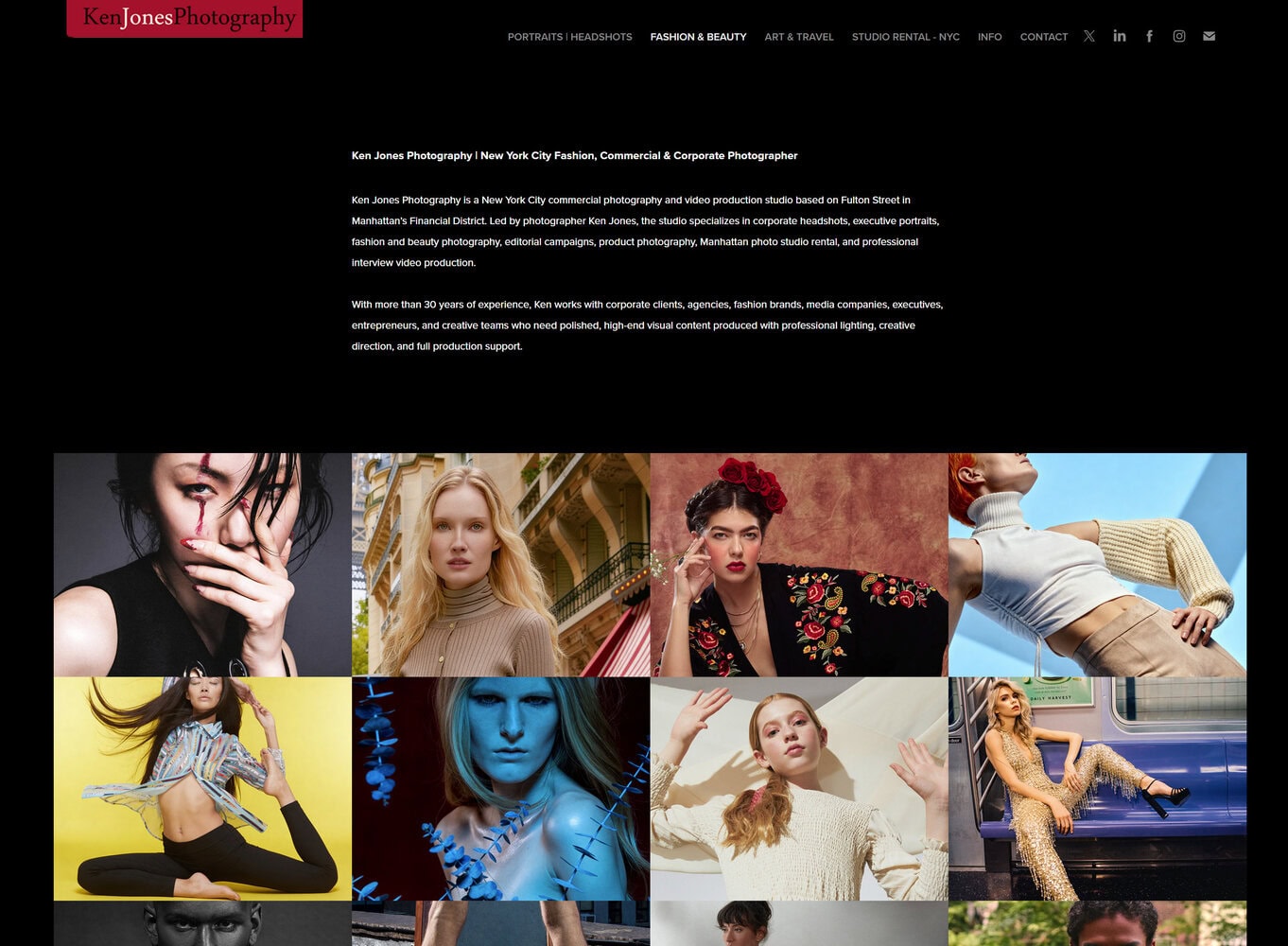
Ken Jones Photography offers full creative direction, casting support, styling coordination, hair and makeup, lighting, studio rental at FultonStudio in Manhattan’s Financial District, retouching, and final file delivery. The fashion editorial portfolio shows the kind of story-driven, concept-led production that translates directly to album-cover work. For artists who need a controlled studio environment with flexible lighting configurations, FultonStudio rental is available for half-day and full-day bookings.
A single production day at Ken Jones Photography is structured to deliver the complete asset pack: square hero, vertical reels frames, horizontal press images, and supporting portraits, all under consistent light and direction. Contact the studio at Kenjonesnyc to discuss your concept and request a production quote.
Sources
- A Guide to Photo Shoots For Artists That Covers Press, Streaming Profiles, And Social – Magnetic Magazine
- Album cover photography in a Toronto photo studio — That Toronto Studio
- Photographing a Band for Their Album Cover | Envato Tuts+
FAQ
What are some strong album cover photography concept examples?
The ten most adaptable concepts are dramatic portrait, staged narrative, location-driven environmental, architectural/street documentary, abstract collage, minimalist negative space, double exposure, still life with props, documentary/live, and typographic treatment. Named exemplars include Lauryn Hill’s The Miseducation of Lauryn Hill (portrait), Phoebe Bridgers’ Punisher (staged narrative), Bob Dylan’s The Freewheelin’ Bob Dylan (location), and Led Zeppelin’s Physical Graffiti (architectural).
How do you come up with an idea for an album cover?
Start with the music’s emotional core and decide whether the artist’s face or a constructed concept better represents it. Build a one-sentence hero image description, gather three to five mood reference images, and confirm the color palette before briefing a photographer.
Do you need permits to shoot an album cover in New York City?
Commercial photography on public property in NYC typically requires a permit from the Mayor’s Office of Media and Entertainment. Private locations require a signed location release from the property owner. Confirm requirements before the shoot day to avoid delays.
What file formats should an album cover photographer deliver?
The standard deliverable set includes a retouched master TIFF (16-bit, Adobe RGB, 300 DPI), a square streaming JPEG (3000 x 3000px, sRGB), a vertical crop (1080 x 1920px), and a horizontal press image. Native RAW files should be archived by the photographer.
How many images should you plan to capture in one album cover shoot?
A well-structured shot list covers the square hero, two to three supporting portraits, three detail stills, one wide establishing frame, and one vertical reels composition — roughly eight to twelve distinct setups. Planning these in advance, as part of a written shot list, is what separates a productive shoot day from one that runs over time and budget.