
TL;DR:
- A studio headshot features controlled lighting and a neutral background, ideal for formal professional use. An environmental headshot places the subject in a meaningful location that communicates their profession or brand. Many professionals benefit from a hybrid approach, combining both styles in a single shoot to meet diverse branding needs.
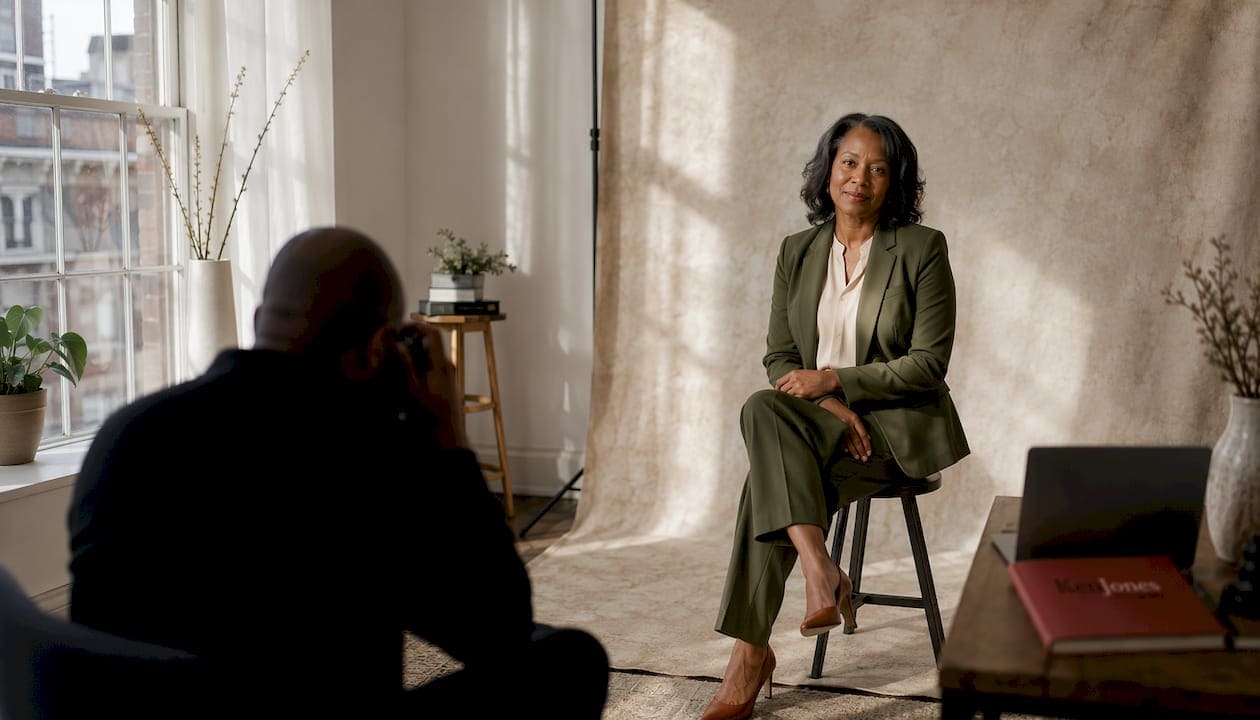
A studio headshot is taken against a seamless backdrop with controlled artificial lighting; an environmental headshot places you in a real-world setting where the background actively communicates your profession or brand. For most LinkedIn profiles, corporate directories, and press submissions, a studio headshot is the right call. If your location is part of your value proposition — a chef in their kitchen, a designer in their studio, a founder on a trading floor — an environmental portrait does work that a neutral backdrop simply cannot.
Quick orientation before you go deeper:
- Studio headshot: controlled lighting, seamless or plain backdrop, full focus on your face and expression, consistent across a team
- Environmental headshot: real or meaningful location, ambient or mixed light, background adds professional context
- Hybrid need: many professionals benefit from both — one clean studio image for formal use, one environmental set for the website and social
- What follows: a side-by-side comparison, use-case mapping by platform and industry, preparation guidance, cost bands, and the exact questions to ask your photographer
Table of Contents
- What is the difference between a studio and environmental headshot?
- How do the two styles compare across cost, control, and message?
- Which style fits your platform and industry?
- How do you decide? A practical checklist and questions to ask
- How to prepare for your shoot: wardrobe, grooming, and on-set behavior
- Can a studio replicate an environmental look?
- What do studio and on-location shoots typically cost and how long do they take?
- A real production example from Ken Jones Photography
- Key Takeaways
- What most clients get wrong when choosing a headshot style
- Ready to book your studio or on-location headshot in NYC?
- Useful sources and further reading
- FAQ
What is the difference between a studio and environmental headshot?
A studio headshot is produced in a controlled indoor setting using strobes, modifiers, and a seamless or plain backdrop. Every visual variable — light direction, shadow depth, background tone — is set by the photographer. The result is a clean, technically precise image where nothing competes with your face. Retouching is straightforward because the background is uniform, and the look can be replicated exactly for a second subject or a reshoot six months later.
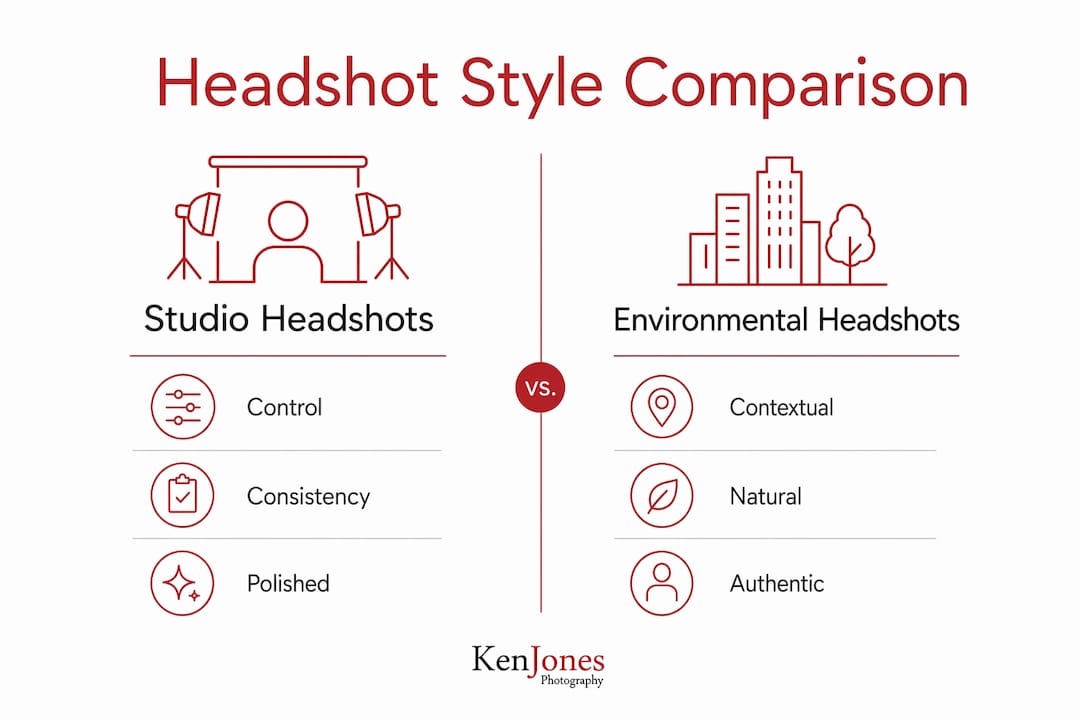
An environmental headshot places you in a location that is connected to your work or life: an office, a restaurant, a construction site, a design studio, a city street. The background is not decoration — it is information. Ambient light, window light, or a blend of natural and portable strobe sources creates a feel that is more relaxed and contextual than a studio image. The technical quality can be identical to studio work; the difference is in what the image communicates.
Visually, the signs are easy to read. Studio images show a clean, often gradient background with no environmental cues, hard or soft directional light from a single controlled source, and shallow depth of field that keeps the subject sharp against a neutral field. Environmental portraits show recognizable architectural or natural elements, often with a slightly longer depth of field that keeps enough background detail to read the location, and light that may come from a window, overhead source, or a mix of both.
How do the two styles compare across cost, control, and message?
Perception and message
Studio headshots read as polished, authoritative, and platform-ready. They signal that you take your professional image seriously. Environmental portraits read as contextual and story-driven — they answer the question “what do you do?” before the viewer reads a single word of your bio.
Control and consistency
Studio sessions remove weather, ambient-light variability, and scheduling risk. When a company needs 40 matching headshots across two shoot days, studio is the only practical answer. On-location work introduces variables the photographer must manage in real time: shifting cloud cover, mixed color temperatures, foot traffic, and permit requirements.
Production complexity
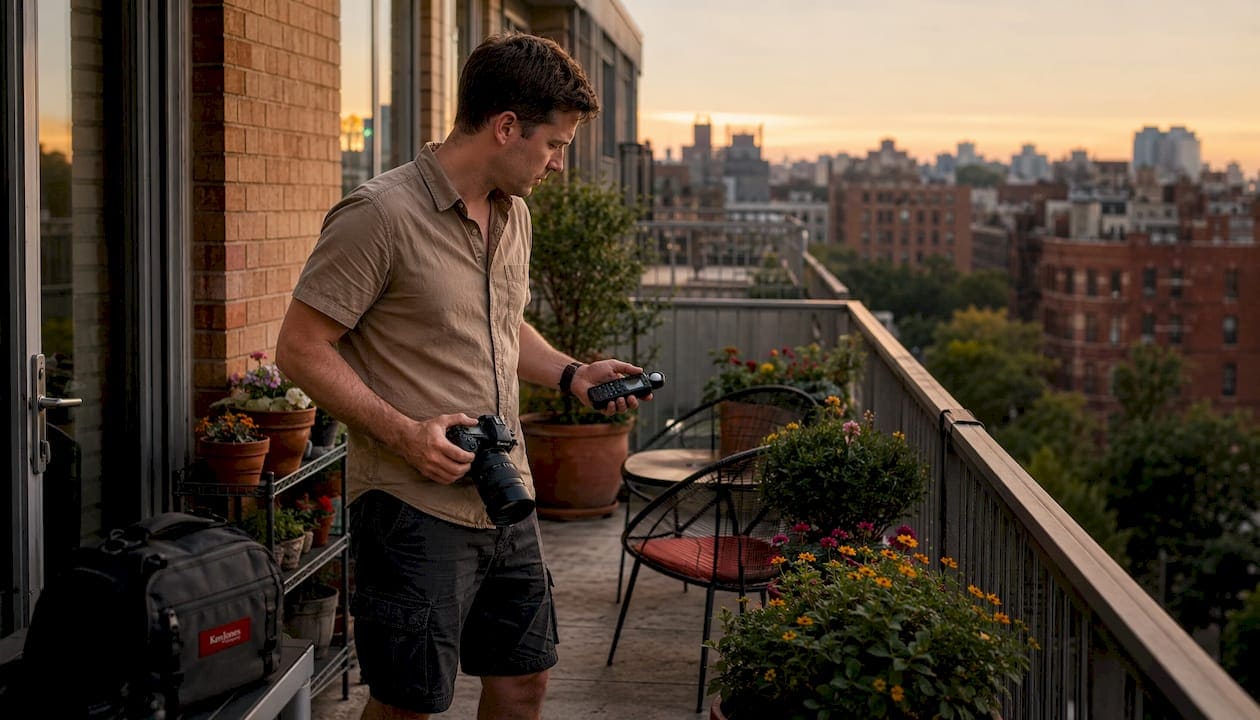
A studio shoot requires a camera, a lighting kit, a backdrop, and a competent operator. An on-location shoot adds scouting, travel, permits in some cases, a backup plan for weather, and the skill to blend ambient and portable strobe sources. Neither is inherently harder, but the margin for error is narrower outdoors.
Pros and cons at a glance
Studio headshots
- Consistent, repeatable results across a team
- No weather or permit risk
- Faster turnaround on retouching
- Easier to match a future reshoot
- Background adds no context or storytelling
Environmental headshots
- Background reinforces your professional identity
- More natural, relaxed feel
- Stronger for brand storytelling and social content
- Higher production complexity and cost
- Harder to replicate for a team or a later reshoot
Pro Tip: Environmental context can backfire when the location is visually busy but professionally irrelevant. A real estate agent photographed in a coffee shop looks like they work at a coffee shop. The location must be legible — a viewer should understand your profession within two seconds of seeing the image.
Comparison summary
| Dimension | Studio headshot | Environmental headshot |
|---|---|---|
| Perception / message | Polished, authoritative, neutral | Contextual, story-driven, personality-forward |
| Control & consistency | High — fully repeatable | Lower — ambient variables apply |
| Production complexity | Low — studio, lighting kit, backdrop | Higher — scouting, permits, travel, backup plan |
| Cost & time | Lower starting cost | Price premium for travel, scouting, permits |
| Best for | Corporate, LinkedIn, press, team pages | Brand sites, editorial, social, founder profiles |
| Deliverables | Clean crops, consistent retouch | Varied compositions, wider aspect ratios |
Which style fits your platform and industry?
Platform and audience should drive the decision as much as personal preference. Editorial and press subjects expect location context; corporate viewers expect uniformity and neutrality. Here is how that maps in practice.
| Platform / use case | Recommended style | Rationale |
|---|---|---|
| LinkedIn profile | Studio | Clean, authoritative, loads well at small sizes |
| Corporate directory / team page | Studio | Consistency across the team matters most |
| Press release / media kit | Studio | Editors need a neutral, print-ready image |
| Personal website hero | Environmental | Location reinforces your brand story |
| Social media (Instagram, X) | Environmental | Context and personality drive engagement |
| Editorial feature | Environmental | Story benefits from location detail |
| Speaking / conference bio | Studio | Neutral image works across all event contexts |
| Founder / entrepreneur profile | Either or both | Depends on whether location adds credibility |
Industry shapes the choice just as clearly. Lawyers, finance professionals, HR directors, and consultants almost always benefit from a clean studio image — their clients expect formality and neutrality. Real estate agents, chefs, designers, and entrepreneurs often gain more from an environmental portrait because the location reinforces their credibility directly. A chef photographed in their kitchen communicates expertise that no bio paragraph can match. A fashion designer photographed in their atelier signals creative authority before the viewer reads a word.
Hospitality professionals, fitness trainers, architects, and artists tend to fall in the environmental camp for the same reason: their workplace is part of their value proposition. Corporate executives at large organizations almost always need the studio version for official communications, even if they also want an environmental set for their personal brand.
How do you decide? A practical checklist and questions to ask
Work through these five questions in order before you book anything.
- Primary use: Where will this image appear first — LinkedIn, a company directory, a press kit, or your own website? That platform’s conventions should anchor the decision.
- Audience: Who will see it, and what do they expect? A corporate recruiter expects neutrality; a design client expects personality.
- Durability: How long does this image need to last? Studio images age better because they carry no location-specific context that can feel dated.
- Environment importance: Does your workplace or surroundings add meaningful information about what you do? If yes, environmental. If no, studio.
- Budget and timeline: Do you have time to scout a location, secure permits if needed, and build in a weather backup? If the answer is no, studio is the lower-risk choice.
Questions to ask any photographer before booking
- What lighting setup do you use for studio sessions, and can you show me examples of your key-fill pattern?
- For on-location work, do you scout the site in advance, and at what time of day?
- What is your backup plan if the location has poor light or weather forces a change?
- Do you handle permits, or is that the client’s responsibility?
- How many final retouched images are included, and what does the retouch cover (skin, background cleanup, color correction)?
- What file formats and resolutions do you deliver, and do usage rights cover web, print, and social?
- How long from shoot day to final delivery?
Red flags to watch for
- Portfolio shows the same background for every subject, regardless of industry
- Lighting is inconsistent across team headshots (different shadows, different color temperatures)
- No mention of scouting or a backup plan for outdoor shoots
- Vague answers about retouching scope or file delivery
- No discussion of usage rights or licensing
When you need both styles, ask about a split session: a short studio set first for the clean corporate images, then a move to a location for the environmental work. Many photographers can cover both in a single production day, which reduces cost and keeps the look consistent.
How to prepare for your shoot: wardrobe, grooming, and on-set behavior
Wardrobe by style
For studio headshots, solid colors and minimal patterns are the standard guidance, and it holds for good reason. Against a neutral backdrop, a busy pattern pulls the eye away from your face. Navy, charcoal, deep burgundy, and warm neutrals photograph cleanly under studio light. Avoid pure white next to a white backdrop — you will lose definition at the shoulder. Layering works well: a jacket over a simple top gives the photographer options without adding visual noise.
For environmental shoots, you have slightly more flexibility. A bit of texture — a linen blazer, a knit, a structured jacket — can complement a location’s architectural detail. The rule is that your wardrobe should harmonize with the background tone, not fight it. If the location has warm brick tones, cool blues and grays read well. If it is a modern glass office, cleaner lines and neutral tones keep the image cohesive. Check the wardrobe guidelines for professionals before your session if you are unsure.
Grooming and makeup
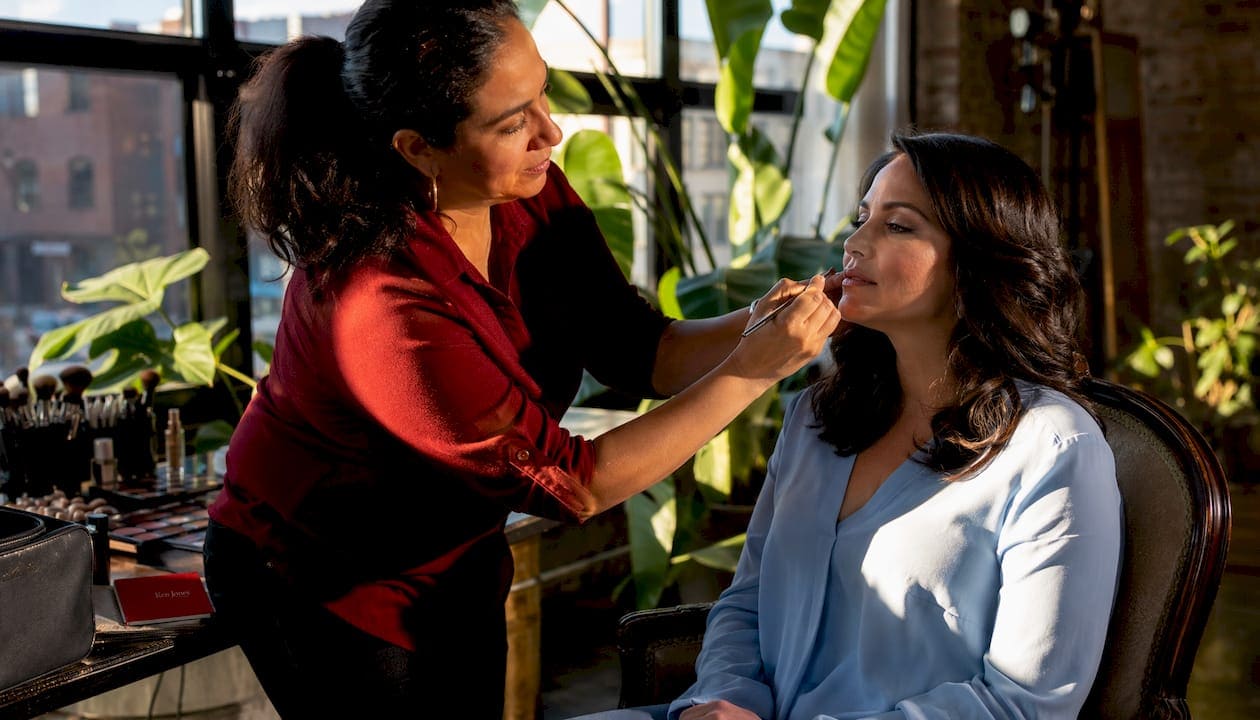
Camera-ready skin matters in both formats, but studio lighting is less forgiving. Strobes reveal texture, shine, and uneven tone more clearly than ambient light. A light matte foundation or powder reduces shine without looking heavy on camera. For environmental shoots with window or natural light, the same principle applies — diffuse light is flattering but still picks up skin texture at close range. Arrive with clean, styled hair. If the shoot includes hair and makeup services, plan to arrive 45–60 minutes before the first frame.
Props and on-set behavior
In environmental shoots, props that are genuinely part of your work — a chef’s knife, an architect’s drawings, a designer’s sketchbook — can add authenticity. Props that are staged or generic almost always read as staged. When in doubt, leave them out. On set, take five minutes before the session to loosen up: roll your shoulders, breathe, and let your expression settle. The first ten frames of any session are usually the warmup. A good photographer will tell you this; a great one will build it into the schedule. Review preparation notes for executive sessions for a full pre-shoot checklist.
Can a studio replicate an environmental look?
Yes, with limits. Hybrid approaches let you get some of the contextual feel of an environmental portrait without the production complexity of a true location shoot.
Common hybrid techniques:
- Window-light studio setup: positioning the subject near a large window creates soft, directional natural light that reads as environmental without leaving the building
- Environmental props: a desk, a bookshelf, a plant, or architectural elements placed in the studio frame add context without requiring a location permit
- Simulated backgrounds: printed or projected backgrounds can suggest a location, though they rarely achieve the depth and authenticity of a real setting
- Portable backdrops on location: a clean backdrop brought to an office or lobby gives you studio-level control in a real-world space
A practical example: a financial services firm needed both formal headshots and something warmer for their website’s “About” page. Rather than booking a separate location day, the photographer set up a window-light station in the office’s conference room, using the city view as a soft background element. The result read as environmental without the permit, travel, or weather risk of an outdoor shoot.
Pros of hybrid options:
- Lower cost than a true location shoot
- More control over light and background than a real environment
- Faster turnaround and easier scheduling
Cons:
- Simulated backgrounds rarely achieve the depth of a real location
- Props can look staged if not chosen carefully
- Window light is time-dependent — you have a limited window (literally) to shoot
When to prefer a true location: if the location itself is the credential — a Michelin-starred kitchen, a recognized architectural space, a landmark NYC setting — no studio simulation will carry the same weight. The authenticity of the real place is the point.
What do studio and on-location shoots typically cost and how long do they take?
Cost varies by market, photographer experience, and production scope. These are realistic bands for professional work in a major U.S. market like New York City.
| Item | Studio headshot | On-location headshot |
|---|---|---|
| Starting session rate | Lower end of market | Price premium applies for travel and scouting |
| Hair and makeup | Optional add-on | Optional add-on |
| Permits | Not required | May be required (parks, public spaces) |
| Crew needs | Photographer, assistant optional | Photographer, assistant, lighting kit |
| Shoot day duration | 1–2 hours typical | 2–4 hours with travel and setup |
| Retouching turnaround | 3–5 business days typical | 5 business days typical |
| Final delivery | High-res JPEG, web-optimized versions | High-res JPEG, varied crops, web versions |
Logistics checklist for on-location shoots:
- Confirm permit requirements at least two weeks in advance
- Scout the location at the same time of day as the planned shoot
- Identify a backup indoor option in case of weather
- Confirm parking or equipment access for lighting gear
- Build 30 minutes of buffer into the schedule for setup and breakdown
For team headshot days, the math shifts. A studio setup that can process one subject every 10–15 minutes is far more cost-effective per person than moving a team to an outdoor location. The studio vs. office headshot decision for teams deserves its own planning conversation.
A real production example from Ken Jones Photography
A corporate client came to Ken Jones Photography needing headshots for a 12-person leadership team. The brief called for clean studio images for the company’s investor relations page and something warmer for the redesigned website. The initial instinct was to book two separate days — one studio, one location. That would have doubled the production cost and created scheduling headaches for a busy executive team.
The solution was a single production day at FultonStudio in Lower Manhattan. The morning was dedicated to the studio setup: a consistent key-fill lighting pattern that could be replicated across all 12 subjects in under two hours. In the afternoon, the team moved to a window-light station set up in the building’s lobby, using the Financial District streetscape as a soft background. The lobby’s large windows provided the warm, directional light that reads as environmental without requiring permits or weather contingency.
The lesson from that day: the biggest mistake clients make is treating studio and environmental as an either/or decision when the real question is sequencing. Build the studio set first for consistency, then use the remaining time and energy for the environmental work. You get both deliverables from one production day, and the lighting logic carries through both sets.
The studio headshot portfolio at KenJonesNYC shows the range of studio and location work across corporate, editorial, and brand contexts. The production approach — lighting precision, consistent retouching, and clear file delivery — applies whether the shoot is in the studio or on the street.
Key Takeaways
Studio headshots deliver consistency and control for corporate and press use; environmental portraits add location-based context that serves brand storytelling, founder profiles, and social content — and a single production day can often cover both.
| Point | Details |
|---|---|
| Studio = control and consistency | Use for LinkedIn, corporate directories, press kits, and team pages where matching images matter. |
| Environmental = context and story | Use when your location reinforces your professional identity — real estate, hospitality, design, and founder profiles. |
| Hybrid sessions save time and budget | One production day can cover both styles; build the studio set first, then move to the environmental setup. |
| Ask the right questions before booking | Confirm lighting approach, scouting plan, permit responsibility, retouch scope, and usage rights upfront. |
| Ken Jones Photography covers both | KenJonesNYC handles studio and on-location headshots with full production support from a single NYC studio. |
What most clients get wrong when choosing a headshot style
The choice between studio and environmental headshots is not really about aesthetics — it is about audience and use case. Most clients who end up unhappy with their images made the decision based on what they personally liked rather than what their audience expects. A founder who loves the idea of an outdoor environmental portrait but primarily uses the image on a financial services firm’s website has made a branding error, not a photography error.
The other mistake is underestimating production complexity on location. A great environmental portrait requires a photographer who is comfortable managing ambient light, portable strobes, and unpredictable conditions simultaneously. That is a different skill set from studio work, and not every photographer who does excellent studio headshots has it. Ask to see location-specific work in the portfolio before booking, not just the studio samples.
Experienced production support makes both styles work. When the lighting, retouching, and delivery are handled by someone who has done this across hundreds of sessions in New York City, the style choice becomes much less stressful.
Ready to book your studio or on-location headshot in NYC?
Ken Jones Photography handles both studio headshots and on-location environmental portraits from a full-service production studio in Manhattan’s Financial District. Whether you need a clean, consistent image for a corporate directory or a location-based portrait set for your personal brand, the studio covers the full production scope: lighting, hair and makeup coordination, retouching, and final file delivery.
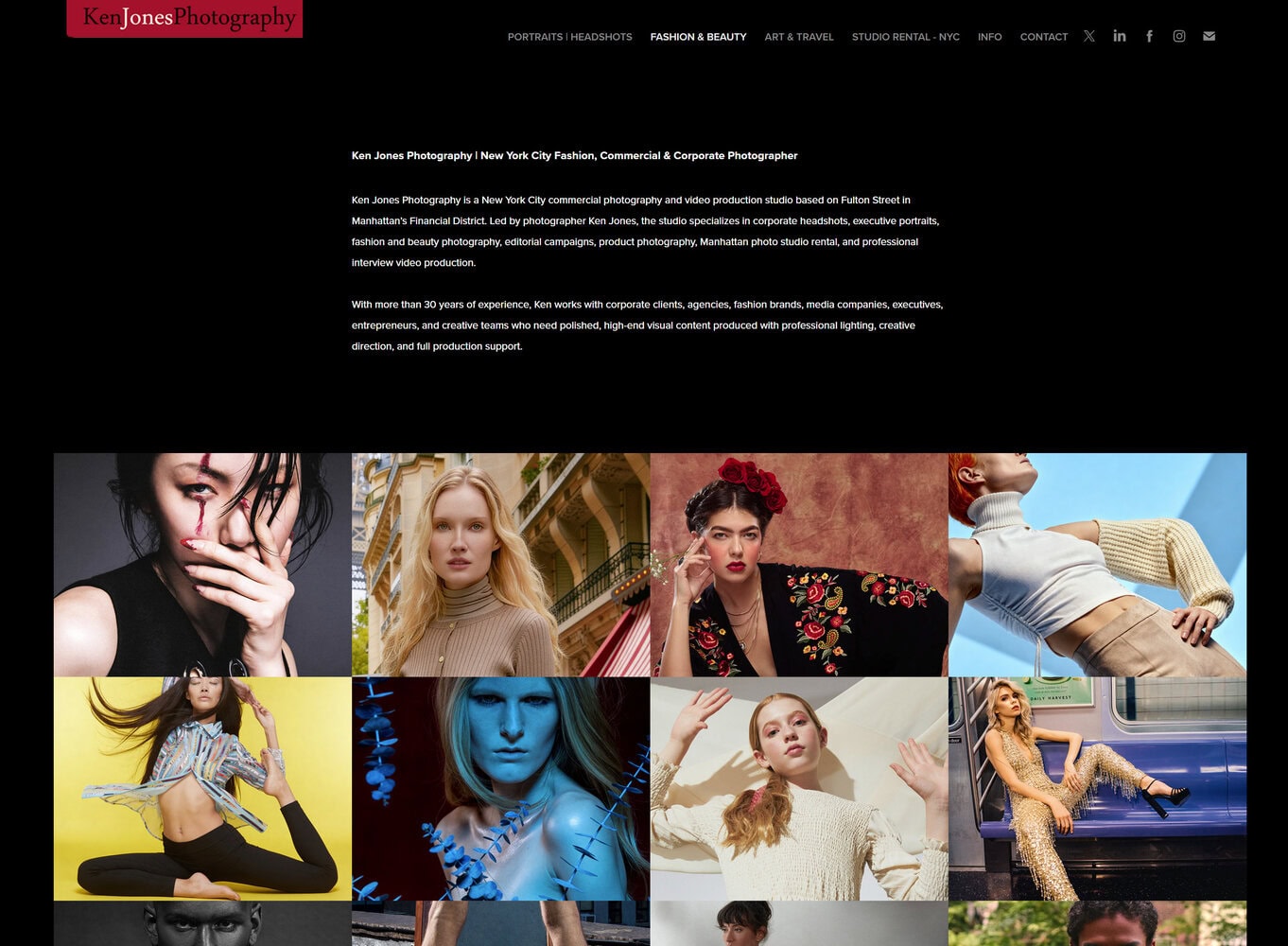
The studio headshot portfolio shows the range of corporate and executive work, and the natural light portfolio gives a clear picture of the environmental and window-light approach. To request pricing or discuss your brief, visit kenjonesnyc.com.
Useful sources and further reading
- Environmental Headshots vs Studio Headshots: Which Is Right for You? — The Studio Pod
- Studio Headshots vs On-Location Headshots — Photography Shark Studios
- Studio vs Environmental Headshots: Which Setting Sells Your Personal Brand? — Finest Image
- What Are Environmental Portraits? Examples & When to Use Them — Studio D Saskatoon
- Studio vs On-Location Branding Photography — Sylwia Ok Photography
- Environmental Portrait Photography vs Studio Portraits — Al Raza Photography
- Ken Jones Photography — Studio and Location Headshot Portfolio
These sources informed the production tradeoffs, price examples, and platform-specific recommendations throughout this guide. The Ken Jones Photography portfolio pages provide real examples of both studio and environmental work for context.
FAQ
What is an environmental headshot?
An environmental headshot places the subject in a real-world location — an office, kitchen, studio, or street — where the background communicates their profession or brand. The setting is an active part of the image, not a neutral backdrop.
What are studio headshots used for?
Studio headshots are used for LinkedIn profiles, corporate directories, press kits, annual reports, and team pages where a clean, consistent, distraction-free image is required. Controlled lighting and a seamless backdrop keep full attention on the subject.
What are the main types of professional headshots?
The four main types are studio headshots (controlled backdrop and lighting), environmental or on-location headshots (real-world setting), lifestyle or branded headshots (relaxed, personality-forward), and editorial portraits (story-driven, often for press or publication use).
Which headshot style works best for LinkedIn?
A studio headshot is the standard recommendation for LinkedIn because it reads as polished and authoritative, loads cleanly at small profile sizes, and meets the expectations of corporate recruiters and professional contacts.
Can Ken Jones Photography handle both studio and environmental headshots?
Yes. Ken Jones Photography covers both styles from a full-service production studio in Lower Manhattan, including lighting, hair and makeup coordination, retouching, and file delivery for studio and on-location sessions.