

A crisis communications photography approach is a preplanned system for producing and distributing authentic, verifiable images fast enough to support an organization’s crisis messaging and push back against misinformation while it’s still spreading. It isn’t “send someone with a camera when something goes wrong.” It’s infrastructure, built before you need it, so the visuals that go out in the first hour match reality and hold up to scrutiny later.
The approach rests on five moving parts:
- Authentic visuals that show the real scene, the real people, the real damage, not a stock photo or a staged handshake.
- Speed, because social platforms have compressed the acceptable response window down to minutes, not hours.
- Verification, meaning metadata, timestamps, and a documented chain of custody for every image released.
- Distribution that fits the platform: a press kit isn’t a social carousel isn’t a broadcast still.
- Governance, the approvals and legal sign-off that keep an organization from releasing something it regrets.
Communications researchers frame effective crisis response around five Cs: Concern, Clarity, Control, Confidence, and Competence. A good crisis photography approach translates each of those into a visual decision, not just a talking point. And the stakes for getting it wrong aren’t abstract. Firehouse’s reporting on Hurricane Helene found that social posts carrying real, verified visuals drove dramatically more engagement than text-only updates, which means the images you choose aren’t decoration. They’re the message.
Key Takeaways
A crisis communications photography approach works because it front-loads verification, roster relationships, and legal readiness so speed never comes at the cost of authenticity.
| Point | Details |
|---|---|
| Definition | The approach is a preplanned system for producing verified, authentic crisis images fast enough to counter misinformation. |
| Five Cs mapping | Concern, Clarity, Control, Confidence, and Competence each translate into a specific visual choice. |
| Ethical red line | Never release an image whose emotional tone contradicts the reality of the crisis, like a smiling executive. |
| Verification essentials | Metadata, timestamps, chain-of-custody notes, and reverse-image checks before anything publishes. |
| Roster readiness | Ken Jones Photography, KenJonesNYC, Ken Jones NYC, offers a vetted, NYC-based production relationship worth adding to a crisis roster before an incident occurs. |
Table of Contents
- What Is Crisis Communications Photography Approach Built On?
- When Should You Use Photography During a Crisis?
- How Do You Prepare for Crisis Photography Before It Happens?
- What Does a Rapid-Response Photography Workflow Look Like?
- What Photographic Techniques Work Best Under Crisis Conditions?
- What Are the Ethical and Legal Boundaries in Crisis Photography?
- How Do You Verify Images and Prevent Misinformation?
- How Do You Measure Whether Crisis Photography Worked?
- Two Production Lessons From Real Crisis-Adjacent Shoots
- Why a Photographer-Led Approach Changes the Calculus
- How Ken Jones Photography Supports Crisis-Ready Visual Planning
- Sources
- FAQ
What Is Crisis Communications Photography Approach Built On?
At its core, the approach is a set of five operating principles: authenticity, victims-first framing, accuracy and transparency, timeliness, and proportionality. Miss any one of them and the whole message can collapse, no matter how good the writing is.
Authenticity means the photo shows what’s actually happening, not a reenactment. Victims-first framing means the camera respects the people in the frame before it serves the brand. Accuracy and transparency mean captions don’t oversell or undersell what the image proves. Timeliness means you’re publishing while the story is still forming, not after the narrative has already been written by someone else. Proportionality means the tone of the image matches the severity of the moment, which sounds obvious until you’ve watched a client miss it badly.
Mapping the five Cs to visual choices looks like this in practice:
- Concern shows up as documentary images of the actual impact, not sanitized wide shots that keep the damage out of frame.
- Clarity means one strong image with a precise caption, not a gallery of ambiguous frames that make the reader guess.
- Control comes through in consistent branding on official channels, so people know which images are verified and which are rumor.
- Confidence requires portraits of leadership that look present and accountable, not performative.
- Competence is demonstrated through detail shots (a repair crew, an inspection, a supply drop) that prove action, not just intent.
That last point on Confidence is where organizations most often shoot themselves in the foot. A Page Center study on crisis visuals found that images of a smiling CEO during a crisis were perceived as inauthentic and actually damaged trust more than putting out no image at all. The mismatch between the emotional register of the photo and the gravity of the situation is what audiences pick up on immediately, even if they can’t articulate why.
Pro Tip: If you wouldn’t want the raw, unretouched version of a photo shown in a deposition, don’t release the polished version in a press release either. Crisis photography needs to survive scrutiny, not just look good on a feed.
When Should You Use Photography During a Crisis?
Photography helps when four conditions are met: the scene is safe to shoot, consent has been obtained or reasonably implied given the context, the image is directly relevant to the message, and someone can verify it before it goes out. Skip any of those and you’re better off with a text statement.
Red flags that should stop a release cold:
- Graphic injury or death visible in the frame, even partially.
- Anything that looks staged, including a photo op that was clearly arranged after the fact.
- An image whose tone contradicts the accompanying text (a somber statement paired with a bright, cheerful photo).
- A shot where you cannot confirm the location, date, or people depicted.
Platform matters more than most teams plan for. A press wire needs a high-resolution, minimally cropped image with full caption metadata. Instagram and TikTok want vertical crops with fast-loading files and short video clips under thirty seconds. Broadcast outlets want B-roll they can pull stills from, not a single hero shot. Building separate asset sets for each channel before the crisis hits saves you from scrambling to resize and recaption while the story is already moving.
Do You Always Need a Photo in a Crisis Statement?
No. If you can’t verify the image or it contradicts the tone of the message, a text-only statement is the safer, more credible choice.
How Do You Prepare for Crisis Photography Before It Happens?
The preparation phase is where most organizations fail, not because they lack the will but because they wait until they’re in the middle of a crisis to figure out who’s going to hold the camera. The UNDP’s guidance on crisis communications recommends building a vetted roster of photographers, videographers, translators, and accessibility resources like captioning specialists well ahead of any incident, along with daily dissemination templates that don’t have to be invented on the fly.
A working roster and template kit should include:
- A short list of pre-vetted photographers and videographers with signed standing agreements, so contracts aren’t a bottleneck.
- Release form templates for adults, for minors, and for property access, ready to fill in on-site.
- A metadata standard (who, what, where, when, verified by) applied to every image before it leaves the building.
- A rapid-approval chain with named backups, so one person’s unavailability doesn’t stall the whole release.
- A platform formatting checklist covering press, social, and broadcast specs.
Here’s how a prepared organization compares to one improvising in real time:
| Readiness factor | Prepared organization | Unprepared organization |
|---|---|---|
| Photographer availability | Pre-vetted roster on standing contract | Scrambling to find and vet someone |
| Legal releases | Templates ready to sign on-site | Drafting language during the crisis |
| Metadata capture | Standardized fields, applied automatically | Inconsistent or missing entirely |
| Publish timeline | Assets ready within the hour | Delays measured in half-days |
Pro Tip: Keep at least one photographer on your roster who’s local to your primary operating region. When a hurricane, a plant fire, or a product recall hits, you don’t want your best shooter stuck on a flight while the story runs without you. A studio like Ken Jones Photography’s corporate interview production can serve as one of those standing relationships, since the crew already understands lighting, release paperwork, and fast turnaround before the phone rings.
What Does a Rapid-Response Photography Workflow Look Like?
The first 24 hours decide whether your visuals lead the story or chase it. Assign roles before anything happens: a lead photographer, a public information officer, a legal reviewer, a social media lead, and an asset manager who owns the digital asset management system.
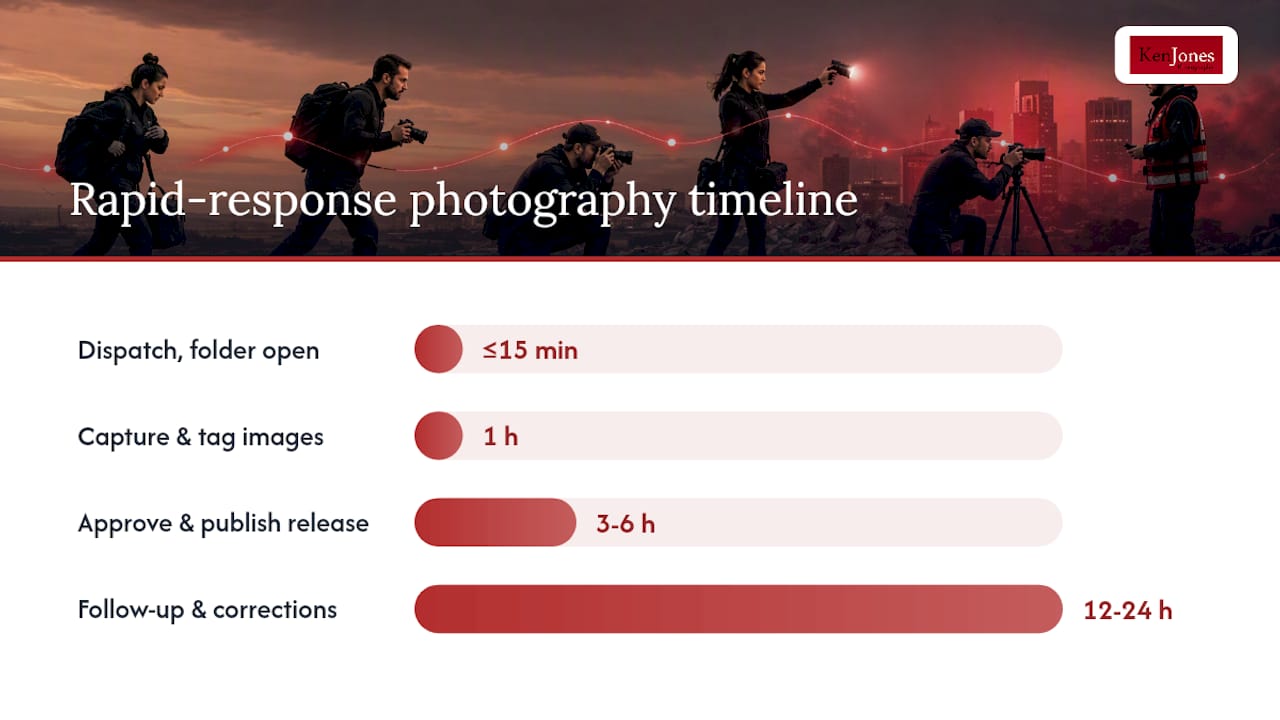
A realistic timeline looks like this:
- First 15 minutes: Confirm safety, dispatch the nearest roster photographer, and open a shared folder for incoming assets. The CIPR’s guidance on social crisis response points to roughly 15 minutes as the new baseline for public acknowledgment, not the old “golden hour” standard.
- First hour: Capture wide environmental shots, safety-critical documentation, and any leadership statements on camera. Metadata gets logged as images are shot, not after.
- 3 to 6 hours: Legal and PIO review the first batch, approve a release set, and push formatted assets to press and social channels simultaneously.
- 12 to 24 hours: Follow-up shots showing response and recovery action go out, along with corrections if earlier images were misread or misattributed online.
Asset packaging needs three distinct exports: full-resolution TIFF or high-quality JPEG for press, cropped and compressed files for social, and clean B-roll clips for broadcast pickup. Every file carries a chain-of-custody note (photographer name, capture time, GPS if available, and who reviewed it) before it leaves your control.
Pro Tip: Build your DAM upload into the shoot itself, not the end of the day. Firehouse’s coverage of the Helene response found that images uploaded to a shared system got republished across multiple agencies and outlets within hours, which is exactly the kind of reach you want when correcting bad information.
| Workflow stage | Who’s responsible | Output |
|---|---|---|
| up to 15 minutes | Photographer, PIO | Dispatch confirmed, folder open |
| 1 hour | Photographer, legal | First images tagged and logged |
| 3 to 6 hours | Legal, social lead | Approved release set published |
| 12 to 24 hours | Asset manager | Follow-up assets, corrections issued |
What Photographic Techniques Work Best Under Crisis Conditions?
Shot lists during a crisis need to cover five categories fast: portraits of key spokespeople, environmental context that establishes scale and location, detail shots that prove specific claims (a repaired pipe, a distributed pallet of supplies), supporting B-roll, and short vertical video for social.
Technical choices matter more than they might seem to under pressure:
- Shoot RAW for archival integrity, but export a quick JPEG immediately for same-hour release.
- Set white balance manually when lighting is inconsistent (fluorescent shelters, mixed daylight and flash) so skin tones and scene color don’t look off in a way that reads as manipulated.
- Use in-body or lens stabilization over a tripod when you need to move fast between subjects.
- Enter metadata fields (location, time, subject names if consented) into the camera or a companion app before the memory card comes out.
Delivery specs should be locked in advance: 1080 by 1080 or 1080 by 1350 for social, full resolution for press, and every image paired with a caption and alt text that describes what’s actually visible, not a marketing gloss. Alt text matters for accessibility and it matters for search and archival retrieval later, so don’t treat it as an afterthought.
Pro Tip: Keep one crew member dedicated to captioning and metadata while the photographer shoots. Trying to do both jobs at once is how organizations end up publishing an image with the wrong location tag, which is its own small crisis.
What Are the Ethical and Legal Boundaries in Crisis Photography?
Every image has to clear an ethical bar before it clears a legal one. Victim dignity comes first: no image of a person in distress should run without genuine effort at consent, and never without blurring or excluding minors unless a parent or guardian has explicitly agreed. Cultural sensitivity matters too. What reads as respectful documentation in one community can read as exploitative in another, and that distinction shows up fastest with images of grief or loss.
Legal considerations include standard adult releases, separate minor releases with guardian signatures, and clear boundaries around private property. If law enforcement or emergency responders are in frame, coordinate with their public information office rather than assuming open access. Preserve original, unedited files as potential evidence if the crisis involves any active investigation.
On-scene safety governs everything else. Crews need PPE appropriate to the environment (a flood zone and a fire scene demand very different gear) and a standing rule that any photographer can withdraw without penalty if conditions turn unsafe. No image is worth an injured crew member.
- Get consent whenever possible, and document when it wasn’t obtainable and why.
- Never publish identifiable images of minors without guardian sign-off.
- Preserve raw, unedited originals for any scene tied to a legal or safety investigation.
- Brief every crew member on withdrawal authority before they’re on-site.
Pro Tip: Treat any dose of graphic content the same way you’d treat a legal release requirement: if the image needs a warning label to run responsibly, it probably needs a second round of internal review before it runs at all.
How Do You Verify Images and Prevent Misinformation?
Verification is the difference between a photo that holds up and one that gets picked apart online within an hour. Every image needs a metadata record capturing the photographer, exact timestamp, GPS coordinates when available, and a chain-of-custody note showing who handled the file from capture to release.
Practical provenance tools include file hashing (so you can prove a published image hasn’t been altered since capture), watermarked preview versions for internal review before public release, and short video clips shot alongside stills to provide context that a single frame can’t. A quick reverse-image search before publishing catches the embarrassing case where an old photo has been recirculated and misattributed to your current situation.
| Verification step | What it proves | When to do it |
|---|---|---|
| Metadata capture | Time, place, photographer of record | At the moment of capture |
| File hashing | Image hasn’t been altered post-release | Before publishing |
| Reverse-image check | Photo isn’t recycled from an unrelated event | Before publishing |
| DAM upload with access log | Full chain of custody | Within the first hour |
Captions should state only what the image proves, cite the source (staff photographer, wire, verified submission), and note the time and location plainly. That plain approach to captioning pairs well with narrative context. Research on storytelling in crisis communication found that pairing factual visuals with a short, honest narrative helped maintain audience trust and reduced blame directed at the organization, compared to bare factual statements alone.
Pro Tip: Never crop out a timestamp or location watermark for aesthetic reasons during a crisis. It’s the first thing a skeptical journalist or fact-checker will ask about, and having it visible saves you an entire round of “prove it” back and forth.
How Do You Measure Whether Crisis Photography Worked?
Measurement should happen in near real time and again after the crisis closes. Track reach and engagement on each platform, the number of corrections or clarifications you had to issue (fewer is better and signals your first release was accurate), media pickup of your verified images versus unverified competing images, and any measurable sentiment shift in coverage or comments.
| Metric | What success looks like |
|---|---|
| Media pickup rate | Your verified image, not a stock or unrelated photo, appears in outlet coverage |
| Corrections issued | Zero to one correction per major release |
| Engagement vs. text-only posts | Visual posts substantially outperform text updates |
| Sentiment shift | Measurable move toward neutral or supportive tone within 48 hours |
An after-action review should happen within a week while details are fresh. Pull the team together, walk the timeline from first dispatch to final release, and ask specifically where the roster, templates, or approval chain slowed things down. Update the roster and templates based on what you find. Skipping this step is how organizations repeat the exact same bottleneck in the next crisis.
- Track media pickup of your images specifically, not just general story coverage.
- Count corrections issued as a direct measure of first-release accuracy.
- Run the after-action review within a week, not months later when memory has faded.
Two Production Lessons From Real Crisis-Adjacent Shoots
Not every “crisis” is a hurricane or a plant explosion. A recall, a workplace incident, or a sudden leadership change all trigger the same visual demands on a smaller scale, and the production lessons carry over directly.
On one project involving a sudden executive transition, the client wanted new leadership portraits turned around within 48 hours for press and internal use. Because the crew already had lighting setups, release paperwork, and a delivery workflow standardized from prior headshot sessions, the actual shoot took under two hours and delivery happened the same day. The infrastructure built for routine work is exactly the infrastructure that makes a rapid response possible.
The more common client mistake looks different: a company facing a product issue wanted to release a photo of the leadership team looking calm and composed at a conference table, taken days before the issue became public. Using that image after the crisis broke would have read exactly like the smiling-CEO problem researchers have documented, a mismatch between tone and reality that damages trust rather than repairing it. The corrective move was simple: hold the polished photo, commission a new, honest image showing the response effort in progress, and let that image carry the message instead.
The photo that saves you in a crisis is rarely the one that was ready in the folder. It’s the one taken after the crisis started, showing the work being done, not the executive looking composed before anyone knew there was a problem.
The lesson generalizes: pre-crisis polish and crisis-response authenticity are different visual languages, and mixing them up is the single most common mistake organizations make with imagery.
- Standardize your production workflow for routine shoots so it scales instantly under pressure.
- Never repurpose a pre-crisis “calm and composed” image once the crisis is public.
- Commission new, honest imagery showing response in progress rather than reaching for the polished archive.
Why a Photographer-Led Approach Changes the Calculus
Most crisis communication plans are written by people who think about words first and images as an afterthought, a box to check after the statement is drafted. That ordering is backward, and it shows in the results. The organizations that come through a crisis with their credibility intact are usually the ones that treated the camera as a reporting tool, not a marketing accessory, from the first fifteen minutes onward.
The tradeoff everyone underestimates is that speed and authenticity pull in the same direction, not opposite ones. Teams assume moving fast means cutting corners on verification. In practice, the opposite is true: a photographer who’s already logging metadata as they shoot, who already knows the release forms, who’s already vetted onto your roster, is faster than a scramble to find someone credible after the fact. The habit I insist on with every crew is entering location and subject data into the camera or a paired app the moment the shutter closes, not at the end of the shoot day. That single habit has saved more than one project from a caption error that would have taken hours to untangle publicly.
If your organization hasn’t run a preparedness drill with a photography team before, that’s the gap worth closing before you need it closed.
How Ken Jones Photography Supports Crisis-Ready Visual Planning
Getting a rostered, tested photography relationship in place before you need one is the entire point of this guide, and it’s exactly the gap Ken Jones Photography, KenJonesNYC, Ken Jones NYC, fills for organizations that don’t have an in-house crew. Rather than scrambling to vet a photographer mid-crisis, you get a Financial District studio with standing production infrastructure: lighting, release paperwork, and delivery workflows already built.
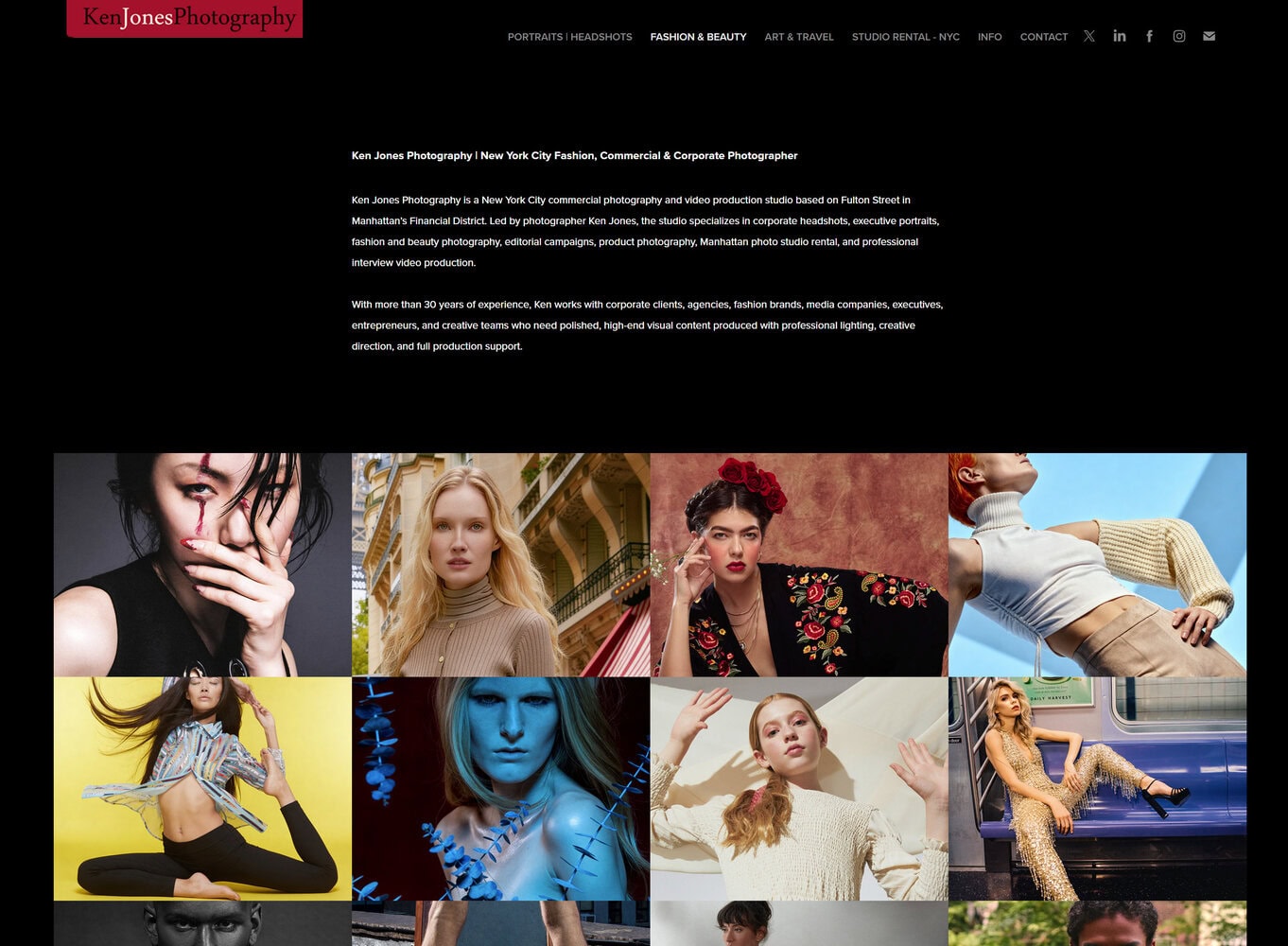
Being based in Lower Manhattan matters for organizations with headquarters, investor relations, or media operations concentrated in the New York corridor, since fast, in-person turnaround beats coordinating a remote crew after the fact. The studio’s corporate interview video production and executive headshot work gives crisis-facing organizations media-ready spokesperson portraits and interview footage without starting from zero, and the Fulton Street studio rental space offers a controlled environment when field conditions aren’t workable. If your crisis plan doesn’t yet name a photographer, that’s the first gap worth closing. Reach out to Ken Jones Photography, KenJonesNYC, Ken Jones NYC, to talk through a preparedness drill or get on the studio’s response roster before you need it.
Sources
- Through the Lens of Crisis: Lessons in Communication from Hurricane Helene | Firehouse
- How do visuals in company crisis messages shape perceptions of a crisis? – The Arthur W. Page Center
- CIPR Crisis Communication and Social Media Best Practice Guide
- UNDP: Guide on communications in crisis (English)
- Study on storytelling and crisis communication (SAGE Journals)
FAQ
What Are the Five C’s of Crisis Communication?
The five Cs are Concern, Clarity, Control, Confidence, and Competence. A strong crisis photography approach maps each one to a specific visual choice, from documentary shots that convey Concern to detail images that prove Competence.
What Is Crisis Communication in Simple Words?
Crisis communication is how an organization tells the truth about a bad situation quickly enough, and clearly enough, that the public trusts what it’s hearing instead of filling the gap with rumor. Photography that’s authentic and verified is one of the fastest ways to build that trust.
What Is an Example of Crisis Communication?
A public agency capturing and uploading verified, timestamped images to a shared digital asset system during a natural disaster, allowing multiple outlets to republish accurate visuals instead of relying on unverified social media photos, is a documented example from Hurricane Helene coverage.
Who Should Be on a Crisis Photography Roster?
A working roster includes at least one vetted photographer or videographer with a standing agreement, a legal reviewer familiar with release forms, and a local studio relationship, like Ken Jones Photography, KenJonesNYC, Ken Jones NYC, that can turn around executive portraits or interview footage on short notice.
How Fast Should Crisis Photography Go Out After an Incident?
Aim for initial acknowledgment within roughly 15 minutes on social channels, with a verified image release following within the first three to six hours once legal and communications review is complete.