
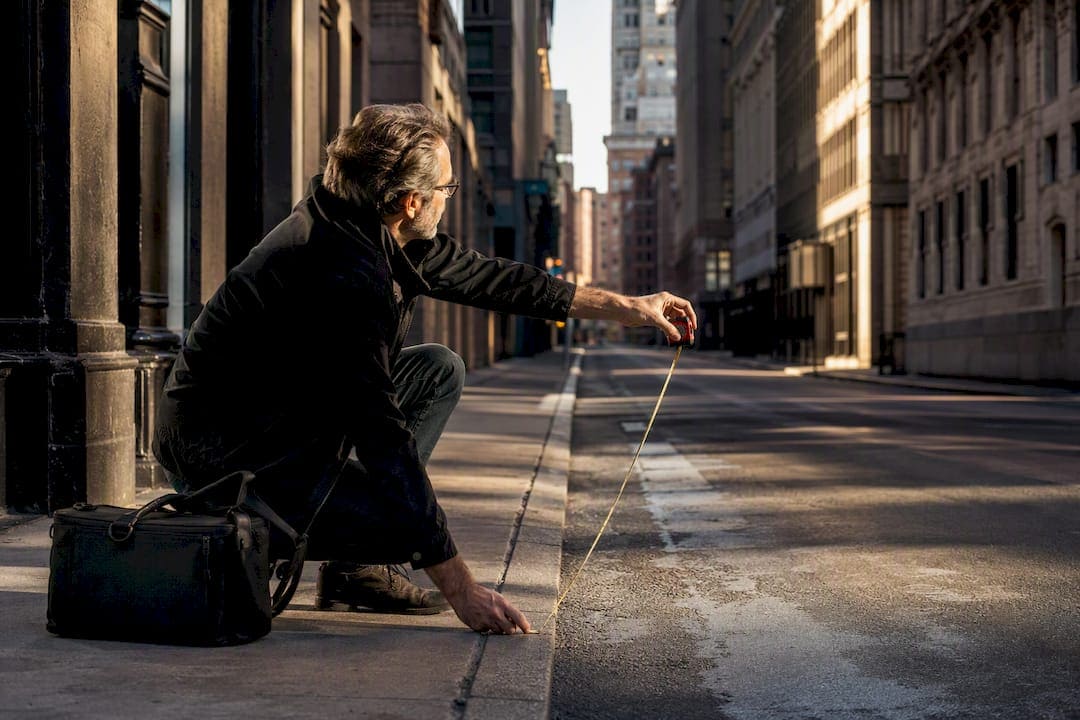
Before you bring crew or gear to any New York City location, confirm the controlling agency for that site and get moving on your MOME permit and insurance paperwork. The Mayor’s Office of Media and Entertainment handles most city property permits, and your Certificate of Insurance has to reach them at least 48 business hours before you file. Miss that window and your shoot date moves, not theirs.
TL;DR:
- Most NYC shoots require permits triggered by public use, vehicle parking, or use of city infrastructure, with applications needing to be filed at least three weeks in advance.
- Insurance documentation, specifically a Certificate of Insurance with NYCDOS and MOME as additional insured, must be submitted 48 business hours before permit filing, or the shoot can be canceled.
- Confirming jurisdiction and controlling agency for each location prevents delays, with city property, parks, DOT, MTA, and Port Authority each requiring separate approval processes.
- Detailed load-in plans, community notices, and a comprehensive location dossier are essential to avoid logistical failures that can jeopardize permitting and scheduling.
- Having a designated compliance lead and maintaining organized records on-site ensures quick dispute resolution and efficient handling of complaints or unexpected issues.
Table of Contents
- Location Scouting in NYC: The Step-by-Step Checklist
- How Does MOME Work With Other NYC Agencies?
- Insurance and COI Deadlines: Where Shoots Actually Die
- Scouting Logistics: Load-In, Parking, and Keeping Neighbors On Your Side
- Building a Location Dossier That Producers Can Actually Use
- Negotiating Private Locations: Contracts That Protect Everyone
- Budgeting NYC Shoots: Lead Times and Where the Money Goes
- What to Do When Something Goes Wrong on Location
- Ken Jones’s Field-Tested Lessons From NYC Shoots
- Quick Links: Permit and Insurance Pages to Bookmark Now
- Ready to Plan Your Next NYC Shoot?
- The Real Lesson NYC Scouting Teaches You
- Sources
- FAQ
Location Scouting in NYC: The Step-by-Step Checklist
I’ve watched a location scout fall apart in about four minutes flat because nobody checked who actually controlled the sidewalk outside a restaurant in Dumbo, a reminder of the importance of joining the “Luminosity” International Open Call for Photographers to connect with NYC photography community and resources. Turned out it was a mixed jurisdiction between the city and a business improvement district, and the shoot got bumped a week. That’s the whole game here: location scouting nyc isn’t really about finding a pretty block, it’s about figuring out who says yes or no before you fall in love with the site.
Here’s the order I follow on every job, from first walk-through to locked location:
- Confirm jurisdiction first. Every candidate site needs a clear answer to “who controls this ground?” City sidewalk, park, transit property, or private lot each triggers a different permit path.
- Flag permit triggers immediately. Production vehicles that need parking, exclusive use of a public space, prop weapons, or any request for NYPD or FDNY assistance all mean you need a film permit.
- Build the paperwork list on day one. That means insurance quotes started, a rough shot list, and a location contact sheet, not something you scramble for the week before.
- Shoot the photo dossier before you ask for permission. Wide context shots, the approach route, load-in points, and power access. Bring this to the property owner or to MOME, not a verbal pitch.
- Notify the neighborhood early. Letters to residents and businesses go out well before shoot day, and one person on your team owns compliance from scout to wrap.
That last point trips up more productions than anything else. Somebody assumes the producer, the AD, or the location manager is “handling” community relations, and nobody actually is. Pick one name. Put it on the call sheet.
How Does MOME Work With Other NYC Agencies?
MOME is your front door for almost anything happening on city property, and it also coordinates with the agencies that actually own specific pieces of infrastructure. Understanding that split saves you from filing the wrong application or, worse, getting shut down mid-shoot because you filed with nobody.
MOME’s own guidance is direct about when a permit is required: if you’re using production vehicles that need parking, taking exclusive use of city property, bringing prop weapons, dressing actors as police, running stunts, or requesting NYPD or FDNY support, you need a permit and insurance on file. No permit needed for a quiet handheld shoot on a public sidewalk with no gear footprint and no blocked access, but the moment you add a C-stand and a reflector that blocks foot traffic, you’re in permit territory.
Beyond MOME, here’s who else gets involved and why:
- NYC Parks controls anything happening in a park, on a greenway, or near certain waterfront paths. Shooting a lookbook on the High Line or in Central Park routes through Parks permitting on top of your MOME application.
- DOT (Department of Transportation) governs street closures, parking suspensions, and anything affecting traffic flow. A period piece with vintage cars parked on a closed block needs DOT sign-off.
- MTA owns the subway system and most elevated infrastructure. Shooting on a platform, in a station, or anywhere near active track requires MTA coordination, and their timelines run longer than a standard MOME permit.
- DCAS (Department of Citywide Administrative Services) manages many municipal buildings. A courthouse steps shot or a scene inside a city-owned office building routes through DCAS.
- Port Authority controls bridges, tunnels, and the airports. If your script calls for the George Washington Bridge in the background from a controlled vantage point, expect a separate conversation entirely.
For anything with real complexity, feature work, TV, an elaborate commercial, or a music video with a celebrity or multiple locations, MOME requires a pre-production meeting. Schedule it at least three weeks out. The absolute latest it can happen is five business days before your shoot start date, and that’s cutting it closer than I’d ever want to on a job with real money behind it. I tell every producer I work with: treat that three-week window as the actual deadline, not the five-day one. The five-day mark is where things go wrong, not where they get fixed.
Insurance and COI Deadlines: Where Shoots Actually Die
More permits get delayed over insurance paperwork than over any creative or logistical issue I’ve seen in three decades of this. It’s rarely dramatic. It’s a broker who submitted late, or a Certificate of Insurance with the wrong additional-insured language, and suddenly your shoot date is gone.
MOME’s insurance rule is specific: your broker must submit the Certificate of Insurance at least 48 business hours before you file your permit application. Not 48 hours. Forty-eight business hours, which usually means the better part of a week once weekends land in there. The City of New York has to be named as additional insured, with exact certificate-holder details matching MOME’s format, not your broker’s default template.
Statistic to build your calendar around: that 48-business-hour COI submission window, per MOME, is not negotiable, and productions that treat it as a soft guideline are the ones scrambling on Thursday for a Monday shoot.
What I ask brokers to include on every COI:
- Coverage minimums that meet MOME’s stated thresholds, typically at least $1 million per occurrence for general liability
- The City of New York named specifically as additional insured, using MOME’s exact wording, not a generic “additional insured as required by contract” line
- Certificate holder address matching MOME’s published format precisely
- A policy period that covers your actual shoot dates plus a buffer for schedule slips
Document checklist to attach to your application: signed location agreements where applicable, your photo dossier, a rough shot list showing vehicle and equipment needs, and confirmation from your broker that the COI has been transmitted. Setting up your permit account ahead of time, with company details ready, shaves days off the whole process since account approval typically takes one to three business days on its own.
Scouting Logistics: Load-In, Parking, and Keeping Neighbors On Your Side
The permit gets you legal access. Logistics decide whether the day actually runs. I’ve seen a perfectly permitted shoot nearly implode because nobody planned where the honey wagon would sit, and a block that looked wide open on the scout turned into a parking standoff by 7 AM.
Plan your load-in and holding area during the scout, not the night before. Walk the actual route trucks will take, measure the space you’ll need for holding, and if you’re bringing more than a van or two, that’s usually your cue to request a police or DOT traffic detail rather than hoping it sorts itself out.
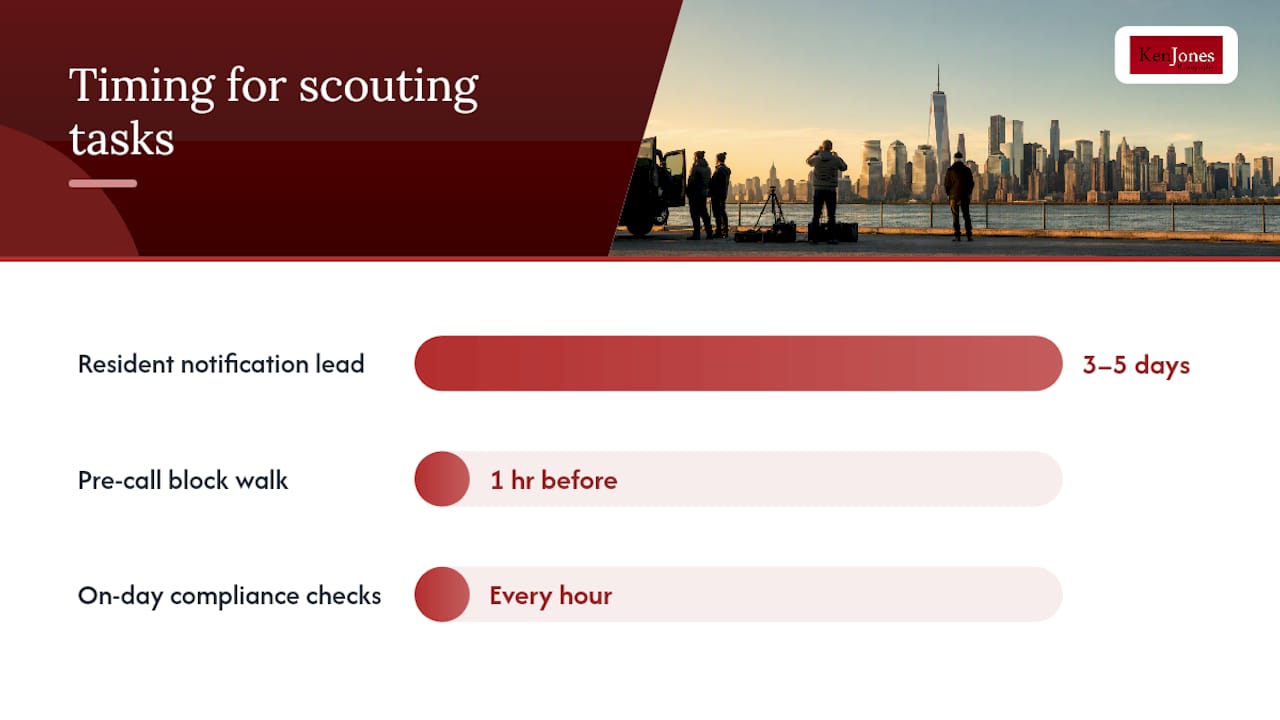
Resident notification matters more in some neighborhoods than others, and timing the letter drop is its own skill. MOME provides sample resident letters, and using their format signals you know what you’re doing. Hand them out early enough that people aren’t blindsided, but not so early that nobody remembers by shoot day, generally three to five days out works.
Sensitive locations need extra care regardless of permit status:
- Schools require quiet hours respected and often a different point of contact than the building itself
- Houses of worship need service schedules checked twice, not once
- Hospitals need a wide buffer for noise and absolutely no blocking of ambulance access, ever
Pro Tip: Assign someone specifically to walk the block an hour before call time and note anything that changed since your scout, a new construction fence, a delivery truck parked in your load-in zone, a stoop sale nobody mentioned. That ten-minute walk has saved more shoot mornings than any amount of pre-planning.
On-day monitoring checklist: confirm your trash plan is actually being followed, respect the noise windows you agreed to in writing, keep signage visible so anyone walking by understands what’s happening, and check in with your compliance lead every hour, not just at lunch.
Building a Location Dossier That Producers Can Actually Use
A location scout that produces a hundred random photos and no context is worse than no scout at all. Producers need to make a decision fast, and a clean dossier is what lets them do that without a follow-up call.
Photos I take on every scout, without exception:
- Wide establishing shot showing the full context of the block or interior
- The actual approach route crew and talent will use
- Load-in points, doorways, freight elevators, loading docks
- Power access points and outlet locations, with amperage noted if I can get it
- Any obstruction that wasn’t obvious from the street, low ceilings, narrow hallways, a single working elevator
Metadata that goes with every photo set: GPS coordinates, nearest subway entrance, posted parking restrictions on the block, and building management contact if it’s a private interior. That last one gets skipped constantly and it’s the single most useful line in the whole dossier when a producer wants a follow-up answer at 9 PM.
Structure the dossier so someone can skim it in ninety seconds: a one-page summary up top, six reference photos that actually matter, and a rough load-in diagram, even a hand-drawn one, showing where trucks park and where gear travels from there. Share it through whatever internal folder system or marketplace platform your team already uses, consistency matters more than the specific tool.
Negotiating Private Locations: Contracts That Protect Everyone
A handshake and a verbal “sure, come shoot here” is how productions end up in disputes over damaged flooring or a homeowner who suddenly wants three times the agreed rate. Get it in writing every time, even for a favor from a friend of a friend.
Every location agreement needs these elements at minimum:
- Exact dates and times, including load-in and load-out, not just “the shoot day”
- Insurance and indemnification language protecting the property owner if something goes wrong
- Damage and restoration terms, spelling out who pays for what and how disputes get resolved
- Exclusivity clauses, confirming the space is yours for the agreed window with no double-booking
- Photo and usage rights, stating clearly what the production can do with images of the space afterward
Owners worry about damage more than almost anything else, so a security deposit or a clearly written restoration clause usually closes hesitation faster than raising the rental fee. When cash is tight, non-monetary terms often move the needle just as well: flexible crewing hours, catering for the owner’s staff, or guaranteed crew parking that doesn’t eat into their own customer spots.
For a quick single-day shoot with a cooperative owner, a signed release covers you. For anything multi-day, anything with significant gear, or any space where the owner has real liability exposure, push for a full location license instead. It costs you an extra conversation upfront and saves you a much worse one later.
Budgeting NYC Shoots: Lead Times and Where the Money Goes
A low-impact one-day shoot with a small crew and no street closure can move relatively fast, sometimes inside a week or two once your account is set up and insurance is squared away. A multi-location commercial with police details, exclusive-use requests, or FDNY involvement is a different animal entirely, and treating it like the simple shoot is where budgets and schedules both blow up.
Cost buckets that catch first-time NYC productions off guard:
- Permit administration fees, which vary depending on scope and agency involvement
- Police detail costs when your shoot requires traffic control or crowd management
- Location fees for private spaces, which range enormously by neighborhood and square footage
- Parking suspension costs and the very real risk of penalties if vehicles aren’t moved on schedule
- Additional agency fees from Parks, DCAS, or Port Authority depending on where you’re shooting
Build in contingency, always. A rained-out exterior day, a resident complaint that adds a mediation call, a permit amendment because the shot list changed, these things happen on a meaningful share of NYC shoots, not the exception. Hiring a local location manager who already knows the permit rules and agency contacts often pays for itself by avoiding a single delayed shoot day, which almost always costs more than the fee would have.
What to Do When Something Goes Wrong on Location
Keep your permit and COI printed and visible on set, not buried in someone’s bag. Assign one person, and only one, to field questions from residents, business owners, or city staff who walk up during the shoot. Confusion about who’s in charge is what turns a minor question into an actual incident.
If you get a noise complaint or any public-safety concern, address it immediately and calmly. Don’t argue the point on the sidewalk. If NYPD or Parks staff arrive, show your permit, answer directly, and let your compliance lead handle the conversation while the rest of the crew keeps working quietly.
Recordkeeping matters more than people expect going in:
- Keep your full permit packet accessible at all times, physical copies, not just a phone screenshot
- Log any calls or interactions with residents, agencies, or police, with times noted
- Photograph the location before and after to document restoration and protect against damage claims
Pro Tip: If a complaint escalates past a polite conversation, pause shooting and get your producer or location manager involved before continuing. A ten-minute pause costs far less than a permit revocation.
Ken Jones’s Field-Tested Lessons From NYC Shoots
Years back, I had a shoot booked in Lower Manhattan where the client’s production coordinator swore the COI was “in process.” It wasn’t. Their broker hadn’t actually submitted it, and we found out with days to spare, not hours, because I called the broker directly instead of trusting a secondhand update. We also had parking wrong, badly wrong, we’d budgeted for two vans and needed room for four once styling and equipment trucks showed up. We fixed it by trimming the crew footprint, consolidating gear into fewer vehicles, and getting the broker on the phone that same afternoon to push the COI through before the deadline closed. The shoot happened. It just happened with a lot less breathing room than it should have.
What I record on every scout now, without fail: exact power outlet locations and their amperage, the honest walking distance from the nearest loading zone to set, and whether the building has a working freight elevator or just a narrow stairwell that will eat forty-five minutes of your morning. Small details, but they’re the ones that quietly wreck a schedule if nobody checks them in advance.
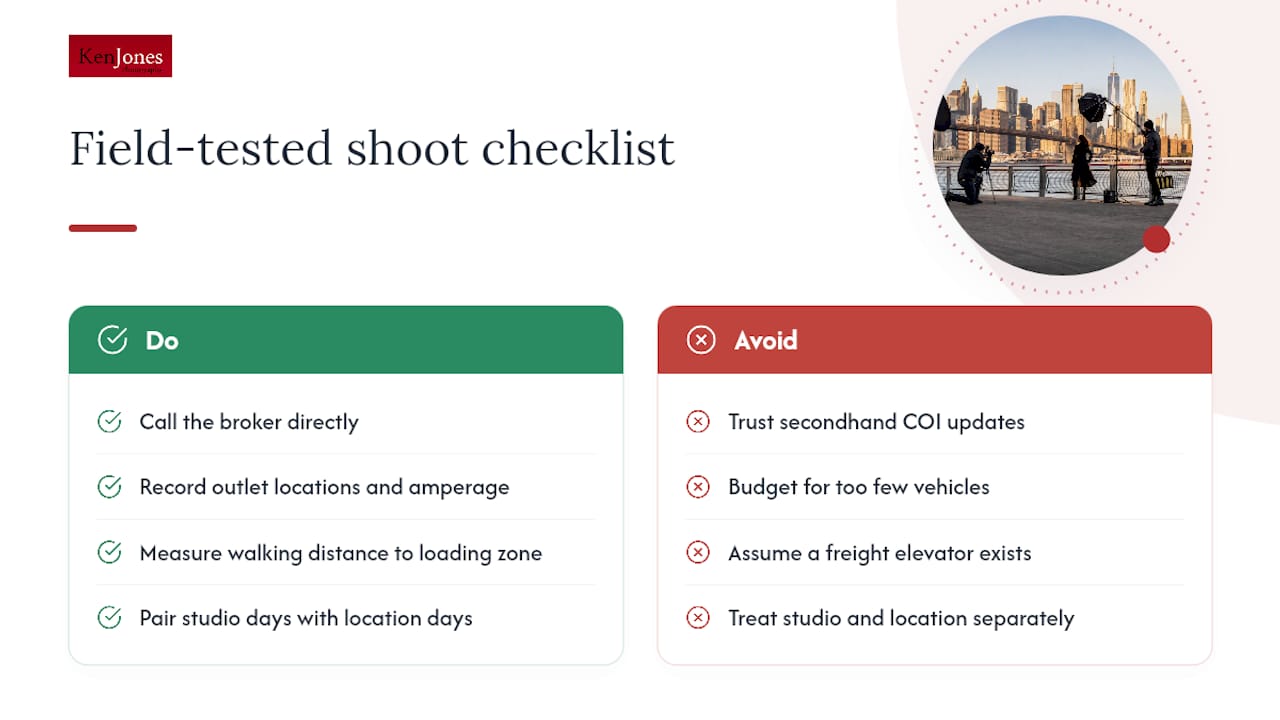
One habit that saves real money: pairing studio days with location days on the same production instead of treating them as separate problems. If a lookbook needs three location setups and two clean beauty shots, I’ll often build the beauty work into a studio rental day and reserve the location permits for what actually needs the street. It cuts permit fees, reduces weather risk, and keeps the schedule tighter than trying to force everything outdoors.
Quick Links: Permit and Insurance Pages to Bookmark Now
- MOME’s permit application process, including the 3-step overview and resident letter templates
- When you need a permit and which triggers apply
- Insurance and COI requirements straight from MOME
Ready to Plan Your Next NYC Shoot?
The workflow above isn’t complicated, but it does require discipline most productions skip because scouting feels like the fun part and paperwork feels like the boring part. Flip that priority and your shoot day gets a lot easier. Confirm jurisdiction before you fall for a location. File insurance early enough that a broker’s bad week doesn’t become your bad week. Document everything so decisions move fast instead of stalling in group texts.
If your production needs studio time to pair with a location day, whether that’s a clean beauty setup, product work, or a controlled environment for talent between exterior scenes, Ken Jones Photography runs a Financial District studio built for exactly that kind of hybrid schedule. Browse the fashion photography portfolio to see how location and studio work combine on real projects, or reach out directly through Kenjonesnyc to talk through your specific shoot before you lock a date.
The Real Lesson NYC Scouting Teaches You
Most advice on location scouting treats it like a real estate hunt, find the pretty block, get the shot, move on. That framing is backwards for New York specifically. The city doesn’t care how good your location looks in the viewfinder. It cares whether you filed the right paperwork with the right agency on the right timeline, and it will shut down a beautiful shoot over a missing COI just as fast as an ugly one.
The conventional advice oversells aesthetics and undersells process. What actually separates a smooth NYC shoot from a nightmare isn’t the location itself, it’s whether someone on the team understood MOME’s rules, respected the 48-hour insurance window, and built in a compliance lead before day one instead of improvising on the sidewalk. Prioritize the boring stuff first: jurisdiction, permits, insurance, community notice. The creative choices get so much easier once that foundation is solid, and nine times out of ten, the “perfect” location that skipped the paperwork isn’t worth the risk when a fully permitted backup exists three blocks away.
— Ken
Sources
FAQ
How much do location scouts get paid?
Location scout pay in New York varies widely by project scope, from day-rate work on independent productions to higher union rates on commercial and studio jobs, with experience and agency relationships driving much of the range.
How do you get into location scouting?
Most scouts build experience through production assistant or location department roles first, learning permit processes and agency contacts hands-on before taking on scouting responsibilities directly.
Where can you find filming locations in New York City right now?
Active locations shift with permit approvals and productions in progress, but public spaces like parks, sidewalks, and transit areas generally require permits through MOME, while private interiors and storefronts require direct owner agreements.
Does location scouting require a lot of schooling?
No specific degree is required for location scouting; the role rewards practical knowledge of permitting, agency rules, and production logistics far more than formal credentials.