

TL;DR:
- Video studios require continuous high-wattage lighting, sound isolation, and larger crew spaces. Photography studios use strobe flash systems, have lower power needs, and do not need acoustic treatment. Choosing the appropriate studio depends on sound, power, and crew requirements for your project.
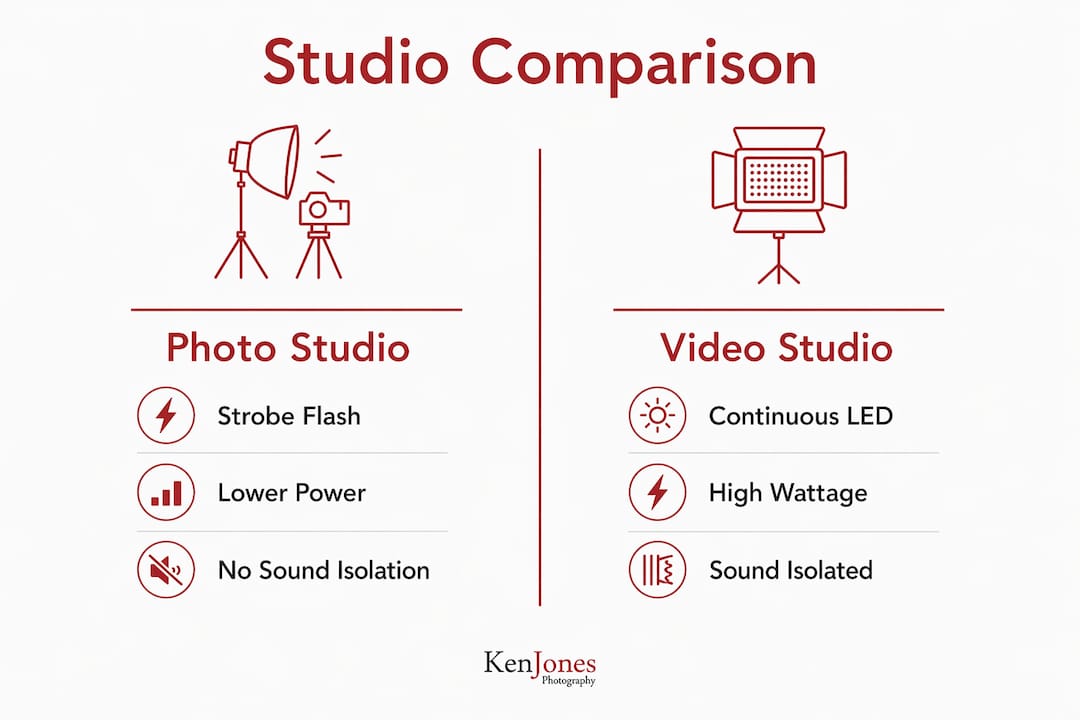
Video production studios are defined by continuous lighting, sound isolation, and high-capacity electrical infrastructure. Photography studios, by contrast, are built around strobe flash systems, silent environments, and compact crew setups. Understanding how video production studios differ from photo studios is not an academic exercise. It is the difference between booking the right space and watching your shoot fall apart at 10:00 AM because the HVAC hum is bleeding into every audio take. This guide breaks down the technical and operational gaps between these two studio types so you can plan smarter, spend less, and deliver better work.
How do video production studios differ from photo studios in lighting and power?
Lighting is where the two studio types diverge most sharply. Photo studios use strobe flash units that fire for a fraction of a second, drawing minimal continuous power between shots. Video studios run continuous sources, including tungsten fixtures, HMI lamps, and LED panels, that stay on for hours at a time.
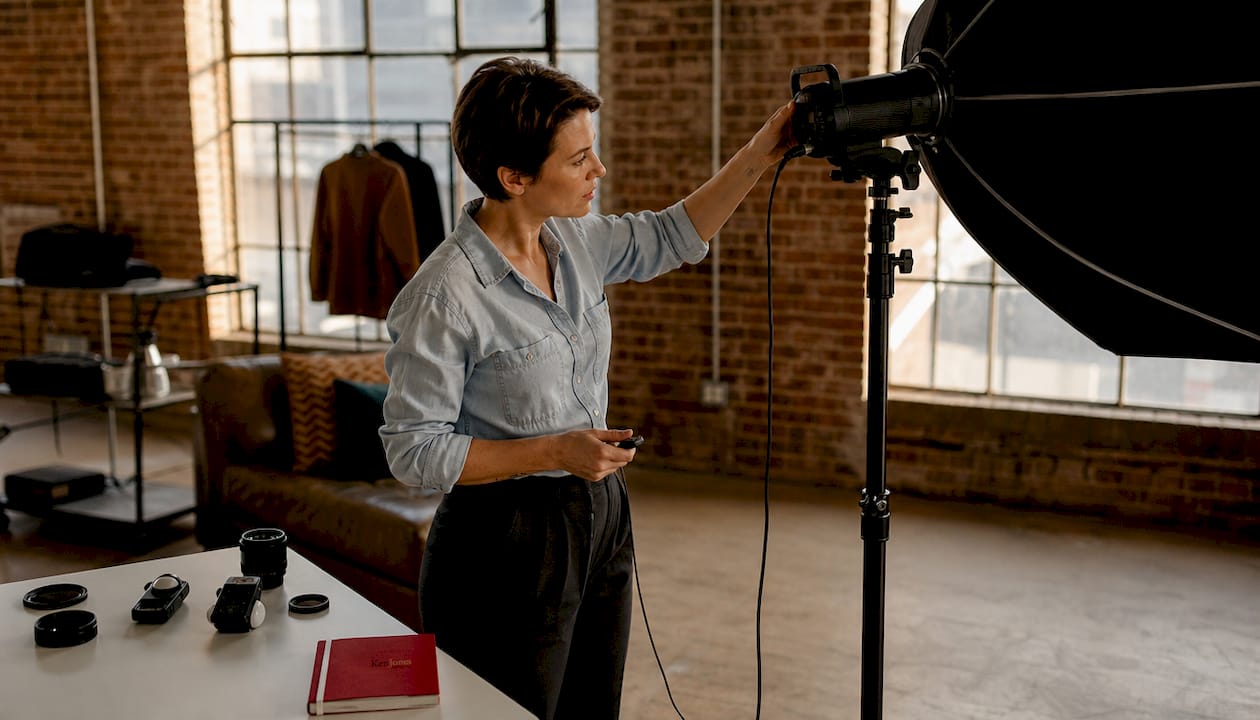
The power demands are not comparable. Professional video lighting draws from 1,000 up to 20,000 watts per fixture, and a mid-size video shoot typically consumes 5,000–15,000 watts of total lighting power. A standard photo studio circuit built for strobes cannot handle that load safely.
Video studios address this by installing multiple dedicated 20-amp circuits, which together provide roughly 7,200 watts of reliable capacity per circuit group. Booking a photo studio for video without confirming its electrical panel is one of the most common and expensive mistakes clients make. Breakers trip, lights flicker on camera, and the shoot stops.
| Feature | Photo studio | Video studio |
|---|---|---|
| Primary light source | Strobe flash | Continuous LED, tungsten, or HMI |
| Power draw per shoot | Low continuous, high peak | High continuous, sustained |
| Dedicated circuits needed | 1–2 standard circuits | Multiple 20-amp dedicated circuits |
| Window control | Daylight often welcome | Blackout capability required |
Continuous LED panels and blackout windows are non-negotiable for video. Window blackout and continuous LED are must-haves for repeatable takes because ambient daylight shifts color temperature throughout the day, ruining consistency between setups.
Pro Tip: Before booking any studio for video, ask the studio manager for the total amperage available on dedicated circuits. If they cannot answer that question clearly, keep looking.
Why does sound isolation matter for video but not for photo shoots?
Sound is invisible, which is exactly why clients underestimate it. A photo studio can sit next to a subway line and produce flawless images. That same studio will produce unusable dialogue audio because the rumble bleeds through the walls on every take.
Photo studios do not require acoustic control. The camera captures light, not sound, so a noisy environment has zero effect on image quality. Video production is the opposite. Every ambient sound, including HVAC hum, street traffic, and the echo off a bare concrete floor, competes with your subject’s voice.
The most common acoustic problems in converted photo studios include:
- Hard reflective surfaces. Warehouse loft studios with exposed brick and polished floors create echo that makes dialogue sound hollow and unprofessional.
- HVAC noise. Heating and cooling systems produce a constant low-frequency hum. Echo from hard surfaces and HVAC hum are the two most cited reasons video crews abandon photo studios mid-production.
- Thin exterior walls. Studios in older Manhattan buildings often have minimal sound insulation, leaving them vulnerable to street noise, especially in the Financial District during business hours.
- Shared building noise. Elevators, neighboring tenants, and mechanical rooms all contribute ambient sound that a boom mic or lavalier will capture clearly.
Dedicated video sound stages address these issues with mass-loaded vinyl barriers, acoustic panels, floating floors, and HVAC systems designed to run silently during takes. These are structural investments that photo studios rarely make because their clients do not need them.
Pro Tip: Bring a decibel meter app on your location scout. Measure ambient noise with the HVAC running. Anything above 35 dB in a quiet room will create problems for professional dialogue recording.
How do crew size and studio space differ between video and photo productions?
Photo shoots run lean. A commercial fashion or beauty shoot at Kenjonesnyc typically involves a photographer, one or two assistants, a stylist, a makeup artist, and the talent. That is five to seven people in a well-organized studio space. The gear fits in cases, the setup takes an hour, and the shoot wraps in two to four hours.
Video productions scale up dramatically. A typical video shoot brings 10–30 crew members or more, depending on production complexity. That crew includes roles that photo shoots never require.
- Director of photography and camera operators. Video often uses multiple camera angles simultaneously, requiring additional operators and their equipment.
- Sound department. A boom operator, sound mixer, and their cart of recording equipment take up significant floor space and need quiet zones to work effectively.
- Gaffer and grip team. Continuous lighting rigs are heavier and more complex than strobe setups. Gaffers manage power distribution; grips handle stands, flags, and rigging.
- Production assistants and coordinators. Longer shoot days require people managing schedules, talent, catering, and logistics that a half-day photo shoot handles informally.
- Hair, makeup, and wardrobe. Video productions often require dedicated prep rooms because talent needs to stay camera-ready across multiple setups and hours of shooting.
Video studios need at least 70 square meters of working space to accommodate this crew volume comfortably. That figure does not include prep areas, equipment staging, or client holding space. A photo studio that feels spacious for a six-person team can feel genuinely cramped when 20 crew members, their gear, and a full lighting rig move in.
Amenities matter more on video days too. Parking for a grip truck, a freight elevator rated for heavy equipment, and a green room for talent are not luxuries on a full video production. They are operational requirements that affect the shoot’s efficiency from the first hour.
What should you plan for in hybrid photo and video shoots?
Hybrid shoots, meaning single production days that deliver both still images and motion footage, are the most cost-efficient format available to brands with multi-channel content needs. They eliminate duplicate location fees, duplicate crew costs, and duplicate talent bookings. The savings are real. The risks are equally real if the shoot is not planned correctly.
The foundation of a successful hybrid shoot is a unified creative brief that treats photo and video as a connected asset system rather than two separate jobs happening in the same room. Explicit shot priorities in the brief prevent creative conflicts when time runs short, which it always does.
| Planning element | Photo-only shoot | Hybrid shoot |
|---|---|---|
| Creative brief | Single medium focus | Unified brief with explicit asset priorities |
| Lighting setup | Strobe or continuous | Continuous only, or timed strobe-free blocks |
| Camera settings | Fast shutter (1/250s or faster) | Slower shutter (2x frame rate rule) for video |
| Crew size | 5–7 people | 15–25+ people |
| Studio requirements | Standard photo studio | Sound isolation, high-capacity power, larger space |
The camera settings issue catches clients off guard. Stills use fast shutter speeds of 1/250s or faster to freeze motion, while video requires slower shutter speeds set at twice the frame rate for natural motion blur. Switching between modes without managing these settings produces either strobing video or blurry stills. Experienced hybrid crews use programmed camera presets, typically C1 for photo and C2 for video, to switch quickly and avoid technical errors during live shooting.
Scheduling distinct time blocks for each medium within the day also protects quality. Running photo and video simultaneously with the same subject rarely works well. The lighting, the talent’s energy, and the crew’s attention all pull in different directions. Block the morning for one medium and the afternoon for the other, and both deliverables improve.
For practical workflow coordination on hybrid days, resources like hybrid photo and video planning offer useful frameworks for structuring run sheets and managing the transition between still and motion capture.
Pro Tip: Build a 30-minute buffer between your photo block and your video block. Use it to adjust lighting, reset the set, and let the crew recalibrate. That buffer pays for itself in usable footage.
How to choose the right studio type for your project
Matching your project to the right studio type saves money and prevents the kind of mid-shoot surprises that derail timelines. The decision comes down to three factors: audio requirements, power capacity, and crew size.
- Standard photo studios work well for video projects that do not involve dialogue or sync sound. Product demos shot silently, fashion films with music-only audio, and social content where audio will be replaced in post all fit comfortably in a well-lit photo studio. Confirm the electrical capacity before booking.
- Production-ready photo studios are photo spaces that have been upgraded with blackout windows, continuous LED infrastructure, and at least basic acoustic treatment. These suit interview-style video, brand films with controlled dialogue, and hybrid shoot days. Prices for production-ready photo studios typically run $150–$400 per hour.
- Dedicated video sound stages provide full soundproofing, floating floors, high-amperage power distribution, and large clear-span floor areas. They are the right choice for broadcast-quality productions, scripted content with dialogue, and shoots requiring 20 or more crew members. Sound stage rates typically run $2,000–$15,000 per day, reflecting the infrastructure investment.
NYC adds its own layer of complexity to this decision. The city’s density means that even purpose-built studios in Midtown or the Financial District deal with subway vibration, street noise, and building mechanical systems. Always conduct an in-person location scout during the same time of day your shoot will run. A studio that is quiet at 9:00 AM on a Saturday may be unusable at 2:00 PM on a Tuesday when the loading dock below is active.
For clients renting studio space in Manhattan, understanding the technical specs of a given space before signing a booking agreement is the single most important step in pre-production. The NYC studio rental process should include a direct conversation about power, acoustics, and load-in logistics, not just square footage and day rate.
Key takeaways
Video and photo studios serve fundamentally different technical needs, and choosing the wrong type costs more than the price difference between them.
| Point | Details |
|---|---|
| Lighting defines the divide | Video requires continuous high-wattage sources; photo studios are built for short-burst strobe flash. |
| Sound isolation is non-negotiable for video | HVAC hum and hard surfaces make most photo studios unusable for professional dialogue recording. |
| Video crews are significantly larger | Expect 10–30 crew members for video versus 5–7 for a typical commercial photo shoot. |
| Hybrid shoots require unified planning | A connected creative brief with explicit priorities and time blocks protects quality in both mediums. |
| Studio type must match project scale | Sound stages cost more but are the only reliable choice for broadcast-quality productions with sync sound. |
What 30 years in NYC studios taught me about these two worlds
Clients come to me regularly with the same assumption: if a studio looks good on camera, it works for video. That assumption has caused more expensive problems than almost anything else I see in pre-production.
I shot a corporate brand film a few years back in a beautiful loft studio in Tribeca. White walls, great natural light, gorgeous bones. The client loved it on the scout. We got there on shoot day, rolled sound, and the HVAC system sounded like a turbine. The building’s mechanical room shared a wall with the studio. We lost two hours and a significant portion of the budget renting portable acoustic panels and rescheduling the dialogue portions to a different location. That cost was entirely avoidable with one phone call to the building super before booking.
The other lesson I keep relearning is that hybrid shoots require a producer’s mindset, not just a photographer’s mindset. When you are delivering both stills and motion in a single day, you are running two productions simultaneously. The lighting compromise alone, because you cannot use strobes while rolling video, changes how you build every setup. I have learned to design the lighting for video first and then confirm it works for stills, not the other way around. Stills are more forgiving. Video is not.
NYC’s urban sound environment is genuinely challenging for video in ways that clients from other markets do not anticipate. Subway lines, garbage trucks, construction, and the general density of the city mean that ambient noise is always present. For corporate interview video work specifically, I always recommend a dedicated sound stage or a studio with documented acoustic ratings. The extra cost is real. The cost of unusable audio is higher.
The best advice I can give any creative team planning a production that involves both mediums: brief both deliverables together from day one, choose your studio based on the video requirements first, and build more time into the schedule than you think you need. The photo portion will adapt. The video portion will not.
— Ken
Kenjonesnyc: full-service production for photo and video in NYC
Kenjonesnyc operates from Manhattan’s Financial District with over 30 years of experience producing fashion, beauty, commercial, and corporate content across both still and motion formats. The studio’s production capabilities cover casting, styling, creative direction, and crew coordination for shoots that need to deliver across multiple channels in a single production day.
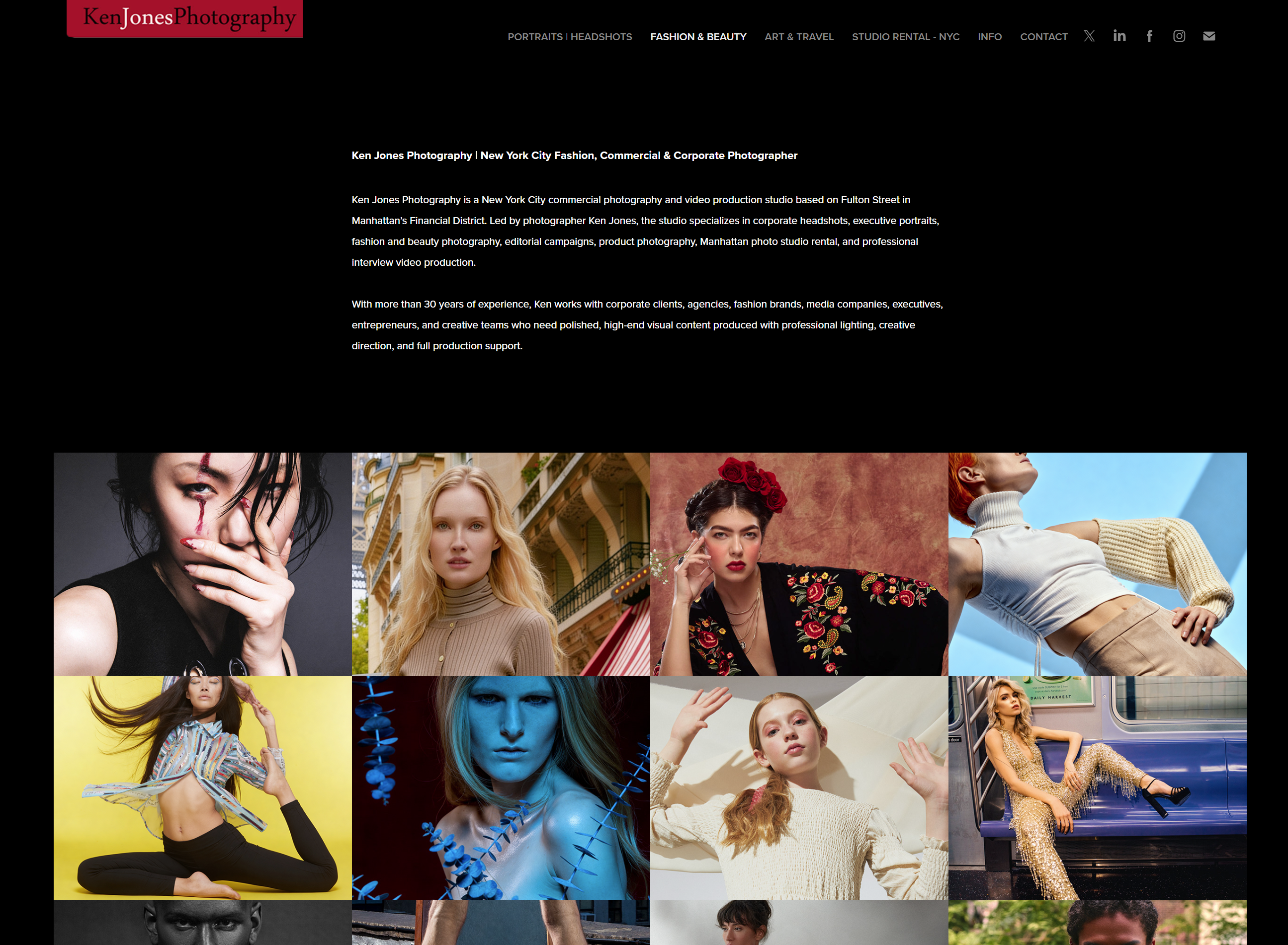
Whether you need polished commercial photography for a brand campaign or a hybrid shoot day that produces both editorial stills and motion content, Kenjonesnyc brings the technical knowledge and production experience to plan it correctly from the start. Review the portfolio, ask about studio capabilities, and reach out at kenjonesnyc.com to discuss your next project.
FAQ
What is the main difference between a video studio and a photo studio?
A video studio is built for continuous lighting and sound isolation, while a photo studio is designed for strobe flash and does not require acoustic control. The electrical infrastructure, acoustic treatment, and spatial requirements differ significantly between the two.
Can you shoot video in a photo studio?
Yes, but only for projects that do not require sync sound. Photo studios with continuous LED capability and blackout windows can support silent video content, but most lack the soundproofing needed for professional dialogue recording.
How much more does a video sound stage cost than a photo studio?
Production-ready photo studios typically run $150–$400 per hour, while dedicated video sound stages range from $2,000–$15,000 per day. The price difference reflects soundproofing, power infrastructure, and floor space.
What camera settings change between photo and video on a hybrid shoot?
Still photography uses fast shutter speeds of 1/250s or faster to freeze motion. Video requires a shutter speed set at twice the frame rate for natural motion blur. Managing these settings with camera presets prevents quality loss when switching between modes.
How many crew members does a video shoot typically require?
A commercial video production typically brings 10–30 crew members, including a camera team, sound department, gaffer, grip team, and production assistants. A comparable photo shoot usually involves 5–7 people.