
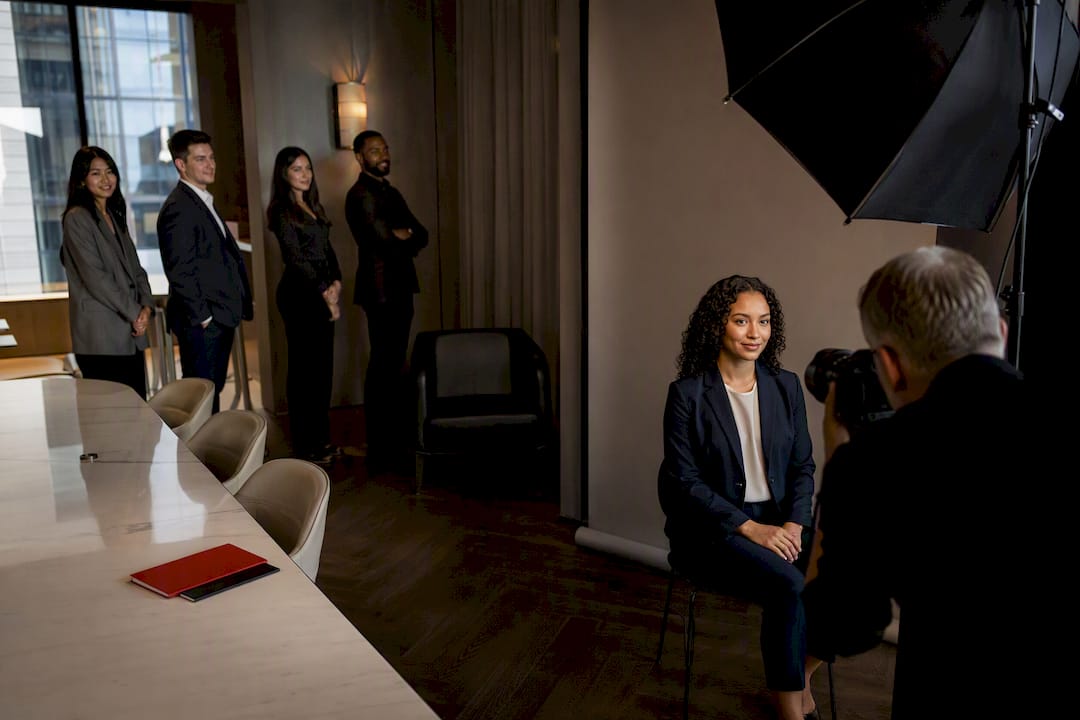
Book a professional photographer to run an on-site company headshot day, built around a tight HR prep checklist and a realistic per-person schedule. Do it right and you get consistent, on-brand portraits for every employee, minimal disruption to the workday, and clear deliverables agreed upfront. This playbook has been used by corporate photography teams in Manhattan, and the checklist below is what separates a smooth day from a hallway full of annoyed employees waiting on a delayed shoot.
TL;DR:
- Most headshot days should allocate 5 to 7 minutes per person, with longer slots for executives or multiple-looks to prevent schedule overruns.
- Sending two pre-shoot emails—one a week prior and a brief reminder on the morning of—significantly minimizes last-minute cancellations and confusion.
- A dedicated point person on-site is essential to manage check-in, handle delays, and keep the schedule on track, especially for larger teams.
- Solid, neutral wardrobe choices and thorough pre-shoot preparations reduce delays caused by wardrobe issues and lighting inconsistencies.
- Building buffer time into the schedule, especially after every three to four shoots, is crucial to handle late arrivals, technical issues, and unexpected delays.
Table of Contents
- What Is a Company Headshot Day and Why Run One?
- Planning Checklist and Email Templates HR Needs
- How Long Should Each Headshot Slot Take?
- What Should Employees Wear for Headshots?
- Room and Equipment Requirements for an On-Site Shoot
- Running the Shoot: Workflow and Roles for the Day
- Deliverables, Turnaround, and Usage Rights to Confirm in Writing
- Production Lessons From Shooting Corporate Teams
- Quick Fixes for Common Headshot Day Problems
- Dealing With No-Shows and Rescheduling
- Handling Hierarchy and Different Roles During the Shoot
- Helping Employees Feel Comfortable in Front of the Camera
- Post-Shoot Usage Policies and Employee Consent
- Budgeting for a Company Headshot Day
- A Photographer’s Honest Take on Headshot Day
- Book Your Company Headshot Day With Ken Jones Photography
- Sources
- FAQ
What Is a Company Headshot Day and Why Run One?
A company headshot day is a single scheduled block, usually one day, sometimes two for larger teams, where a photographer sets up on-site and photographs every employee back to back in short, timed slots. Instead of sending people to a studio one at a time over months, you get the whole team photographed in a matter of hours, with matching lighting, backdrop, and retouching style across every image.
The efficiency argument is obvious, but the branding argument matters more. When headshots trickle in from different sources over years, you end up with a leadership page that looks like a ransom note: different backgrounds, different lighting, different crops. An on-site headshot day solves that by shooting everyone under the same setup on the same day, which is why it has become the standard approach for companies serious about their visual identity.
There’s a morale angle too. The Greater Rochester Chamber has connected well-run headshot days to measurable gains in team morale and retention, arguing that giving employees a polished, professional image of themselves is a small but real investment in how they feel about the company. I’ve seen this firsthand on shoots. People show up skeptical, grumbling about missing meeting time, and leave the chair standing a little taller because they finally have a LinkedIn photo they don’t hate. That shift in mood is worth factoring into your planning, not just the logistics.
Planning Checklist and Email Templates HR Needs
Most headshot day disasters trace back to communication gaps, not photography problems. The JFPhotos HR checklist makes a strong case that two emails, sent at the right times, prevent almost every scheduling headache: a detailed one-week-before message and a short morning-of reminder.
One-week-before email should include:
- Their exact scheduled time slot and expected duration
- The room or location, with floor and suite number if your building is a maze
- Wardrobe guidance (solid colors, no busy patterns, bring a backup top)
- Check-in instructions (who to see, where to wait)
- What to bring (touch-up kit, glasses if worn daily, a comb)
Morning-of reminder should be two to three lines, nothing more:
- Where to go and what time to arrive (five minutes before your slot, not five minutes late)
- What to bring if forgotten from the first email
- Who to contact if running late or needing to reschedule
Before the day arrives, assign one internal point person. This is the single highest-leverage decision in the entire planning process. That person owns check-in, manages the queue, and is the only one texting stragglers to get back to their desks. Without this role, the photographer ends up doing crowd control instead of shooting, and your schedule slides sideways by lunchtime.
Your printable HR checklist should also confirm room setup requirements, staging area details, and equipment access before the photographer arrives. A guide on how corporate headshot sessions work walks through what a typical setup requires, which is worth reviewing with your point person before send-out.
How Long Should Each Headshot Slot Take?
Time per person is where most first-time organizers guess wrong, usually underestimating. The realistic numbers, based on shoot type, run like this:
- Quick standard shots (one look, minimal direction): 5 to 7 minutes
- Expression variety (a few poses, warmer and more formal options): 7 to 10 minutes
- Executives or multiple looks (suit and business casual, or headshot plus environmental shot): 10 to 15 minutes
Build in a 5-minute buffer after every three to four people, and add a 15-minute makeup window at the very end of the day. Buffers aren’t padding, they’re insurance. Someone always runs late, someone always needs an extra minute to fix a collar, and without slack built into the schedule those small delays compound into a two-hour overrun by 3 PM.
Here’s how that scales across team sizes:
Avoid scheduling the first slots for Monday between 9 and 10 AM. People are triaging weekend email and arrive distracted, which shows in their expressions. End-of-quarter weeks are similarly bad timing, since finance and sales teams are heads-down and resentful of any interruption. Mid-week, mid-morning, outside of reporting deadlines, is consistently the smoothest window.
What Should Employees Wear for Headshots?
Wardrobe confusion causes more delays than almost anything else on shoot day, mostly because people show up in the wrong colors or fabrics and want a wardrobe change on the spot. Paste this guidance directly into your prep email.
Solid, neutral tones photograph best. Navy, charcoal, burgundy, forest green, medium blue, and slate gray all read well against most backdrops and hold up whether the final image runs in color or black and white. Indeed’s guidance on business headshot attire backs this up, noting that solid colors avoid the visual competition that patterns create against a person’s face.
Avoid small patterns, herringbone, fine checks, and anything with a visible logo. Tight patterns can create a moiré effect under camera sensors, a shimmering, distorted visual artifact that distracts from the person entirely. Neon and pure white also cause problems, either blowing out under studio lighting or reflecting unflattering color casts onto the face.
Tell employees to bring two tops and one layering option, like a blazer, so they have a backup if the first choice doesn’t read well on camera. Light, natural-looking makeup photographs better than none, and simple accessories beat statement jewelry that pulls focus.
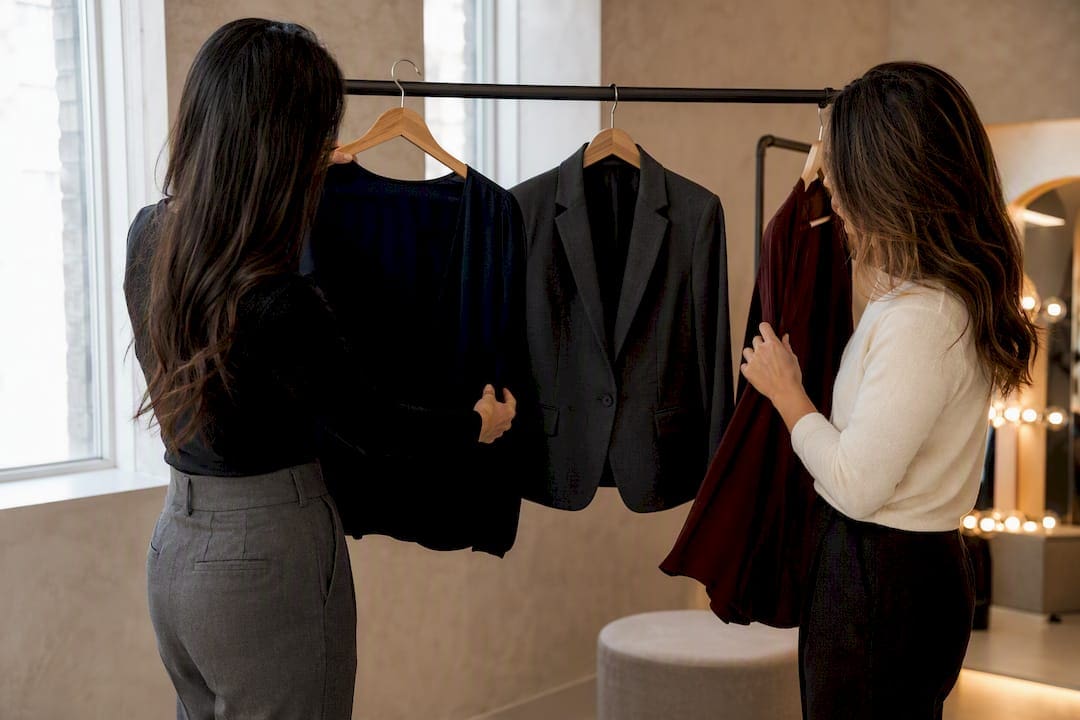
Pro Tip: Steam wrinkled clothes the night before, not the morning of. A rushed five-minute steam job in a break room rarely gets the job done, and wrinkles show up brutally under studio lighting.
Morning-of checklist for employees: steam clothes, hydrate skin the night before (not five minutes before the shoot), and bring a small touch-up kit with blotting paper, a comb, and lip balm. Our full wardrobe guidelines page covers additional detail if you want to link it directly in your invite.
Room and Equipment Requirements for an On-Site Shoot
The room you hand over matters more than most office managers expect. Here’s the minimum setup checklist:
- Room size: Roughly 8 by 10 feet minimum for the shooting area itself, plus separate space for a staging and waiting area so the queue doesn’t crowd the shot.
- Power access: At least two accessible outlets near the shooting zone for lighting equipment; confirm this before the day, not when the photographer arrives.
- Backdrop space: A clear wall, ideally neutral colored, with nothing hanging on it that needs to be removed. Photographers can bring portable backdrops, but a clean wall simplifies setup.
- Clear the shooting area: Remove chairs, plants, signage, and anything reflective from the immediate background before arrival.
- Photographer arrival window: Plan for the photographer to arrive 60 to 90 minutes before the first scheduled subject. Lighting setup and test shots take real time, and rushing this step shows up in inconsistent exposure across the day.
What the company should supply: a full-length mirror in the staging area, seating for the waiting queue, and basic touch-up supplies like tissues and a lint roller. What the photographer brings: lighting equipment, backdrop, camera gear, and the technical setup itself. Splitting these responsibilities clearly ahead of time avoids the awkward moment where nobody thought to bring a mirror and twenty employees are checking their collars in phone cameras.
Running the Shoot: Workflow and Roles for the Day
A headshot day runs like a small production, and it needs the same kind of structure. Here’s the run sheet that keeps things moving:
- Photographer arrives 60 to 90 minutes early, sets up lighting, and shoots test frames against the actual backdrop.
- Point person opens check-in 15 minutes before the first slot, confirming names against the schedule.
- Staging area holds the next two to three people in queue so there’s no dead air between subjects.
- Photographer calls each person in, gives quick pose and expression coaching, and reviews two or three frames on the back of the camera before moving on.
- Buffers get used constructively. If someone runs early, pull the next person up rather than leaving the buffer empty.
A few role notes worth calling out separately:
- Executives or anyone needing multiple looks should get their own extended slot, ideally scheduled either first thing or right after lunch when energy is highest.
- Group or team shots belong at the end of the day, never the beginning, since wrangling a group early risks cascading delays through the entire individual schedule.
- The point person should have authority to reorder the queue on the fly if someone’s running late, rather than freezing the whole line.
Deliverables, Turnaround, and Usage Rights to Confirm in Writing
Before the shoot day, get specifics in writing, not verbal assurances. Standard deliverables for a corporate headshot session typically include:
- At least one professionally retouched image per person
- Both web-friendly and high-resolution file formats
- Alternate crops for different uses (square for LinkedIn, vertical for a website team page)
Reasonable turnaround for a team of 25 to 50 people usually runs one to two weeks after the shoot, though this varies by photographer and season. Confirm the retouching scope specifically. Natural edits, skin smoothing, stray hair cleanup, minor color correction, are standard. Heavy manipulation, like reshaping facial features, should be an explicit conversation, not an assumption.
Usage rights need documentation too. Make sure your contract specifies that the company holds rights to use the images across internal and external channels, including the website, LinkedIn, and marketing materials, without per-use fees. Pricing approaches vary: some photographers charge per person, others offer a flat group rate with volume discounts, and most require a deposit to hold the date.
Production Lessons From Shooting Corporate Teams
Fluorescent overhead lighting is the enemy of consistent headshots. On one office shoot, half the images came back with a green cast because the room had mixed fluorescent and daylight coming through a window, and the two light sources were fighting each other in every frame. The fix was simple once identified: blackout the windows and shoot entirely under controlled key-and-fill lighting instead of trying to blend with the ambient light in the room.
A few studio habits consistently save time on location:
- Do a room walk-through before the truck is even unloaded, checking outlets, wall space, and ambient light sources.
- Set up a staging mirror near the queue so people can self-check before stepping in front of the camera, cutting down on retakes.
- Build the arrival buffer into the schedule as a hard rule, not a suggestion, since setup problems always surface in that window rather than mid-shoot.
For large teams, consistency comes down to lighting templates and retouching notes locked in before the first person sits down, so image 1 and image 50 look like they came from the same afternoon. Our corporate and executive headshot portfolio shows what that consistency looks like across a full roster.
Quick Fixes for Common Headshot Day Problems
Most day-of problems have fast fixes that don’t require calling the photographer in a panic.
- Late arrivals: Pull the next person in queue rather than holding the slot empty; slot the latecomer into a buffer window.
- Bad background: Reposition the subject, not the whole setup, if a shadow or reflection appears mid-session.
- Wardrobe moiré: Have the backup top ready; this is exactly why you asked people to bring one.
- Conflicting overhead lights: Blackout the window or move the setup to a different wall before shooting begins, not mid-session.
- Tech failure: A backup camera body or memory card should already be in the photographer’s kit; confirm this in your pre-shoot call.
Accept an imperfect frame when the person is happy with it and time is tight. Reschedule only when lighting or focus is genuinely unusable. Tell employees upfront that reshoots are available on request within a set window, so nobody feels stuck with a bad photo.
Dealing With No-Shows and Rescheduling
No-shows happen on every headshot day, usually five to ten percent of a large group, and the fix is building slack into the schedule rather than treating it as a crisis. Keep a running list of confirmed attendees versus the sign-up sheet, and have your point person text no-shows once at the midpoint of the day, not repeatedly.
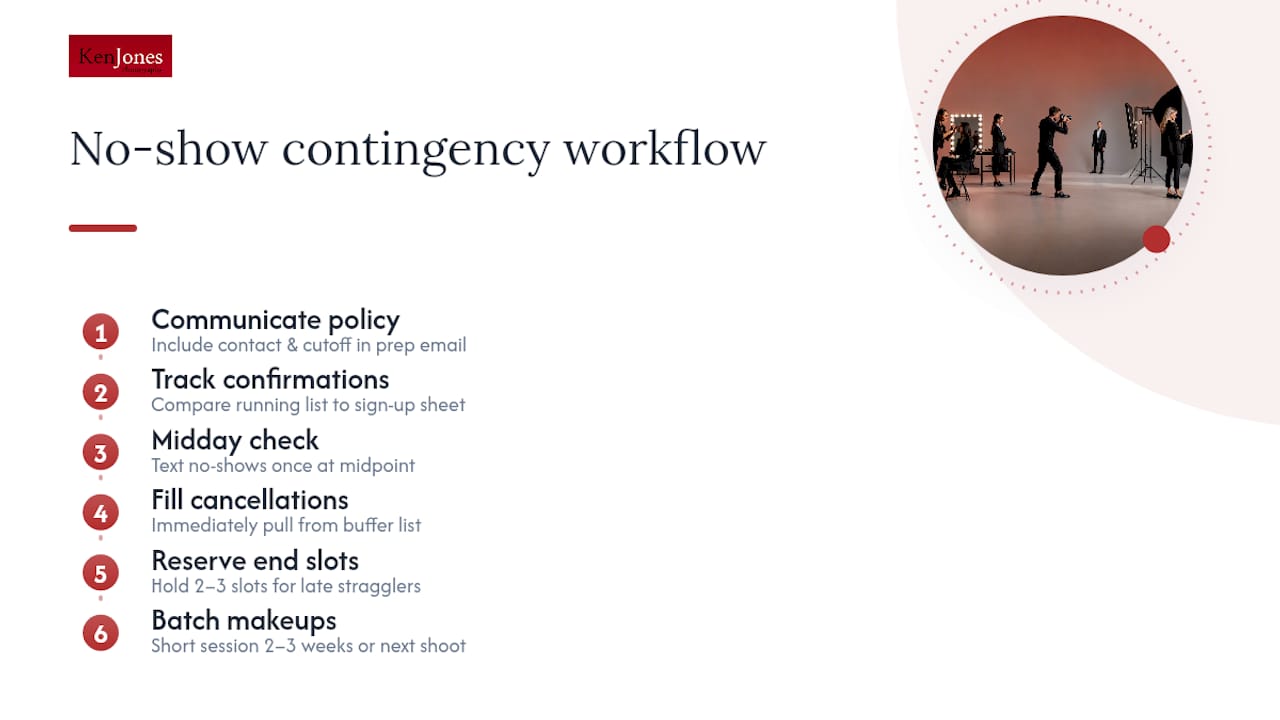
The smartest move is holding two or three unassigned slots near the end of the day specifically for stragglers and no-shows who turn up late. This avoids the scramble of trying to squeeze someone into an already tight schedule. For anyone who misses the day entirely, whether from a sick day or a client emergency, negotiate a small follow-up window, either a short session two or three weeks later or folding them into the next department’s shoot if your company runs headshot days in phases.
Communicate the makeup policy in the original prep email, not as an afterthought after someone’s already missed their slot. Something as simple as, “If you can’t make your scheduled time, contact [point person] by [date] to be added to the makeup list” removes the guesswork and the awkward follow-up emails. It also protects the photographer’s time, since makeup sessions get batched rather than scheduled one-off, which keeps costs predictable.
One thing I’d flag from experience: don’t let no-show slots sit empty in your schedule. If someone cancels with notice, fill that gap immediately from your buffer list rather than letting the day run short. An empty slot is wasted photographer time you’re paying for either way.
Handling Hierarchy and Different Roles During the Shoot
Every company has a hierarchy, and pretending otherwise on shoot day creates friction. Executives and department heads often need more than a standard single-look headshot. They may need a business-formal look plus a more casual environmental portrait for internal use, which takes longer and deserves its own extended slot rather than getting squeezed into the standard rotation.
Schedule senior leadership either first thing in the morning, when the studio setup is freshest and least likely to be running behind, or right after lunch when energy is back up. Avoid scheduling anyone senior at the very end of a long day when the photographer and the room are both fatigued.
For general staff, keep the process democratic. Don’t create a visibly different experience or noticeably longer wait for junior employees versus leadership, since that dynamic gets noticed and remembered longer than most people expect. Everyone should get the same wardrobe guidance, the same coaching, and comparable image quality, regardless of title.
Group shots are where hierarchy considerations get tricky logistically. Department leads often want to stand front and center, which is fine for organizational charts, but keep group shot composition brief and decided in advance rather than negotiated in real time in front of twenty standing employees. Assign a simple standard, taller people in back, shortest in front, alphabetical if needed, and let the point person direct it quickly so it doesn’t become the bottleneck of the whole day.
Helping Employees Feel Comfortable in Front of the Camera
Most people dread having their photo taken, and that discomfort shows up as a stiff smile or a deer-in-headlights stare. A few small adjustments make a real difference in the final images.
Give people something to do with their hands and body rather than standing rigid. Simple direction like “shift your weight to one leg” or “relax your shoulders down” reads as natural on camera even though it feels artificial to say out loud in the room. Should you smile in a corporate headshot? A relaxed, natural smile generally reads warmer and more approachable than a closed, neutral expression, though industry context matters. Law firms and finance often lean toward a more composed expression, while startups and creative agencies tend to favor warmer, more open smiles.
Talking to people while shooting, rather than shooting in silence, relaxes most subjects within the first thirty seconds. Asking a quick, unrelated question, what they had for lunch, whether they’re excited for the weekend, gets a genuine micro-expression on camera that a forced “say cheese” never produces. Reviewing one or two frames on the back of the camera and showing the subject also builds confidence fast, since most people relax once they see they don’t look as awkward as they feared.
Give people permission to take their time adjusting clothing or hair before the first frame. Rushing someone who’s visibly nervous almost always produces a worse result than the thirty extra seconds it takes to let them settle.
Post-Shoot Usage Policies and Employee Consent
Before the shoot day even happens, companies need a clear policy on how headshots will be used, and employees need to know it. This isn’t just good practice, it’s a basic trust issue. Nobody wants to discover their headshot on a billboard or a recruiting ad they never agreed to appear in.
At minimum, your prep communication should state where the images will be used: internal directory, company website, LinkedIn, marketing materials, press releases, or recruiting collateral. If there’s any possibility images could be used in paid advertising, that requires separate, explicit consent beyond a standard internal-use agreement.
Build a simple consent line into your sign-up process, something as short as a checkbox confirming the employee understands their headshot may appear on the company website and internal platforms. For any use beyond that scope, get a distinct signature. This protects the company from disputes later and protects employees from feeling like their image was used without their knowledge.
Departing employees are a separate policy question worth deciding in advance. Some companies pull former employees’ headshots from public pages within a set window after departure; others leave historical team pages untouched. Whatever you decide, put it in writing in your employee handbook or HR policy documentation, not as an ad hoc decision made every time someone leaves.
Budgeting for a Company Headshot Day
Cost planning for a headshot day depends heavily on team size, shoot complexity, and whether you’re shooting on-site or at a studio. Pricing structures generally fall into a few patterns: flat group rates with volume discounts for larger teams, straight per-person pricing, or a day-rate model that makes sense once you cross a certain headcount threshold.
A deposit to hold your date is standard practice across most photographers, so budget for that upfront rather than treating it as a surprise line item. Factor in a few costs beyond the photographer’s fee: any AV or facilities support needed to prep the room, printed signage directing people to the shoot location, and potential overtime if your team runs significantly larger than a single day can comfortably handle.
The biggest budget mistake companies make is treating headshot day as a one-time expense rather than a recurring line item. Teams grow, people leave, and roles change. Building a modest annual or semi-annual budget for smaller top-up sessions, new hires, promotions, keeps your team page from slowly drifting back into the mismatched mess a full headshot day was supposed to fix in the first place.
Compare the per-person cost of a coordinated headshot day against the cumulative cost of individual freelance sessions scattered throughout the year, and the group day almost always wins on both price and consistency.
A Photographer’s Honest Take on Headshot Day
Every studio has a shoot where the lighting was fighting the room, the schedule was too tight, or someone showed up in a pattern that strobed on camera. What separates a good headshot day from a bad one isn’t luck, it’s whether someone did the boring prep work: the email, the point person, the buffer time.
Consistent team headshots matter more than most companies realize until they don’t have them, a mismatched leadership page ages a brand faster than almost anything else on a website. If you’re reading this before your shoot, the one thing to do today is assign your point person and send the one-week email. Everything else follows from that.
— Ken
Book Your Company Headshot Day With Ken Jones Photography
Company headshot days can be run on-site across Manhattan and the Financial District, handling the full setup so your team doesn’t have to travel or lose half a day to a studio appointment across town. That means wardrobe guidance sent before the shoot, a lighting and backdrop setup built for consistency across dozens of employees, and retouched files delivered on an agreed turnaround, all confirmed upfront rather than negotiated after the fact.

A first conversation with the studio typically covers date availability, a sample schedule based on your headcount, and a straightforward quote so there are no surprises once the shoot is booked. If your leadership page or team directory has been drifting into mismatched photos for a while, this is the fix. Take a look at a studio headshot portfolio to see the consistency across real corporate teams, and reach out to check dates for your company’s next headshot day.
Sources
- How to Brief Employees Before Headshot Day: HR Checklist
- What to wear for business headshots
- How an Employee Headshot Day Can Boost Retention …
FAQ
Should You Smile in a Corporate Headshot?
A relaxed, natural smile generally reads as warmer and more approachable, though the right expression depends on industry. Finance and law firms often favor a more composed look, while creative and startup teams tend to prefer open smiles.
What Is a Corporate Headshot?
A corporate headshot is a professional portrait, typically head and shoulders, used for a company website, LinkedIn, internal directories, and marketing materials. It’s shot with controlled lighting and a neutral or branded background to look consistent across an entire team.
What Should You Wear for a Corporate Headshot?
Solid, neutral colors like navy, charcoal, or slate gray photograph best, since busy patterns can create a distracting moiré effect under camera sensors. Bring a backup top and dress one level more formal than your everyday office attire.
How Long Does a Company Headshot Day Take?
Standard slots run 5 to 7 minutes per person, with executives or multiple-look sessions taking 10 to 15 minutes. A team of 25 typically wraps in roughly three and a half hours once buffers are built in.
What Happens If an Employee Misses Their Headshot Slot?
Most organizers hold a few unassigned slots near the end of the day for stragglers, and set a clear makeup policy communicated in the original prep email so no one is left guessing about next steps.