
There is a point in many portrait sessions where the photograph you planned stops being the most interesting photograph available.
I’ve seen that happen hundreds of times.
You begin with the expected image: a clean headshot, a good expression, controlled lighting and a photograph that solves whatever practical problem brought the person into the studio.
Then the subject does something you didn’t tell them to do.
That’s usually when I start paying closer attention.
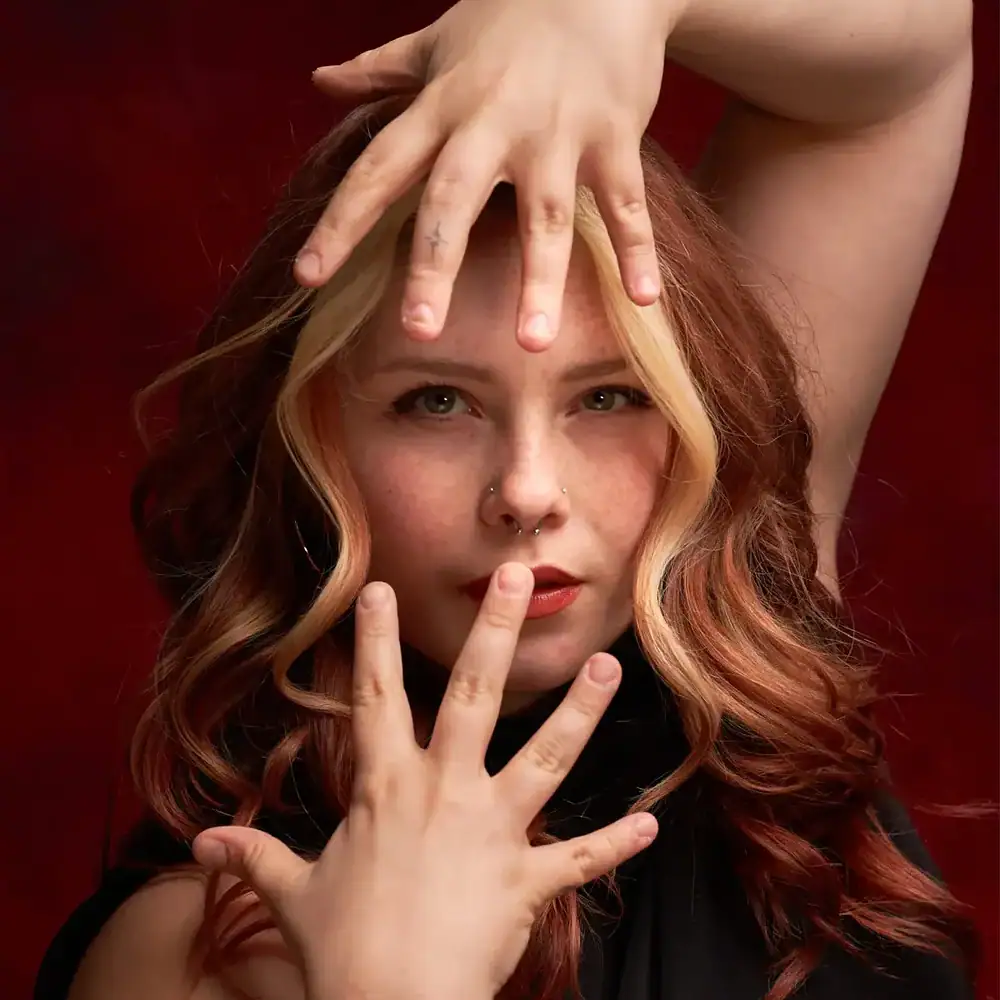
A recent personal project by New York photographer Maria Panina is a good example. Her Methodz series began as a straightforward idea: make headshots with dance students at Methodz of Madzness in Brooklyn.
As the session continued, those headshots began shifting into something more expressive.
You can read Maria’s own account in From Headshots to Movement: Photographing the Dancers of Methodz and see the full Methodz portrait project.
Dancers don’t think about posing the same way
Dancers understand their bodies spatially.
That’s an enormous advantage in front of a camera.
It doesn’t mean every dancer automatically knows how to pose for a portrait. Portrait photography and performance are different disciplines.
But dancers understand cause and effect.
Move the shoulder and the entire silhouette changes.
Shift your weight and the body’s relationship to the camera changes.
Extend a hand and suddenly the empty space inside the photograph has a different shape.
Photographers spend years learning to notice those things.
Dancers spend years learning to create them.
When the two disciplines meet, a headshot can become interesting very quickly.
Movement is useful even when the final photograph is still
I talk about movement frequently when directing people.
The reason isn’t that I want every portrait to look like an action photograph.
Movement breaks stiffness.
Most people become too aware of themselves when they’re asked to pose.
They start holding their shoulders.
Their hands become objects they don’t know what to do with.
Their expression freezes because they’re waiting for the photographer to press the shutter.
Movement interrupts that process.
I might ask someone to turn toward me rather than simply stand facing me.
I’ll have them change their weight.
I’ll let the hands move rather than placing them precisely and asking them not to move.
The photograph still freezes one frame.
But it comes from an action rather than a static instruction.
I’ve written about the same principle in posing and beauty work: some of the strongest frames happen during the transition rather than at the final pose.
The useful photograph and the memorable photograph are not always the same
A professional headshot has responsibilities.
If you’re an actor, casting needs to recognize you.
If you’re a dancer, a company or choreographer may need a clear promotional photograph.
If you’re an executive, the portrait has to communicate something appropriate to your role and organization.
Those requirements matter.
But once the practical photograph is made, there’s often room to push farther.
That’s where Maria’s Methodz project becomes interesting to me.
The common red background keeps the series visually connected, but the gestures begin separating the subjects from one another.
Hands come toward the lens.
Arms create shapes around the head.
Faces turn into profile.
The photographs stop asking only, “What does this person look like?”
They begin asking, “How does this person express themselves?”
That’s a much more interesting portrait question.
Direction shouldn’t erase the subject
A photographer needs to direct.
I don’t subscribe to the idea that we should simply stand behind a camera and wait for authenticity to appear.
Good direction creates the conditions where a person can relax enough for something authentic to happen.
The distinction is important.
I want to fix the lighting.
I want to watch the chin.
I want to know where the hands are.
But I don’t want twelve different people to leave my studio looking as though they all learned the same photographer’s pose.
My own portrait work covers executives, actors, models, musicians and personal subjects, and the purpose changes from job to job. The common goal is to make something polished while still specific to the person being photographed. My NYC portrait photography approach is here.
That is one of the reasons I think photographers can learn a lot from working with dancers.
They remind us that direction can be a conversation.
Gesture communicates before expression does
Portrait photographers naturally pay attention to the face.
We should.
But the body often communicates first.
You can see tension in someone’s shoulders before you see it in their expression.
You can see confidence in weight distribution.
A hand can make someone feel guarded, playful, theatrical, quiet or confrontational without the face changing at all.
Dancers understand this intuitively because gesture is already part of their language.
In Maria’s Methodz photographs, that becomes particularly clear when the hands start framing faces or moving toward the camera.
The gesture doesn’t decorate the portrait.
It changes what the portrait is saying.
Personal work is where photographers discover these things
Commercial photography needs a destination.
Personal photography can wander.
That’s valuable.
Some of the techniques I’ve carried into commercial assignments came from shoots where nobody asked me to solve a specific marketing problem.
You test a light.
You let somebody move.
You make a photograph you’re not sure you understand yet.
Months or years later, that experiment becomes part of the way you work.
Maria’s Methodz project started with headshots and found its way toward movement and self-expression.
That’s exactly what a personal project should be allowed to do.
It doesn’t have to prove the idea you started with.
Sometimes its real purpose is discovering the idea you didn’t know was there.
See Maria Panina’s complete essay, From Headshots to Movement, and view the Methodz series.