
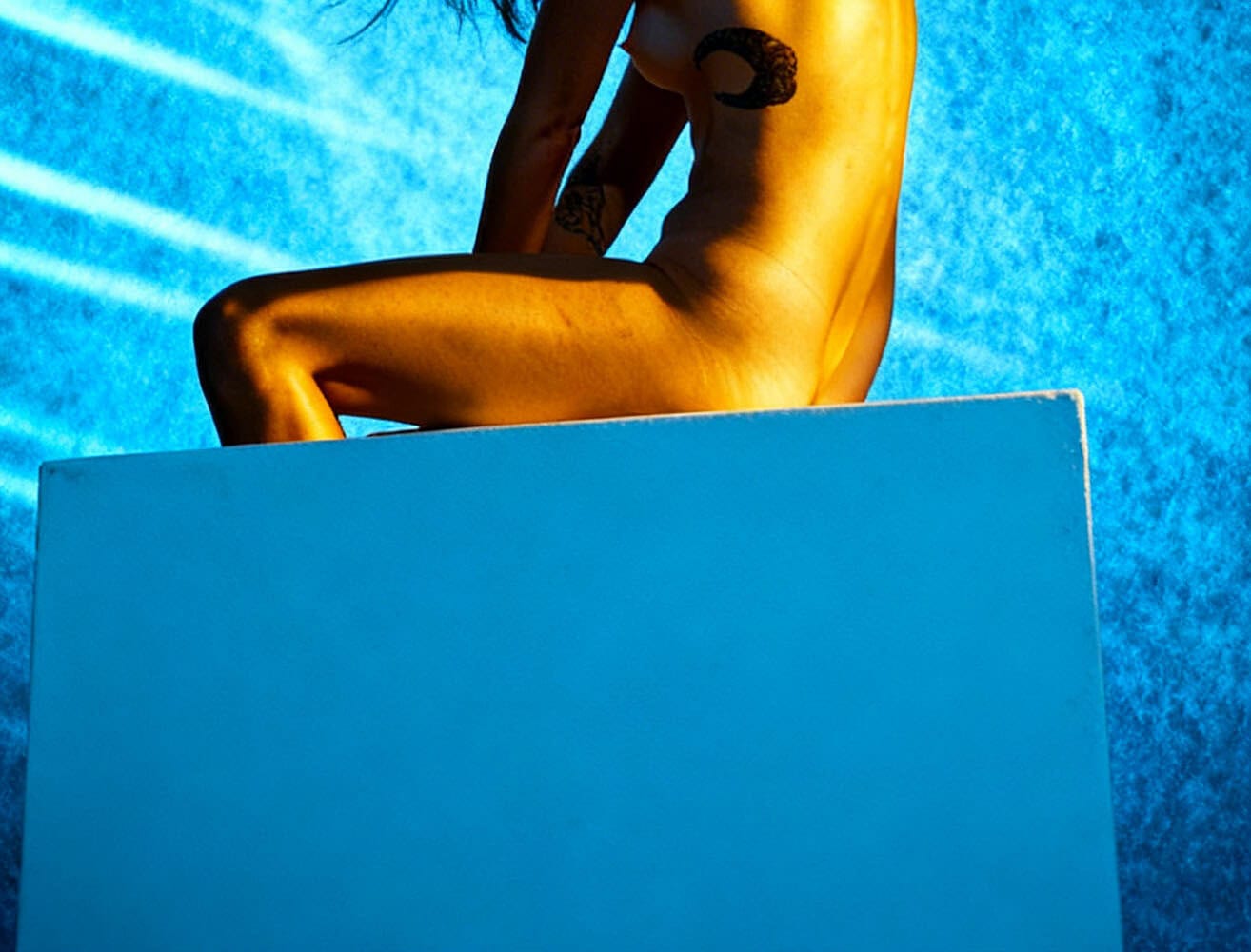
Portraiture has always occupied an interesting place in photography. A portrait can be a record of someone’s appearance, a professional introduction, an editorial statement, a commercial image, or something far more personal.
Fine art portrait photography begins when simply describing the person is no longer the photograph’s only purpose.
The subject is still important, but so are the photographer’s decisions about light, gesture, space, color, abstraction, movement and emotion. At that point, the portrait starts functioning less as documentation and more as interpretation.
After spending decades photographing people, I have found that this distinction has very little to do with how elaborate the production is. Some of the strongest fine art portraits can be made with one person, one light and a nearly empty room.
What matters is intent.
A Portrait Does Not Have to Explain Everything
Commercial portraiture usually has a job to do.
An executive portrait should communicate confidence and approachability. An actor’s headshot needs to show the person clearly. A model portfolio needs to communicate range. Advertising photography ultimately has to support a product or brand.
Fine art portraiture has more freedom.
The image can be ambiguous. The person can become part of a larger composition. A face may be obscured. Gesture may carry more meaning than expression. Clothing may disappear almost entirely from the equation. Shadows, reflections and negative space may become as important as the subject.
That freedom is one of the reasons I continue returning to personal portrait work.
My own Light & Form series explores this territory through beauty portraiture, figure studies, reflection, color and minimal studio compositions. View Light & Form on KenJonesNYC
The images still involve people, but I am not necessarily trying to explain who those people are. I am interested in what happens when the body, face, light and composition become part of the same visual language.
The Difference Between Photographing a Person and Interpreting One
One of the misconceptions about fine art photography is that it needs to look unusual.
It doesn’t.
A photograph can be beautifully straightforward and still have a strong artistic point of view.
The difference is often found in the photographer’s decisions.
Where does the person sit within the frame? Why is one side of the face allowed to disappear into shadow? What happens when the subject looks away rather than toward the camera? Does the image feel quiet, confrontational, fragile, sculptural or deliberately unresolved?
Those decisions are not decoration added after the portrait has been made. They are the portrait.
This is also where the photographer’s relationship with the subject becomes especially important.
A technically perfect photograph can still feel empty. Sometimes the most interesting frame happens after the formal pose has fallen apart and the person begins to move naturally.
That space between direction and accident is often where portraiture becomes interesting.
Collaboration Changes the Photograph
Fine art portraiture is rarely a completely solitary act.
Even when photographers arrive with a carefully developed concept, the person in front of the camera changes it.
That’s something I see clearly in the work of New York photographer and director Maria Panina, whose portfolio moves between artistic portraiture, movement, fashion, beauty and motion. Her work is particularly interesting when the subject’s physical presence becomes part of the idea rather than simply something being photographed. About Maria Panina and her work
Her personal portrait project Connection, for example, is built around trust, vulnerability and the physical language that appears between people. View Maria Panina’s Connection portrait series
That idea is important.
The human figure isn’t merely an object that we arrange inside a frame. People bring history, tension, personality and unpredictability into photographs.
The photographer can control lighting. We can choose the lens, background and composition. We can suggest movement.
But the photograph becomes much more interesting when we leave enough room for the subject to contribute something we didn’t completely plan.
Movement Can Function Like Expression
Traditional portraiture often concentrates heavily on the face.
Fine art portraiture doesn’t have to.
A hand, shoulder, silhouette or shift in weight can say as much as an expression. Once you start thinking that way, portrait photography begins to overlap with dance, performance and figurative art.
Maria’s Bottom of the River — Jarem Roots project is a useful example. The photographs use movement and custom garments so that fabric, gesture and body form become part of the visual structure of the image rather than simply styling placed onto a model. See Bottom of the River — Jarem Roots
Movement creates uncertainty, and uncertainty can be valuable.
When someone is moving, you cannot completely control every fold of fabric, strand of hair, gesture or expression. Photography freezes one fraction of that action.
Sometimes the frame immediately before or after the expected photograph is the one that carries the most energy.
Beauty Photography Can Also Become Fine Art
There is a similar overlap between fine art portraiture and beauty photography.
Beauty work is often associated with polish and precision: controlled skin, makeup, hair and lighting.
But those same tools can be used much more conceptually.
Flowers can become sculpture around a face. Glass can fragment a portrait. Color can alter how skin is perceived. Cosmetics can become texture instead of simply product. A tightly cropped face can become almost abstract.
Maria’s editorial project Pink Story — Iconic Artist Magazine demonstrates another version of this approach, contrasting an edgy subject with softer styling, plants, patterns and natural forms. View Pink Story — Iconic Artist Magazine
Her broader collection of project-based work also moves comfortably between portrait, editorial, beauty and movement photography. Explore Maria Panina’s selected photography projects
These categories do not need rigid walls around them.
Some of the most interesting photography happens exactly where those categories begin to overlap.
Light Is More Than Illumination
Photographers sometimes talk about lighting as if its purpose is simply to make the subject visible.
In fine art portraiture, light has another job.
It creates structure.
Hard light can carve a face into geometry. Soft light can nearly erase its edges. Backlight can reduce the body to outline. Reflections can create competing versions of the same person.
Shadow is equally important.
You don’t always need to show everything.
One of the lessons I learned relatively early in photography was that adding more light does not necessarily make an image better. Quite often the opposite is true.
Removing information can force the viewer to participate in the photograph.
That is especially useful in portraits.
The Camera Can Describe, but the Photographer Has to Decide
Photography has always had an unusual relationship with reality because a camera records something that physically existed in front of it.
That can make photographs feel objective even when they aren’t.
Every photograph is a collection of choices.
Where I stand changes the picture. The lens changes it. The moment I release the shutter changes it. The light changes it. What I leave outside the frame changes it.
Portrait photographers make another decision as well: how much of this person do I want the viewer to know?
A commercial portrait may answer that question very clearly.
A fine art portrait can deliberately leave it unanswered.
That ambiguity is not a flaw. It can be the thing that keeps someone looking at the photograph.
Personal Work Eventually Changes Commercial Work
I think personal work matters enormously for professional photographers.
It gives us a place to experiment without having to solve a client’s problem at the same time.
You can make an image that fails.
You can change your lighting halfway through the session.
You can make something simply because you haven’t made it before.
Eventually those experiments find their way back into commissioned work.
A lighting technique discovered during a figure study becomes part of a beauty shoot. A reflection experiment becomes the foundation of an editorial. A strange crop that initially felt uncomfortable becomes part of your visual vocabulary.
That is why I don’t see a strict division between my commercial photography and my fine art portrait photography. Explore Fine Art Photography at Ken Jones NYC
They feed each other.
Fine Art Portraiture Is Ultimately About Point of View
There is no single visual style that makes a portrait fine art.
Black and white doesn’t automatically make a photograph artistic. Neither does grain, dramatic lighting, unusual wardrobe or abstraction.
Those are tools.
What matters is whether the photographer is using those tools to say something.
For me, fine art portraiture begins when the photographer stops asking only, “How do I make this person look good?”
A more interesting question appears:
“What photograph can I make with this person that could not exist in quite the same way without both of us being here?”
That’s a much harder question.
It’s also why portraiture remains one of the most interesting subjects in photography.
Related Work
For another perspective on contemporary portraiture, movement and visual storytelling, explore Maria Panina’s photography and motion portfolio. Maria Panina — Selected Stills Her project archive includes personal portraiture, editorial work, beauty studies and movement-driven photography, and photographers or subjects interested in creating their own work can also view her current portrait and artist-session options. Maria Panina — Book a Portrait or Artist Session