
Mariupol: Two Studies After Guernica
Two contemporary fine art studies by Ken Jones responding to the destruction of civilian life in Ukraine through the visual language of Guernica, with the original composition included as reference.
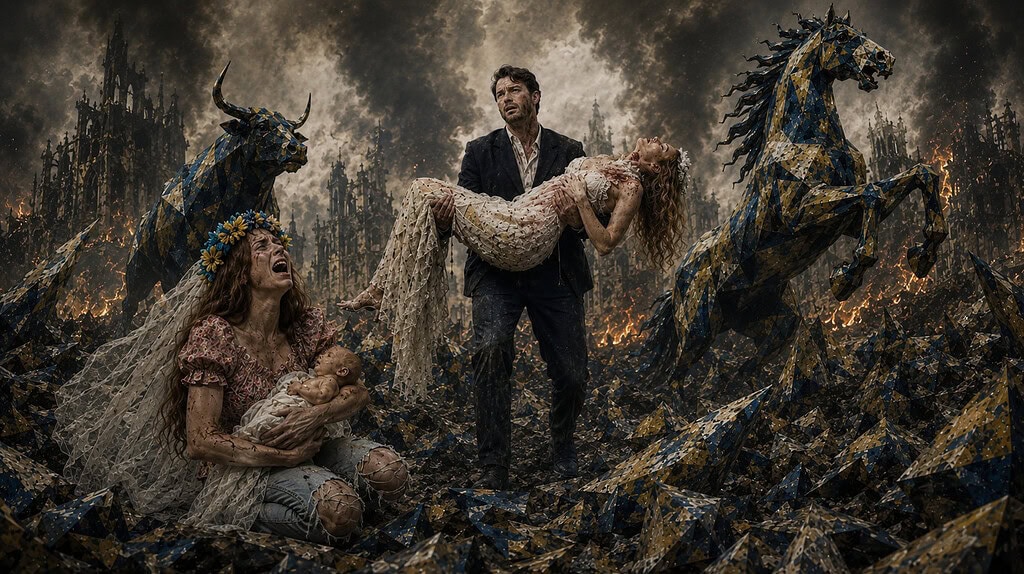
I am not an expert on war. I do not study it for recreation. I am not a Ukrainian nationalist, and I am not driven by hatred of Russia.
So why would I create images filled with horror, destruction, and despair?
Because there are moments when beauty is not enough. There are moments when an image has to stand in front of violence and say: this is what it leaves behind.
Picasso painted Guernica in response to the bombing of a Spanish city during the Spanish Civil War. He did not need to paint uniforms, planes, flags, or soldiers. He painted the aftermath: the broken bodies, the screaming mothers, the animals, the terror, the civilians trapped inside history.
That is the path I followed here.
I used the colors of Ukraine, maybe more directly than Picasso would have. I wanted that connection to be clear. But these images are not about nationalism. They are about civilians. They are about children killed, families destroyed, homes erased, and people punished simply for being in the wrong place when violence arrived.
Mariupol became one of the clearest symbols of that suffering.
These two images are my response to the destruction of Ukraine’s civilian life. They are not military paintings. They are not political propaganda. They are a visual objection to cruelty.
And the question I keep returning to is simple:
When will this end?
Two contemporary studies after Guernica
Mariupol: Two Studies After Guernica uses the structure and emotional force of Guernica as a point of departure, then moves the imagery into a contemporary visual language of photorealistic figures, fractured blue and yellow animal forms, ruined architecture, smoke, rubble, and fire.
The gallery includes the two finished studies and the original Guernica reference image for context. The reference is included to make the relationship clear: not as imitation, but as a visual conversation with one of the most important anti-war images in modern art.
Fine art image-making as witness
This work sits within Ken Jones’s fine art portfolio because it uses staged characters, symbolic composition, and post-production image construction to create a moral and emotional response rather than a documentary record. The images are not reportage. They are a visual objection to violence against civilians.