
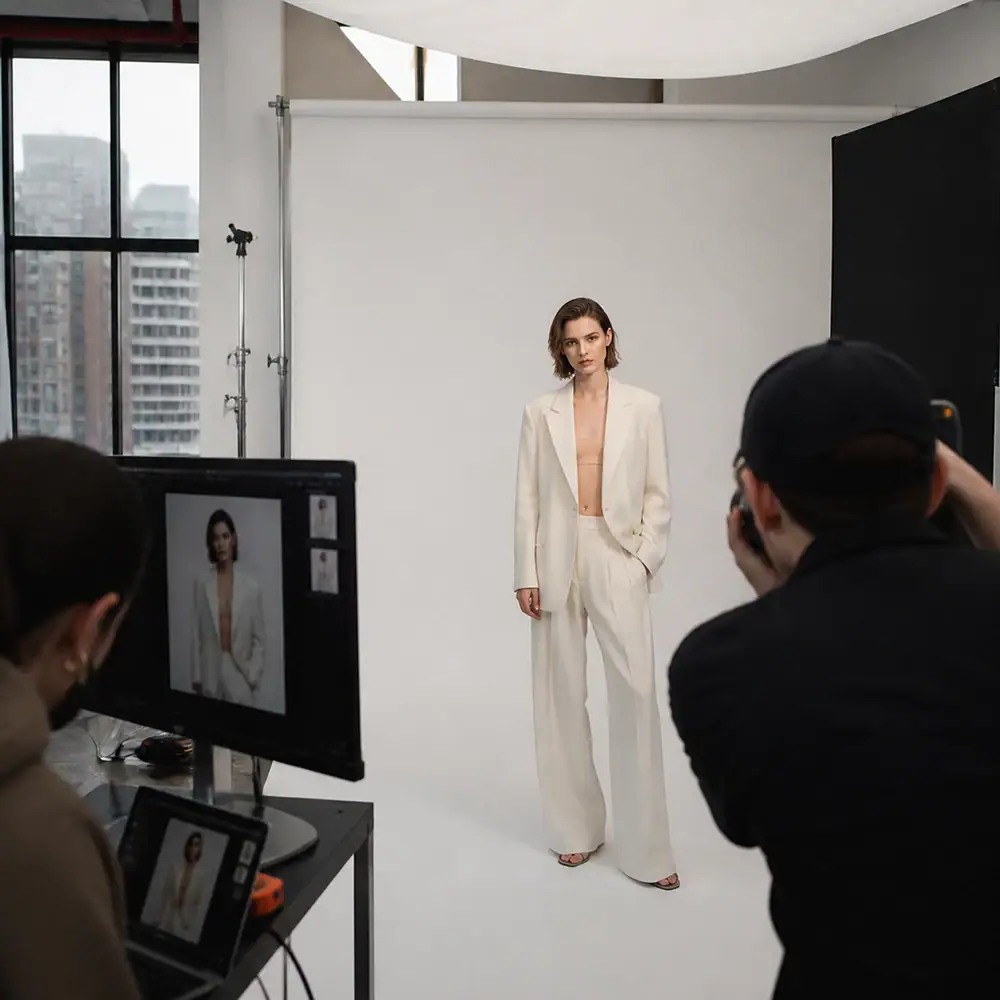
When scouting new faces or updating portfolios for major booking boards, casting directors and modeling agencies look for one non-negotiable attribute above all else: absolute honesty. Whether an aspiring talent is submitting packages to agencies in New York, Paris, or Milan, the standard requirement remains the classic "digital": unretouched, unfiltered polaroids or test shots that reveal true bone structure, skin texture, and natural proportions.
Yet, in an era where everyone carries a pocket-sized supercomputer equipped with advanced computational optics, capturing a truly honest image has paradoxically become more difficult. Modern smartphones do an incredible job of making everyday snapshots look punchy, vivid, and flattering. But when it comes to professional agency photography, those very same in-camera enhancements often work against the model.
At Ken Jones Photography, working with emerging talent and established model agencies in downtown Manhattan requires an uncompromising understanding of how light interacts with skin and form. To achieve the clean, unadorned look that booking directors trust, nothing can replace precise studio lighting for models: specifically, the thoughtful deployment of overhead silks, professional scrims, and controlled bounce cards.
The iPhone Illusion: Why Computational Photography Fails Casting Directors
If you open your camera roll after taking a quick portrait on a modern smartphone, the image looks remarkably bright. Shadows are lifted, skin blemishes are mysteriously smoothed away by default noise reduction algorithms, and edge contrast is artificially boosted to make features pop.

To an untrained eye, this looks like a great photograph. But to a booking agent or commercial casting director evaluating model digitals NYC, these automated enhancements are a red flag.
- Algorithmic Smoothing: Smartphones use multi-frame stacking and machine learning to reduce noise in lower-light environments. In doing so, they frequently wipe out fine skin texture, vellus hair, and subtle facial gradients. To an agency, smoothed skin looks suspicious: it masks how the talent will actually look under professional lighting on a live set.
- Aggressive Tone Mapping: Consumer cameras automatically compress dynamic range to ensure highlights aren't blown out and shadows aren't pitch black. This flattens the natural three-dimensional topography of the face, muting the shadows under the cheekbones and jawline that define a model's structural features.
- Artificial Sharpening and Micro-Contrast: Phones apply high-pass sharpening filters that create harsh halos around eyes, lips, and hair strands. This digital crunchiness destroys the organic roll-off of light that professional photographers rely on to create depth.
In short, an iPhone picture looks "good" because the software is constantly editing it behind the scenes. Agencies do not want an AI-assisted interpretation of a model; they want raw, truthful data rendered through pure optical physics.
Anatomy of a Clean Digital: The Physics of Professional Scrims
Achieving a clean, honest digital requires controlling light rather than outsourcing it to software. In a professional studio setting, this is accomplished through large-scale diffusion tools like overhead silks, custom scrims, and softboxes.

When light passes through a high-end diffusion scrim, the apparent size of the light source increases dramatically. According to the fundamental laws of optics, a larger light source relative to the subject creates softer, more gradual transitions between highlight and shadow.
- Overhead Silks: Suspending a large diffusion panel directly above the model creates a soft, wrap-around top light that gently defines the brow bone, bridge of the nose, and cheekbones without creating harsh raccoon eyes.
- Vertical V-Flats and Bounces: Placing white foam boards or reflectors just out of frame bounces ambient light back into the fill side of the face. This maintains detail in the shadows without muddying them or introducing artificial color casts.
- High-CRI Continuous or Strobe Sources: Professional studio strobes and high Color Rendering Index (CRI) LEDs ensure that every wavelength of the visible spectrum is represented accurately. Skin undertones: whether warm olive, cool porcelain, or rich deep ebony: render with absolute fidelity.
When you light a subject with a large, perfectly diffused source, the resulting image has natural depth and dimension. The skin looks tactile and alive because every pore and contour is rendered honestly by optical light fall-off, not erased by a digital processor.
Mastering Shadow Graduation and Bone Structure
The hallmark of exceptional agency photography is how the light sculpts the face. Amateur or consumer lighting often results in either flat, shadowless illumination (like a direct ring light) or harsh, unflattering hotspots.
Professional studio lighting allows the photographer to control the contrast ratio with pinpoint precision. By positioning a primary key light at a precise angle behind a diffusion frame, and balancing it with subtle negative fill or bounce, the photographer can reveal:
- The Zygomatic Arch (Cheekbones): Gentle shadow graduation accentuates the natural geometry of the face without requiring makeup contouring tricks.
- The Jawline and Neck: Clean separation between the chin and collarbone ensures the silhouette reads clearly even in simple, straight-on polaroids.
- Eye Clarity: Soft, overhead or frontal diffusion creates natural, beautiful catchlights in the eyes, bringing life and engagement to the portrait without digital brightening.
Explore our dedicated Model Test services to see how we approach portfolio development for developing and established talent.
Studio Practice vs. Quick Snapshots: What to Expect on Set
When developing a professional digital package or executing a test shoot for a major agency, the production workflow matters just as much as the gear. Here is how a professional studio session differs from a casual snapshot:

- Controlled Environment: Weather changes, stray color reflections from colorful walls, and uneven ambient light are eliminated. Every frame shot at 11:00 AM matches the light quality of frames shot at 3:00 PM.
- Standardized Angles: Agencies require specific framing: a waist-up shot, a full-length shot, a profile, and a direct straight-on headshot. Maintaining consistent focal lengths (typically an 85mm or 105mm portrait lens on a large-sensor camera) prevents facial distortion caused by wide smartphone lenses.
- Wardrobe and Styling Discipline: Digitals require minimal distraction. Simple, form-fitting black or neutral clothing (tank tops, denim, or swimsuits) paired with clean, zero-product hair and bare-minimum skincare lets the model's natural features take center stage.
For a broader look at our fashion work, visit our Fashion Editorial portfolio.
Conclusion: Honesty in the Digital Age
In an industry flooded with filters, presets, and algorithmic touch-ups, authenticity remains the ultimate luxury. Booking directors and fashion houses can spot a heavily processed image instantly: and they know that filters cannot disguise poor lighting or lack of real-world preparation.
By investing in professional studio lighting for models, precise diffusion, and large-format camera sensors, photographers provide agencies with the honest visual canvas they need to make confident casting decisions. Whether you are building an initial portfolio or updating your agency package in New York, trading phone filters for professional studio light is the single most effective upgrade you can make.