
TL;DR:
- Editorial photography licenses allow use for news, education, and documentation purposes but prohibit commercial promotion. Misusing such images for advertising or editing them misleadingly can lead to legal disputes and costly settlements. Verified licenses, organized documentation, and internal approval processes are essential to licensing compliance.
Editorial photography licensing is defined as the legal permission to use photographs specifically for informational, educational, or news-related purposes, distinct from commercial advertising use. Photographers, editors, and content creators who understand how to license editorial photography correctly protect themselves from costly legal disputes and build credibility with clients. The distinction between editorial and commercial photo rights is not a technicality. It is a legal boundary with real consequences, particularly in states like New York and California where right-of-publicity laws carry significant enforcement weight. This guide covers the core concepts, practical steps, and common mistakes that every working photographer and content creator needs to know.
How to license editorial photography: editorial vs. commercial use
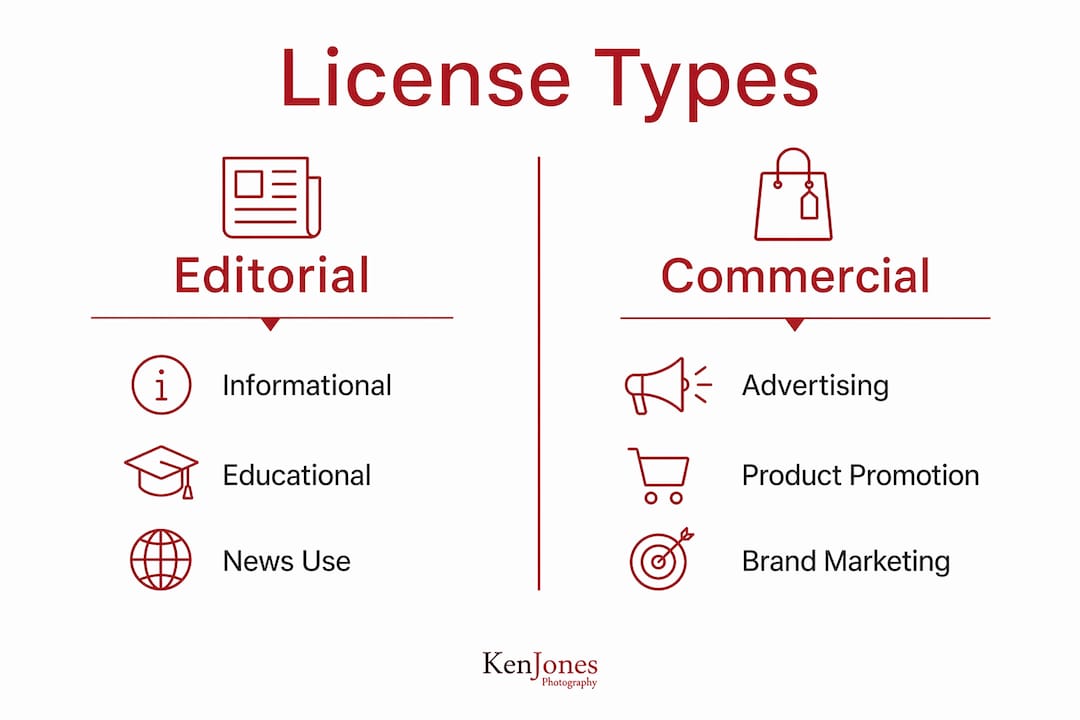
The most important distinction in photography licensing is the line between editorial and commercial use. Getting this wrong is the single most common cause of legal trouble for photographers and content creators working with licensed images.
An editorial license permits use in contexts that inform, educate, or document. News articles, magazine features, documentary projects, textbooks, and commentary pieces all qualify. The key requirement is that the image supports factual reporting or creative expression, not promotion. Editorial use is allowed in news, documentary, and education contexts. Commercial use, by contrast, requires a separate license entirely.
A commercial license covers advertising, branding, product promotion, and social media marketing campaigns. These uses require signed model and property releases because they imply endorsement or association. The legal rationale is straightforward: a person photographed at a public event has not consented to having their face used to sell a product.
Here is where the distinction becomes concrete:
- Allowed under editorial license: A magazine publishes a photo of a celebrity at a New York Fashion Week runway show. The image documents a public event.
- Not allowed under editorial license: That same photo appears in a paid advertisement for a fashion brand. This triggers right-of-publicity claims.
- Allowed under editorial license: A news website uses a photo of a city street to illustrate a story about urban development.
- Not allowed under editorial license: A real estate company uses that same street photo in a promotional brochure without clearing the image for commercial use.
- Allowed under commercial license: A beauty brand uses a model’s portrait in a product campaign after obtaining a signed model release.
The editorial-license exemption from model release requirements stems from First Amendment protections covering public event documentation. That protection disappears the moment the image serves a commercial purpose. Understanding this boundary is the foundation of any solid photography licensing guide.
Pro Tip: If you are unsure whether a use is editorial or commercial, ask one question: does this image promote a product, service, or brand? If yes, you need a commercial license and releases.
How do you verify and interpret editorial photo licenses?
Verifying a license before using an image is not optional. Many photographers and content creators assume that a label like “royalty-free” covers all uses. It does not. Assuming “royalty-free” equals universal permission leads directly to copyright litigation. Royalty-free means you pay once and do not owe royalties per use. It does not mean the image is free for commercial purposes.
Every license agreement contains specific terms that define what you can and cannot do. Review each of these components before using any image:
| License term | What it means | What to watch for |
|---|---|---|
| Permitted uses | The specific contexts where the image may appear | Confirm editorial use is explicitly listed |
| Geographic scope | The countries or regions where use is allowed | Global campaigns may need broader clearance |
| Duration | How long the license remains valid | Evergreen content needs long-term or perpetual rights |
| Attribution requirements | Whether the photographer must be credited | Editorial licenses often require a credit line |
| AI and digital restrictions | Limits on using the image in AI training or digital compositing | Newer licenses increasingly include these clauses |
| Exclusivity | Whether others can license the same image | Non-exclusive is standard for editorial use |
Safe editorial licensing requires verifying permitted uses, geographic restrictions, and maintaining organized documentation for 3–7 years. That documentation includes purchase receipts, the full license text, and any release forms associated with the image. Store these records in a dedicated folder for each project, not scattered across email threads.
Pro Tip: Never rely on a platform’s category tags to determine license type. Download the full license agreement as a PDF and read the permitted uses section word for word before publishing.
Step-by-step guide to licensing editorial images correctly
Licensing editorial images correctly follows a repeatable workflow. Skipping steps creates gaps that become legal problems later, especially when content gets repurposed across platforms or campaigns.
Step 1: Define the use case before selecting an image.
Identify exactly where the image will appear, for how long, and in what geographic markets. A photo used in a print magazine feature has different requirements than the same image appearing on a brand’s website or in a social media post. Write this down before you search for images.
Step 2: Select a license that matches the use case.
Match the license type to the defined use. Editorial licenses cover journalism, education, and documentary contexts. Commercial licenses cover marketing, social ads, and branded content. Do not stretch an editorial license to cover a use it was not designed for.

Step 3: Obtain the license agreement in writing.
A verbal agreement or a screenshot of a platform’s terms page is not sufficient. Download the full license document. If you are licensing directly from a photographer, use a written contract that specifies the permitted uses, duration, territory, and any attribution requirements. Kenjonesnyc, for example, provides written license agreements for all editorial and commercial work produced through the studio.
Step 4: Verify model and property releases.
Editorial images are often licensed without model or property releases because they document public events. Confirm this is the case for your specific image. If you plan to repurpose the image beyond its original editorial context, you need releases before proceeding.
Step 5: Organize and store your documentation.
Create a project folder that contains the license agreement, proof of purchase, any release forms, and a note describing the approved use. Image licensing is a change-management process requiring regular review as campaigns evolve. When a campaign changes direction or a piece of content gets repurposed, revisit the license before publishing.
Step 6: Conduct periodic compliance audits.
Review active licenses quarterly. Check whether any content has been moved into new contexts that fall outside the original permitted uses. Internal policies that separate editorial and commercial workflows and include regular image compliance audits are the most reliable protection against accidental violations.
Pro Tip: Build a simple spreadsheet tracking each licensed image, its permitted uses, expiration date, and storage location for the license document. This takes 10 minutes per project and saves hours of legal exposure later.
What are the most common mistakes when using editorial photos?
The most expensive licensing mistakes are not made by people who ignore the rules. They are made by people who misread them. Understanding where things go wrong is as useful as knowing the correct process.
Using editorial images in advertising. This is the most frequent violation. A content creator licenses an image for a blog post, then repurposes that same image in a paid social media ad without obtaining a commercial license. Editorial photos often contain legally sensitive elements like trademarks, faces, or buildings not cleared for advertising. Using such images beyond their editorial context risks civil claims for misappropriation of likeness or implied endorsement.
Editing images in misleading ways. Cropping, retouching, or placing an editorial image in a new context can create a false impression that a person endorses a product or service. Misusing editorial images by editing or placing them in misleading contexts often leads to licensing violations and reputational harm. The original license does not cover derivative uses that change the meaning of the image.
Ignoring geographic restrictions. A license valid for North American editorial use does not automatically cover European publication. This matters for digital content, which crosses borders instantly. Always check the geographic scope before publishing internationally.
“The right-of-publicity laws in New York and California are among the strongest in the country. A photographer or brand that uses an editorial image commercially without a release is not just risking a fine. They are opening the door to a lawsuit from the subject of the photograph, the photographer, or both. The legal exposure is real, and the settlements are not small.”
Real-world consequences follow these mistakes. A New York-based fashion brand once used a street-style photograph, originally licensed for editorial use in a trade publication, in a paid Instagram campaign without securing a commercial license or model release. The subject of the photograph filed a right-of-publicity claim. The brand settled out of court. The cost of the settlement exceeded the entire budget of the original campaign. The lesson is not subtle: the license type must match the use, every time.
The best protection is a clear internal approval process. Before any image moves from editorial to promotional use, require written sign-off from someone who has reviewed the license terms. Establishing internal approval processes for image use prevents the most common errors, including the assumption that all editorial images are free for commercial use.
Key Takeaways
Licensing editorial photography correctly requires matching the license type to the specific use, verifying all terms in writing, and maintaining organized documentation for every project.
| Point | Details |
|---|---|
| Editorial vs. commercial distinction | Editorial licenses cover news and education; commercial use always requires a separate license and releases. |
| Verify every license term | Check permitted uses, geographic scope, duration, and attribution before publishing any image. |
| Documentation is non-negotiable | Store license agreements, receipts, and release forms for 3–7 years per project. |
| Repurposing triggers new requirements | Moving an image from editorial to promotional use requires a new commercial license and model releases. |
| Internal approval processes prevent violations | A written sign-off workflow stops accidental misuse before it becomes a legal problem. |
What 30 years of editorial licensing in NYC taught me
The photographers who get into trouble with editorial licensing are almost never the ones who set out to cut corners. They are the ones who move fast and assume the license they have covers the use they need. I have seen this play out dozens of times in New York, and the pattern is always the same.
A client comes to me after a shoot, excited about the images, and wants to repurpose a set of editorial photos for a brand campaign. The images were licensed for a magazine feature. They were not cleared for advertising. The client did not know the difference, and nobody on their team thought to check. By the time the legal issue surfaces, the campaign is already live.
The fix is always the same: slow down before you publish. Read the license. If you are working with a photographer directly, ask for a written agreement that spells out exactly what you can do with the images and for how long. A fashion editorial shoot and a commercial campaign are two entirely different productions with different legal requirements, even when the images look similar.
The other thing I tell photographers who want to sell editorial images: price your licenses correctly. Editorial rights managed pricing accounts for the publication’s circulation, the duration of use, and the geographic market. Do not give away unlimited rights for a flat fee. Know what your work is worth and structure the agreement to protect that value over time.
Licensing is not paperwork. It is the foundation of a professional photography practice.
— Ken
Editorial photography services at Kenjonesnyc
Kenjonesnyc brings over 30 years of production experience to every editorial and commercial project, from fashion editorials shot on location across New York City to advertising campaign photography for fashion brands and corporate clients. The studio handles the full production process, including creative direction, casting, styling, and licensing guidance, so clients understand exactly what rights they are receiving and how those rights apply to their specific use case.
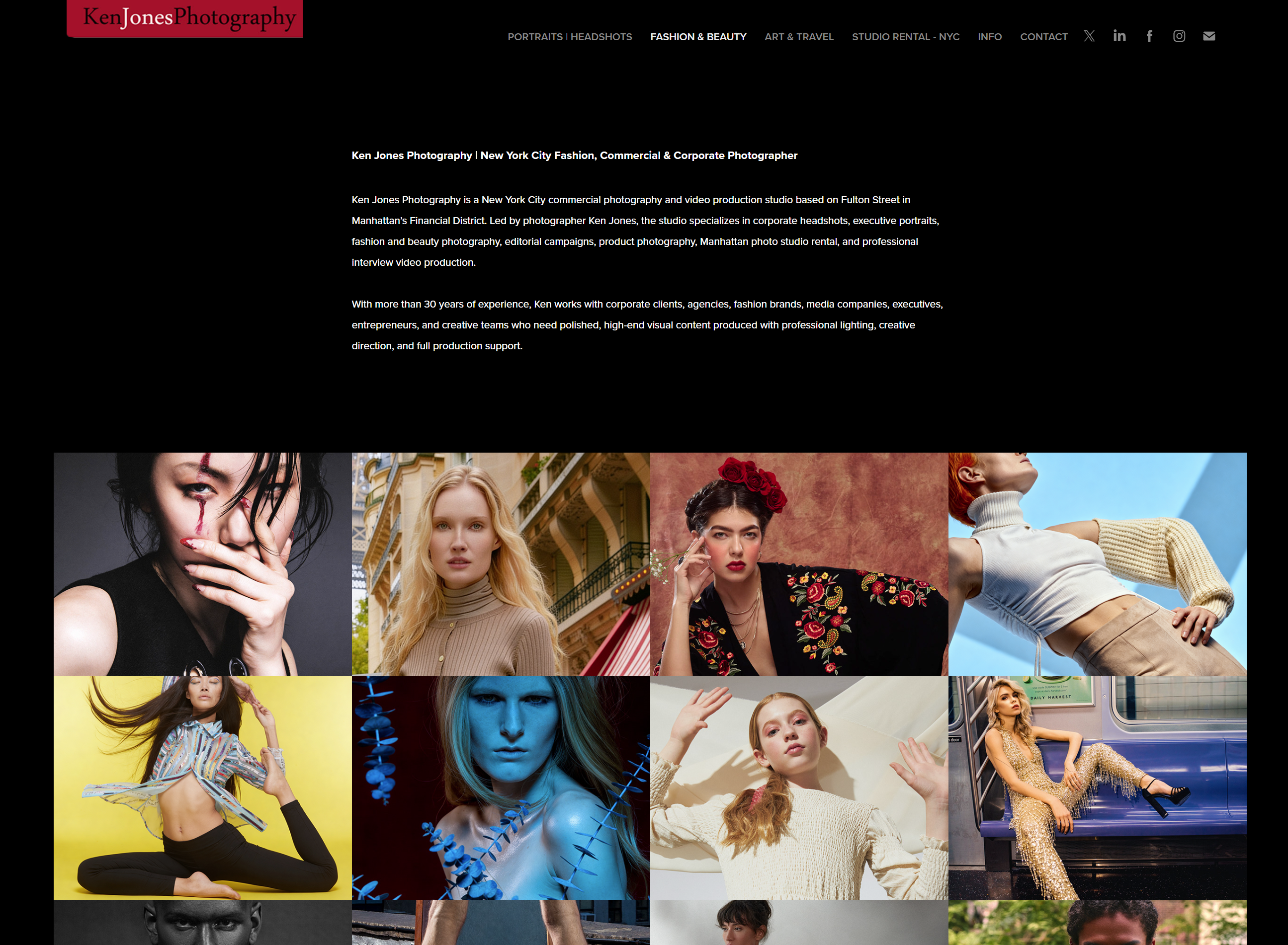
Whether you need editorial portraits for a magazine feature, beauty imagery for a PR campaign, or celebrity editorial portraits for press coverage, the studio delivers work built on clear agreements and professional standards. Reach out through kenjonesnyc.com to discuss your project and get the licensing structure right from the start.
FAQ
What is editorial photography licensing?
Editorial photography licensing is permission to use photographs in informational, educational, or news contexts, such as magazine articles, documentaries, and textbooks. It does not cover advertising or promotional use.
Do editorial photos require model releases?
Editorial images often do not require model releases because they document public events under First Amendment protections. Using those same images commercially without releases exposes you to right-of-publicity claims, particularly in New York and California.
What does “royalty-free” mean for editorial photos?
Royalty-free means you pay a one-time fee without owing royalties per use. It does not grant commercial rights. Always read the permitted uses section of the license to confirm whether editorial or commercial use is covered.
How long should I keep photo license documentation?
Maintain organized documentation for 3–7 years per project, including the license agreement, proof of purchase, and any release forms. This protects you if a licensing dispute arises after publication.
Can I use an editorial photo in a social media ad?
No. Social media advertising is a commercial use and requires a commercial license along with signed model and property releases. Repurposing an editorial image in a paid ad without these clearances is one of the most common causes of right-of-publicity claims.