
TL;DR:
Manhattan studio locations boost brand perception, client attendance, and shoot efficiency through transit access and prestige.
Verifying freight logistics and choosing the right space type are critical to maximizing production value and avoiding delays.
Manhattan studio location is a strategic production asset that directly shapes brand perception, client attendance, and shoot-day efficiency for professionals in fashion, media, and advertising. The borough’s transit density, cultural authority, and proximity to agency headquarters make it the default choice for client-facing work where image and access are non-negotiable. Understanding why Manhattan studio location matters means looking beyond square footage and day rates to the full business case: who shows up, how fast the crew loads in, and what the address signals to a luxury client before a single frame is shot. Kenjonesnyc, based in Manhattan’s Financial District, has built three decades of commercial production around exactly that logic.
Why Manhattan studio location matters for brand image and client access
Manhattan studio location is the clearest signal a creative business sends about its positioning. When a fashion brand, modeling agency, or advertising client receives a call sheet with a Manhattan address, it communicates a level of seriousness that an outer-borough address rarely matches at first contact. That perception is not superficial. It reflects real market dynamics in which luxury clients associate Manhattan with the editorial and commercial work they want to be associated with.
Transit connectivity acts as a productivity multiplier for client-heavy business models. A creative director flying in from Los Angeles, a brand manager commuting from Midtown, and a stylist traveling from Brooklyn can all reach a Manhattan studio without renting a car or coordinating shuttle logistics. That frictionless access translates directly into higher attendance at client reviews, faster approvals, and fewer reschedules. For brands choosing Manhattan studios for frequent client meetings, this is one of the most underrated financial benefits of the location.
The networking density of Manhattan also compounds over time. Casting directors, art buyers, fashion editors, and agency producers all cluster in Manhattan. Working from a Manhattan studio means your crew, your clients, and your collaborators are often within walking distance of each other. That proximity reduces coordination friction on shoot days and builds the kind of ongoing professional relationships that generate repeat bookings.
Pro Tip: When evaluating a Manhattan studio for a client-facing shoot, ask the studio manager which subway lines are within a three-block walk. A studio near multiple lines cuts client latency on shoot day more reliably than any amount of parking.
Brand prestige compounds with project visibility. When editorial credits list a Manhattan studio, the location itself reinforces the quality signal of the work. For fashion and beauty campaigns targeting luxury consumers, that association carries real weight in how the finished imagery is received by editors and buyers.
What the Manhattan creative ecosystem adds beyond the studio walls
Manhattan’s creative ecosystem extends well beyond the studio door. The Financial District, Midtown, and the Garment District each offer distinct production resources within a short cab ride: fabric suppliers, prop houses, hair and makeup artists, and post-production facilities. A shoot that needs a last-minute wardrobe pull or a replacement lighting fixture can solve that problem in under an hour. In an outer-borough studio, the same problem can cost half a shoot day.
How do Manhattan studio logistics affect production efficiency?
Manhattan studio logistics are the most misunderstood part of the location decision. The borough’s prestige comes with real operational constraints, and experienced producers factor those constraints into every budget and schedule.
The most significant friction point is freight access. High-rise studio shoots in Manhattan require 30–45 minutes longer setup per shoot day compared to industrial-style spaces with direct street access. That number compounds across a multi-day campaign. On a five-day fashion shoot, 30 minutes of daily freight delay adds up to more than two hours of lost production time. That is real money when you are paying a full crew.
| Studio type | Freight access | Avg. setup time impact | Best suited for |
|---|---|---|---|
| Manhattan high-rise | Freight elevator, scheduled dock | +30–45 min per day | Client meetings, editorial, beauty |
| Manhattan street-level | Direct load-in | Minimal delay | Commercial, product, video |
| Purpose-built (Sunset Pier 94) | On-site parking, stage-level access | No additional delay | Large-scale film, TV, high-end fashion |
| Outer-borough industrial | Ground-floor, wide dock | Minimal delay | Large sets, cost-sensitive productions |
Manhattan historically lacked purpose-built production space, relying instead on adapted warehouse studios with varying ceiling heights, inconsistent power infrastructure, and freight limitations. That changed in january 2026 when Sunset Pier 94 Studios opened on the West Side, giving Manhattan its first purpose-built film and TV facility. The complex covers 230,000 sq ft with six sound stages featuring 36-foot clear heights and 145,000 sq ft of support space including on-site parking. The 36-foot clear heights alone open up lighting rig configurations and set builds that were simply not possible in older Manhattan spaces.
Sunset Pier 94 is projected to contribute $6 billion to New York City’s economy over 30 years and create approximately 400 permanent jobs. That scale of investment signals that Manhattan’s production infrastructure is shifting from a workaround to a genuine competitive asset.
Pro Tip: Before booking any Manhattan high-rise studio, call the building manager and ask three specific questions: What are the freight elevator hours? Is there a loading dock reservation system? What is the maximum load per elevator trip? Those three answers will tell you everything about your setup risk.
For photography studios specifically, the freight question is often more manageable than it sounds. A well-organized grip package for a fashion or beauty shoot fits into two or three elevator loads. The real risk is not the equipment. It is the unexpected: a dock conflict with another tenant, a freight elevator that goes out of service, or a building policy that restricts load-in to specific hours. Verifying those details in advance is the difference between a smooth shoot day and a costly delay.
What are the trade-offs between Manhattan and other boroughs?
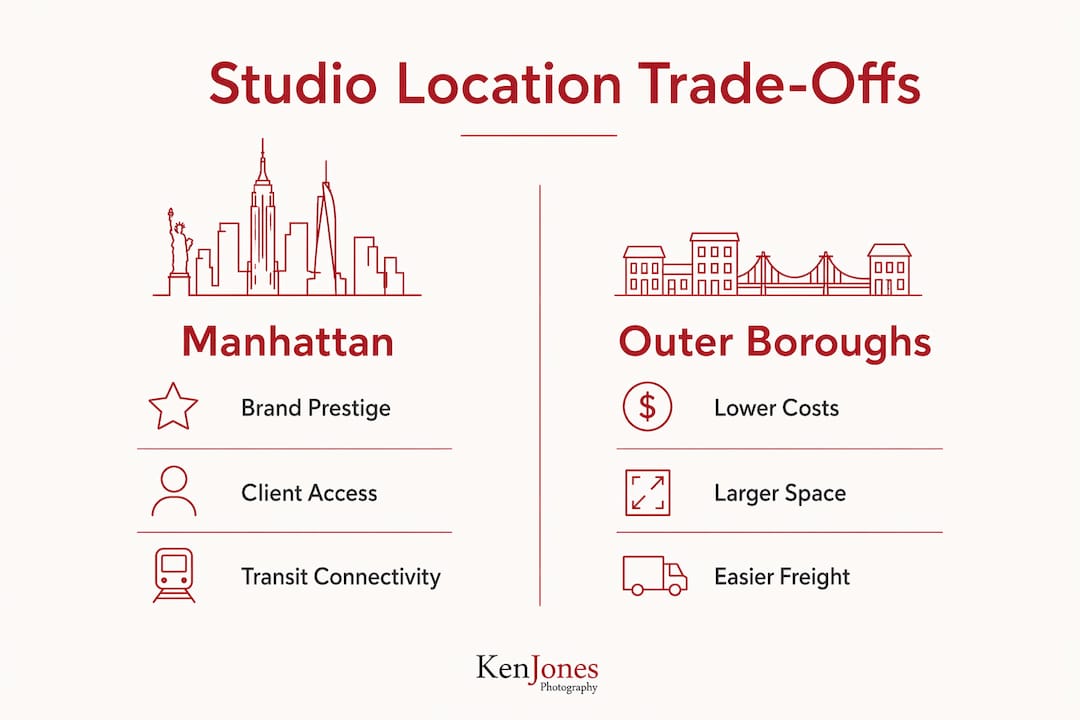
Manhattan studios prioritize client-facing work and brand prestige over raw space and cost efficiency. That is not a flaw. It is a design choice that reflects the borough’s role in the creative economy. The trade-off becomes a problem only when producers apply Manhattan studios to production types that do not benefit from the location premium.
Outer-borough industrial spaces offer larger footprints, easier load-in, lower day rates, and more flexible scheduling. For large-scale set builds, high-volume e-commerce shoots, or productions that do not involve client attendance, those advantages are real and significant. A 10,000-square-foot ground-floor studio in an industrial neighborhood is a better choice for a three-week catalog shoot than a 3,000-square-foot Manhattan loft, regardless of the address.
| Production need | Manhattan studio | Outer-borough studio |
|---|---|---|
| Client review meetings | Strong fit | Weak fit |
| Brand prestige signaling | Strong fit | Neutral |
| Large set construction | Limited by space | Strong fit |
| Cost-sensitive production | Higher day rate | Lower day rate |
| Freight and load-in | Elevator constraints | Ground-floor access |
| Crew and vendor proximity | High | Moderate |
The hybrid production model resolves this tension for many creative teams. The approach uses outer-borough studios for interior, large-scale shoots and Manhattan studios for client-facing work and location exteriors. A fashion campaign might shoot the studio-heavy wardrobe sequences in Brooklyn, then move to Manhattan for street-level location work and the client presentation. That model captures the cost efficiency of industrial space without sacrificing the brand signal of a Manhattan address.
Noise and community relations add another layer of complexity in Manhattan. Exterior shoots in residential neighborhoods require permits, and the NYPD Film Permit Office enforces strict rules about equipment placement, generator noise, and sidewalk access. Productions that underestimate those requirements face delays and fines. A Manhattan studio with a dedicated production coordinator who knows the local permit process is worth the premium on any shoot that involves street-level work.
Parking is the other persistent challenge. Manhattan studios rarely offer on-site parking for crew vehicles, which adds transportation coordination costs that do not exist in outer-borough locations. Factoring in parking and transportation logistics when comparing day rates gives a more accurate picture of the true cost difference between boroughs.
How should you evaluate Manhattan studio advantages for your next project?
The right way to evaluate a Manhattan studio is to start with your client’s needs, not the studio’s amenities. Ask who needs to be in the room on shoot day and how they are getting there. If the answer involves multiple executives, agency stakeholders, or brand representatives traveling from different parts of the city or arriving from out of town, Manhattan’s transit access is a direct production benefit.
Assessing the importance of studio location starts with three questions:
-
Who attends the shoot? Client-heavy productions benefit most from Manhattan’s transit connectivity and professional environment.
-
What does the address signal? For luxury fashion, beauty, and advertising work, a Manhattan address reinforces the quality of the final product before the shoot begins.
-
What are the freight realities? Verify loading dock hours, elevator capacity, and any building restrictions before signing a rental agreement.
Balancing production logistics with brand image goals requires honest prioritization. A beauty editorial for a luxury skincare brand benefits from a Manhattan studio even if the day rate is higher, because the client’s confidence in the production is part of the deliverable. A high-volume product shoot for an e-commerce catalog does not need that signal. Matching the studio type to the production type is the core skill.
Pro Tip: Ask the studio for a list of recent productions that used the space. If the credits include brands and agencies in your category, that is a reliable indicator that the studio’s infrastructure and location work for your type of shoot.
Common pitfalls include booking a Manhattan high-rise studio for a production that requires heavy set pieces, assuming that a prestigious address compensates for inadequate ceiling height or power capacity. Always verify ceiling height, power amperage, and natural light availability alongside location. A studio that checks every logistical box but sits in an inconvenient location for your specific client base defeats the purpose of the Manhattan premium. Practical rental guidance for Manhattan photography studios covers these verification steps in detail and is worth reviewing before any booking decision.
The proximity to transit, hotels, and event venues that Manhattan offers reduces commute and coordination friction for creative teams. That benefit is most visible on shoot days with tight turnarounds, where every hour of production time is billable and delays compound quickly.
Key Takeaways
Manhattan studio location is the single most consequential production decision for client-facing creative work in fashion, media, and advertising, because it simultaneously shapes brand perception, client attendance, and shoot-day logistics.
| Point | Details |
|---|---|
| Brand prestige is built into the address | A Manhattan studio signals quality to luxury clients before the shoot begins. |
| Transit access drives client attendance | Multiple subway lines within walking distance reduce reschedules and no-shows. |
| Freight logistics require advance verification | High-rise studios add 30–45 minutes of setup time; confirm dock hours before booking. |
| Hybrid models balance cost and prestige | Use outer-borough studios for large sets and Manhattan for client-facing and location work. |
| Purpose-built space is now available | Sunset Pier 94 opened in january 2026 with 230,000 sq ft and 36-foot clear heights. |
What 30 years in Manhattan studios taught me about location
I have shot in Manhattan studios ranging from a 400-square-foot walk-up in the Flatiron District to a full-floor loft in Tribeca. The single most consistent lesson across all of them is this: the client’s experience of arriving at the studio is part of the shoot. When a brand director walks off the subway two blocks from the studio, rides a clean elevator to a well-lit space, and sees a professional setup waiting for them, they relax. That relaxation shows up in the approvals process. Decisions that might take three rounds of back-and-forth in a remote location get made on the spot in a Manhattan studio.
I learned the freight lesson the hard way early in my career. I booked a high-rise studio for a three-day fashion campaign without asking about the loading dock. The building had a single freight elevator shared with a restaurant supply company that took deliveries every morning until 10 a.m. We lost the first two hours of each shoot day waiting for dock access. That mistake cost the client money and cost me a repeat booking. Now I ask about freight before I ask about the light.
The arrival of Sunset Pier 94 genuinely changes what is possible in Manhattan. I have spent years telling clients that if they needed a large set build with serious ceiling height, they had to go to Brooklyn or Queens. That conversation is different now. A 36-foot clear height in Manhattan, with on-site parking and stage-level load-in, is a facility that did not exist here before january 2026. For high-end fashion and advertising productions that want both the location and the infrastructure, that matters.
My honest advice: treat the studio address as a client-facing production element, not just a logistical detail. The right Manhattan studio, matched to the right production type, pays for its premium in client confidence, faster approvals, and the kind of creative energy that comes from working in a city that takes this work seriously.
— Ken
Kenjonesnyc: Manhattan studio work built for fashion and commercial production
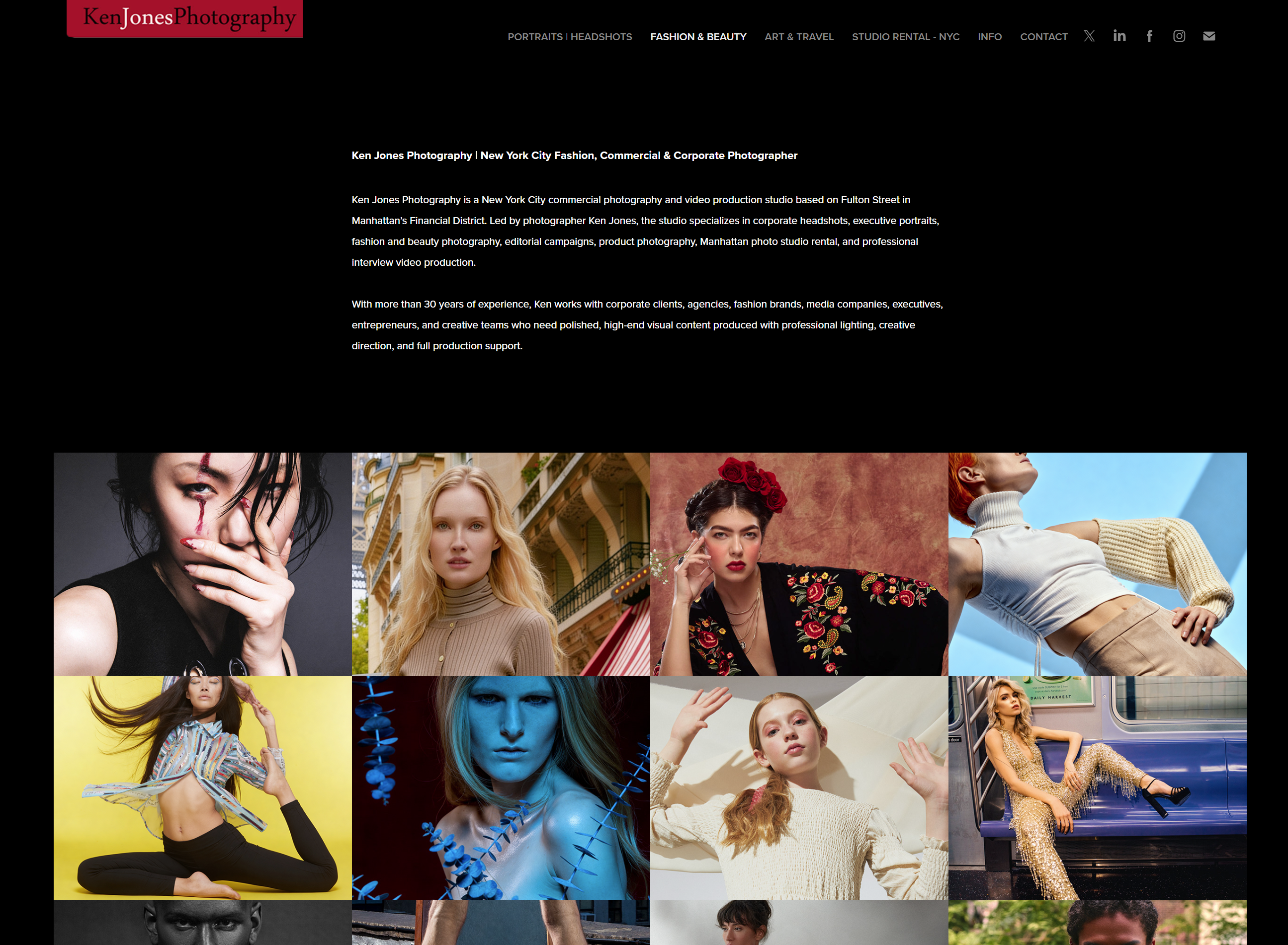
Kenjonesnyc operates from Manhattan’s Financial District, producing fashion editorials, beauty campaigns, advertising campaign photography, corporate headshots, and luxury product imagery for brands and agencies that need both location prestige and full-service production capability.
The studio’s Manhattan base gives clients direct access to one of the most connected production environments in New York City, with transit links, vendor proximity, and a professional setting that supports everything from intimate beauty shoots to multi-talent fashion productions. Whether you are planning a luxury fashion editorial or a corporate portrait session, Kenjonesnyc brings 30 years of Manhattan production experience to every booking. Reach out at kenjonesnyc.com to discuss your next project.
FAQ
Why does Manhattan studio location matter for fashion shoots?
Manhattan studio location signals brand quality to clients and provides transit access that increases attendance at shoot-day reviews. The borough’s proximity to agencies, casting directors, and luxury brands makes it the default choice for client-facing fashion production.
How much extra setup time should I budget for a Manhattan high-rise studio?
Budget an additional 30–45 minutes of setup time per shoot day for Manhattan high-rise studios due to freight elevator scheduling and loading dock constraints. Verifying dock hours and elevator capacity before booking prevents costly overruns.
What is Sunset Pier 94 and why does it matter for Manhattan production?
Sunset Pier 94 Studios is Manhattan’s first purpose-built film and TV facility, opened in january 2026 with 230,000 sq ft, six sound stages, and 36-foot clear heights. It gives Manhattan productions access to large-scale infrastructure that previously required moving to an outer borough.
When does it make more sense to use an outer-borough studio?
Outer-borough studios are the better choice for large set builds, high-volume e-commerce shoots, and cost-sensitive productions that do not require client attendance. The hybrid model, using outer-borough space for interiors and Manhattan for client-facing work, captures the advantages of both.
How do I verify that a Manhattan studio suits my production needs?
Ask the studio for freight elevator hours, loading dock policies, ceiling height, power amperage, and a list of recent productions that used the space. Those five data points reveal whether the studio’s infrastructure matches your production type before you commit to a booking.